









| 查看: 1638 | 回复: 5 | |||
[交流]
一篇首次采用“质子型有机离子塑性晶体(POIPC)”作为燃料电池质子导体的论文 已有3人参与
|

|
一篇首次采用“质子型有机离子塑性晶体(protic organic ionic plastic crystals, POIPCs)”作为燃料电池高温(100-200 oC)质子导体的论文。 highlights(亮点): 之一:首次提出”质子型有机离子塑性晶体“的概念。 之二:固态(塑晶态)下的185度时,无水质子电导率高达10 mS/cm。应该是迄今为止最高的全固态质子电导率之一了。 之三:该有机离子塑性晶体是不掺杂的,即pure,non-doped,避免了与掺杂物dopant的不相容问题。 探索了该质子导体在复合膜中的应用。复合膜的表征手段上也有一些有意思的地方:采用了掠入射X射线衍射(grazing incidence X-ray diffraction (GIXRD))来表征复合膜是否成功担载了质子导体。掠入射X射线衍射可以探测复合膜在厚度方向上质子导体的分布情况,而不是仅仅表面的情况(比如红外、SEM):The existence of crystalline 1 in the deeper layers of the composite membrane is still evident as ω increases and simultaneously the X-rays penetrate deeper into the membrane。 (// 小角掠入射是以固定的小角度入射X射线,使得X射线几乎与薄膜表面平行。这样X射线穿入薄膜的深度浅,但是走过的路程长,适合薄膜的研究。) 此外,也初步探讨了本征(离线)与燃料电池运行情况(“在线”)下的质子传导机理。 真诚欢迎引用,欢迎交流。 Imidazolium methanesulfonate as a high temperature proton conductor J. Mater. Chem. A, 2013,1, 2238-2247 DOI: 10.1039/C2TA00713D Imidazolium methanesulfonate (1) has been studied as a model proton conductor for high temperature polymer electrolyte membrane fuel cells (PEMFCs). It is found that 1 undergoes transformation from crystalline to plastic crystalline and then molten states successively from ambient temperature to 200 °C. The solid–solid phase transition of 1 at 174 °C has been preliminarily verified by differential scanning calorimetry (DSC) and temperature-dependent X-ray diffraction (XRD). At the melting point of 188 °C, 1 displays a low entropy of fusion of around 24 J mol−1 K−1. In particular, a high ionic conductivity of 1.0 × 10⁻² S cm−1 is reached at 185 °C in the plastic phase. The activation energy for ionic conduction decreases as 1 is heated from the crystal phase to the melt phase. In the molten state, the contribution of protons to the ionic conductivity of 1 was corroborated electrochemically. In addition, 1 is electrochemically active for H2 oxidation and O2 reduction at a Pt electrode while it shows a high electrochemical window of 2.0 V. Furthermore, a Nafion® membrane has been successfully doped with 1, as identified by infrared spectroscopy, powder XRD, grazing incidence XRD and thermogravimetric analysis. To the best of our knowledge, this may be the first report on a protic organic ionic plastic crystal (OIPC) consisting of protonated imidazole (C3H5N2+) and an organic anion. The good thermal stability, high ionic conductivity, wide electrochemical window, favorable plastic crystal behavior and simple synthesis make 1 a highly interesting model proton conductor for high temperature PEMFCs. 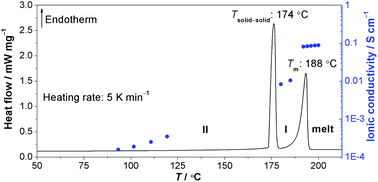 protic organic ionic plastic crystal.gif 已被引5次: Crystal Structure and Solid-state Ionic Conductivity of Cyclic Sulfonylamide Salts with Cyano-substituted Quaternary Ammonium Cations 作者: Moriya, Makoto; Watanabe, Takaaki; Nabeno, Shohei; 等. CHEMISTRY LETTERS 卷: 43 期: 1 页: 108-110 出版年: JAN 5 2014 Bis-quaternary ammonium cation-based organic ionic plastic crystals: plastic crystal behaviour and ionic liquid properties above melting points Chengzhen Shi, Shichao Li, Wei Zhang, Lihua Qiu and Feng Yan J. Mater. Chem. A, 2013, 1, 13956 DOI: 10.1039/c3ta12712e A novel proton exchange membrane prepared from imidazole metal complex and Nafion for low humidity Lijia Yang, Beibei Tang and Peiyi Wu Journal of Membrane Science, 2014, 467, 236 DOI: 10.1016/j.memsci.2014.05.033 Simple synthesis of ironIII sulfophenyl phosphate nanosheets as a high temperature inorganic–organic proton conductor Guohong Liu, Zhongfang Li, Lei Jin and Suwen Wang Ionics, 2014 DOI: 10.1007/s11581-014-1109-0 An organic ionic plastic crystal electrolyte for rate capability and stability of ambient temperature lithium batteries Liyu Jin, Patrick C. Howlett, Jennifer M. Pringle, Judith Janikowski, Michel Armand, Douglas R. MacFarlane and Maria Forsyth Energy Environ. Sci., 2014, Advance Article DOI: 10.1039/C4EE01085J |
 回复此楼
回复此楼» 本帖附件资源列表
-
欢迎监督和反馈:小木虫仅提供交流平台,不对该内容负责。
本内容由用户自主发布,如果其内容涉及到知识产权问题,其责任在于用户本人,如对版权有异议,请联系邮箱:xiaomuchong@tal.com - 附件 1 : Imidazolium_methanesulfonate_as_a_high_temperature_proton_conductor.pdf
- 附件 2 : Supplementary_information.pdf
2014-08-07 22:33:09, 567.96 K
2014-08-09 01:39:16, 469.23 K
» 猜你喜欢
 铁基改性石墨催化电极的制备、表征及电催化降解性能研究
已经有0人回复
铁基改性石墨催化电极的制备、表征及电催化降解性能研究
已经有0人回复
-
N2O分解催化
已经有1人回复
-
物理化学论文润色/翻译怎么收费?
已经有272人回复
-
石墨电极生产缺陷成因及工艺优化控制技术研究
已经有0人回复
-
三维电极体系催化极板应用优势,大幅提升废水处理容积负荷
已经有0人回复
-
西华大学-化学、生物与医药-研究生招生信息-欢迎报考
已经有0人回复
-
中科院东莞材料所|新能源材料研究部招聘研究员 / 副研究员(可中央事业编制)
已经有0人回复
-
复合催化电极在高盐难降解废水电催化体系中的工程应用研究
已经有1人回复
-
化工难降解废水处理中催化电极自由基生成效率与反应选择性研究
已经有0人回复
-
线性电阻法对干粉涂布粉体和极片的均匀性测试表征
已经有0人回复
diamandpoly
新虫 (小有名气)
- 应助: 5 (幼儿园)
- 金币: 137.7
- 红花: 4
- 帖子: 219
- 在线: 181.5小时
- 虫号: 2044177
- 注册: 2012-10-05
- 专业: 凝聚态物性 II :电子结构

2楼2014-08-08 13:14:18
3楼2014-08-08 18:44:28
4楼2014-08-15 17:29:50
5楼2015-06-02 23:41:28
6楼2020-06-03 19:03:34

