






| 查看: 2203 | 回复: 34 | ||||||||
| 【奖励】 本帖被评价33次,作者nowitzki_ci增加金币 26 个 | ||||||||
| 当前只显示满足指定条件的回帖,点击这里查看本话题的所有回帖 | ||||||||
nowitzki_ci专家顾问 (著名写手)
|
[资源]
Chemical Reviews最新综述:Nano/Micromotors在生物化学方面的应用
|
|||||||


|
Nano/Micromotors in (Bio)chemical Science Applications 共38页 引文219篇 Maria Guix,† Carmen C. Mayorga-Martinez,† and Arben Merkoçi* ,†,‡ †Nanobioelectronics & Biosensors Group, Institut Catala ̀ de Nanosciencia i Nanotecnologia (ICN2), UAB Campus, 08193 Bellaterra, Barcelona, Spain ‡ICREA, Passeig de Lluís Companys, 23, 08010 Barcelona, Spain Nano- and micromotors are nano- and microscale devices, respectively, designed to perform selected mechanical movements (e.g., rotation, rolling, shuttling, delivery, contraction,and collective behavior) in response to speci fi c stimuli. They are built from a few nano- and microscale components, each of which can be biologically or chemically functionalized, and operate using some type of energy input. In fact, these devices are principally characterized according to the type of energy input that they use, as their operating mechanism is strongly related to the energy source, which can be fuel (natural or synthetic), or a physical source (e.g., light, magnetic fi elds, electric fi elds, or ultrasonic acoustic waves). Nano- and micromotors are often mimics of natural biological motors. CONTENTS 1. Introduction A 2. Biological Motors C 2.1. Linear-Motion Motors C 2.1.1. Cytoskeletal Molecular Motors C 2.1.2. DNA- or RNA-Processing Enzymes Motors D 2.2. Rotary Motors E 2.2.1. F 0 F 1 -ATP Synthase: A Dual-Motor System E 2.2.2. Bacterial Rotary Flagellar Motors F 3. Synthetic Motors G 3.1. Catalytic Nanomotors G 3.1.1. Chemical Fuels G 3.2. Photodriven Motors S 3.2.1. Light-Driven Nano- and Micromotors Based on Molecular Switches S 3.2.2. Nano- and Micromotors as Functional Dopants in Liquid Crystals T 3.2.3. Doped Liquid Crystal Elastomers T 3.3. Magnetically Driven Motors V 3.3.1. Flexible Magnetically Driven Nano- and Micromotors W 3.3.2. Magnetically Driven, Flexible, Polymer-Based Structures W 3.3.3. Magnetically Driven, Colloidal Particle-Based Structures W 3.3.4. Magnetically Driven Rigid Structures X 3.4. Electrically Driven Nano- and Micromotors Z 3.4.1. Electrically Driven Motion of Liquids (Manipulation of Droplets) Z 3.4.2. Electrically Driven Motion of Solids Z 3.4.3. Electrically Driven Single-Molecule Nanomotors AC 3.5. Ultrasonically Driven Nano- and Micromotors AC 3.5.1. Surface Acoustic Wave-Driven Nano-and Micromotors AC 3.5.2. Acoustic Droplet Vaporization-Induced Motion AE 4. Hybrid Nano- and Micromotors AE 5. Conclusions and Perspectives AG Associated Content AH Supporting Information AH Author Information AH Corresponding Author AH Notes AH Biographies AH Acknowledgments AI References AI 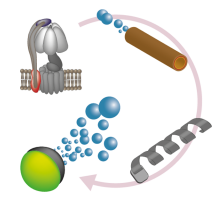 |
 回复此楼
回复此楼» 本帖附件资源列表
-
欢迎监督和反馈:小木虫仅提供交流平台,不对该内容负责。
本内容由用户自主发布,如果其内容涉及到知识产权问题,其责任在于用户本人,如对版权有异议,请联系邮箱:xiaomuchong@tal.com - 附件 1 : cr400273r.pdf
2014-05-15 18:34:28, 25.7 M
» 收录本帖的淘帖专辑推荐
 Nano&Micro Nano&Micro | reviews paper | nano review | 科研啊 努力啊 希望有用啊 |
» 猜你喜欢
 请问对标matlab的开源软件octave的网站https://octave.org为什么打不开?
已经有1人回复
请问对标matlab的开源软件octave的网站https://octave.org为什么打不开?
已经有1人回复
-
求助两种BiOBr晶体的CIF文件(卡片号为JCPDS 09-0393与JCPDS 01-1004 )
已经有0人回复
-
无机化学论文润色/翻译怎么收费?
已经有179人回复
-
哈尔滨工程大学材化学院国家级青年人才-26年硕士招生
已经有0人回复
» 本主题相关价值贴推荐,对您同样有帮助:
5楼2014-05-15 20:35:56