








| 查看: 497 | 回复: 2 | |||
飘蓬子木虫 (小有名气)
|
[交流]
Nano Energy 最新综述 Radial junction Si micro/nano-wire array photovoltaics 已有2人参与
|

|
Nano Energy Review Radial junction Si micro/nano-wire array photovoltaics: Recent progress from theoretical investigation to experimental realization Yali Lia, Qiang Chenb, 1, Deyan Hea, Corresponding author contact information, E-mail the corresponding author, Junshuai Lia, http://dx.doi.org/10.1016/j.nanoen.2014.04.015 Highlights •A comprehensive review on recent developments regarding boththeoretical investigation and experimental reports for Si micro/nano-wire array-based solar cells are presented. •An easily used explanationto illustrate optical behaviors in Si micro/nano-wire arrays is concluded, which is also applicable to other subwavelength structures. •Suggested device parameters including geometrical parameters, electrical parameters and issues regarding high quality wire preparation are summarized. •Several representative advanced solar cells employing Si micro/nano-wire arrays as a platformare introduced, such as 3D Si thin film solar cells. Abstract Radial pn junction Si micro/nano-wire arrays exhibit unique optical and electrical characteristics for building photovoltaic devices with high performance-to-cost ratios over traditional planar junction bulk Si structures. Through optimizing the structural parameters, such as wire diameter and array periodicity, antireflection even superior to the optimized antireflective coatings can be realized. In the meantime, excellent light confinement is easily achievable for Si micro/nano-wire arrays using much less materials compared to their bulk Si counterparts. From the electrical aspect, the radial pn junction configuration formed around the wires significantly reduces the minority carrier collection length along the radial direction, providing outstanding tolerance to material qualities. Owing to these charming properties, radial junction Si micro/nano-wire array-based solar cells have been attracting extensive attention. The power conversion efficiency has also made huge progress from <1% to the present >12% in less than 10 years. With cell performance improvement, the number of research papers regarding theoretical understanding and optimization of the optical and electrical processes, experimental reports of the related solar cells has also surged, also including review papers. Accordingly, in this paper we are focusing on the recent progress, following a brief but systematic introduction to the related topic. Then the issues needing to be addressed for further improving the optical and electrical structures and cell performance are summarized. Following that, several other advanced solar cells employing Si micro/nano-wire arrays as a platform are introduced. 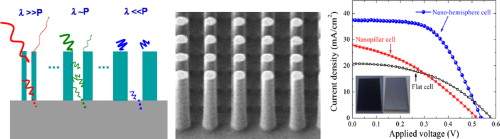 1-s2.0-S2211285514000718-fx1.jpg |
 回复此楼
回复此楼» 本帖附件资源列表
-
欢迎监督和反馈:小木虫仅提供交流平台,不对该内容负责。
本内容由用户自主发布,如果其内容涉及到知识产权问题,其责任在于用户本人,如对版权有异议,请联系邮箱:xiaomuchong@tal.com - 附件 1 : Radial_junctionSimicro....pdf
2014-05-15 10:11:09, 4.63 M
» 猜你喜欢
 修改论文,如何借助其他力量?
已经有3人回复
修改论文,如何借助其他力量?
已经有3人回复
-
无机化学论文润色/翻译怎么收费?
已经有225人回复

westwolf3839
金虫 (小有名气)
拾荒者
- 应助: 0 (幼儿园)
- 金币: 1890.4
- 散金: 50
- 帖子: 169
- 在线: 40.9小时
- 虫号: 674874
- 注册: 2008-12-15
- 专业: 凝聚态物性 II :电子结构
2楼2014-05-15 10:22:09
 |
3楼2014-05-15 12:48:58