









| 查看: 768 | 回复: 0 | ||||||
nowitzki_ci专家顾问 (著名写手)
|
[交流]
关于手性的另一本好书Amplification of Chirality
|


|
Amplification of Chirality Volume Editor: Kenso Soai With contributions by J. M. Brown · T. Buhse · M. Fujiki · I. Gridnev · H. Hyuga J. R. Islas · T. Kawasaki · J. Klankermayer · D. Lavabre J.-C. Micheau · Y. Saito · K. Soai Biomolecules in nature exhibit overwhelming one-handedness, often called homochirality, such as L-amino acids and D-sugars. Since the discovery of molecular chirality by Pasteur, the origins of chirality and the process lead- ing to enantiopure biomolecules have attracted broad attention from many researchers. Several theories have been proposed for the origin of chirality in organiccompounds,forexample,leftandright-circularlypolarizedlight,spon- taneous absolute asymmetric synthesis, and chiral inorganic crystals such as quartz. However, the enantioenrichments induced by these mechanisms have been very low or even below detection levels. Thus, the process of amplification of enantioenrichment is inevitable to reach enantiopure compounds. In 1953, Frank proposed a mechanism of asymmetric autocatalysis without mentioning any chemical structure. However, it then took over 40 years for us to discover asymmetric autocatalysis with amplification of chirality in 1995. This book illustrates the recent aspects of amplification of chirality by asym- metric autocatalysis and by forming helical structures. The first four chapters summarize experimental asymmetric autocatalysis with amplification of enan- tiopurity, the mechanism of asymmetric autocatalysis examined by NMR and calculation, the computer simulation models of the reaction mechanism of asymmetric autocatalysis, and the theoretical models of amplification of chi- rality. The last chapter deals with the amplification of chirality by the for- mation of helical structures. However, the amplification of enantiopurity in non-autocatalytic asymmetric reaction and the amplification by enantiomer separation involving crystallization or sublimation are beyond the scope of this book. One of the main features of asymmetric autocatalysis and the formation of the helix is that the initial extremely low enantioenrichment is amplified significantly to near enantiopure. These processes of amplification of chirality have become powerful tools to elucidate the origin of chirality of organic compounds. For example, by using asymmetric autocatalysis, spontaneous absolute asymmetric synthesis without the intervention of any chiral factor has been realized. Contents Asymmetric Autocatalysis with Amplification of Chirality K. Soai · T. Kawasaki . . . . . . . . . . . . . . . . . . . . . . . . . . . . 1 Asymmetric Autocatalysis with Organozinc Complexes; Elucidation of the Reaction Pathway J. M. Brown · I. Gridnev · J. Klankermayer . . . . . . . . . . . . . . . . . 35 Kinetic Insight into Specific Features of the Autocatalytic Soai Reaction D. Lavabre · J.-C. Micheau · J. R. Islas · T. Buhse . . . . . . . . . . . . . . 67 Rate Equation Approaches to Amplification of Enantiomeric Excess and Chiral Symmetry Breaking Y. Saito · H. Hyuga . . . . . . . . . . . . . . . . . . . . . . . . . . . . . 97 Helix Generation, Amplification, Switching, and Memory of Chromophoric Polymers M. Fujiki . . . . . . . . . . . . . . . . . . . . . . . . . . . . . . . . . . 119 Author Index Volumes 251–284 . . . . . . . . . . . . . . . . . . . . . . 187 Subject Index . . . . . . . . . . . . . . . . . . . . . . . . . . . . . . . . 203 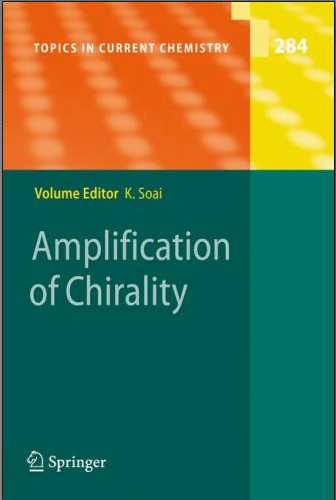 |
 回复此楼
回复此楼» 本帖附件资源列表
-
欢迎监督和反馈:小木虫仅提供交流平台,不对该内容负责。
本内容由用户自主发布,如果其内容涉及到知识产权问题,其责任在于用户本人,如对版权有异议,请联系邮箱:xiaomuchong@tal.com - 附件 1 : Amplification_of_Chirality,2008.pdf
2014-04-27 16:41:45, 4.16 M
» 收录本帖的淘帖专辑推荐
 有机 有机 |
» 猜你喜欢
 修改论文,如何借助其他力量?
已经有4人回复
修改论文,如何借助其他力量?
已经有4人回复
-
中山大学潘越教授课题组2027级推免硕士研究生招生 新增一个专业医学技术名额
已经有21人回复
-
无机化学论文润色/翻译怎么收费?
已经有279人回复