









| 查看: 1313 | 回复: 3 | |||||
nowitzki_ci专家顾问 (著名写手)
|
[交流]
关于手性的一本好书:Chiral Recognition in Separation Methods 已有1人参与
|


|
Chiral Recognition in Separation Methods Mechanisms and Applications Editor Prof. Alain Berthod University of Lyon CNRS UMR 5180 69622 Villeurbanne Cédex France berthod@univ-lyon1.fr What drives a scientist to edit a book on a specific scientific subject such as chiral mechanisms in separation methods? Until December 2005, the journal Analytical Chemistry of the American Chemical Society (Washington, DC) had an A-page section that was dedicated to simple and clear presentations of the most recent techniques or the state of the art in a particular field or topic. The “A-page” section was prepared for a broad audience of chemists including industrial professionals, students as well as academics looking for information outside their field of expertise. Daniel W. Armstrong, one of the editors of this journal and a twenty-year+ long friend, invited me to present my view on chiral recognition mechanisms in a simple and clear way in an “A-page” article. In 2006, the “A-page” section was maintained as the first articles at the beginning of each first bi-monthly issue but the pagination was no longer page distinguished from the regular research articles published by the journal. During the time between the invitation and the submission, the A-page section was integrated into the rest of the journal and the article appeared as (2006) Anal Chem (78):2093–2099. The article was well received. John Dorsey, another very long time friend and colleague, invited me to present it as a lecture in his Dal-Nogare Award session of the 2008 Pittsburg Conference in New Orleans. I presented a talk focusing on the only part of chiral mechanisms that I really know and worked on: chiral recognition mechanism with the macrocyclic glycopeptide chiral selectors. Steffen Pauly, Senior Editor Chemistry for the publisher Springer, heard the talk and asked me to edit a book on the subject. It was so well paid (sigh!) that I could not refuse the offer . . .and now, you have the book in hand. Contents Chiral Recognition Mechanisms in Enantiomers Separations: A General View . . . . . . . . . . . . . . . . . . . . . . . . . . . . . . . 1 Alain Berthod Preparation and Chiral Recognition of Polysaccharide-Based Selectors . . . . . . . . . . . . . . . . . . . . . . . . . . . . . . . . . . . 33 Tomoyuki Ikai and Yoshio Okamoto Description and Evaluation of Chiral Interactive Sites on Bonded Cyclodextrin Stationary Phases for Liquid Chromatography . . . . . . . . . . . . . . . . . . . . . . . . 53 Thomas E. Beesley Cyclofructans, a New Class of Chiral Stationary Phases . . . . . . . . . 77 Chunlei Wang, Ping Sun, and Daniel W. Armstrong Chiral Recognition and Enantioseparation Mechanisms in Capillary Electrokinetic Chromatography . . . . . . . . . . . . . . . 97 Bezhan Chankvetadze Chiral Recognition Mechanism: Practical Considerations for Pharmaceutical Analysis of Chiral Compounds . . . . . . . . . . . . 153 Brian Lingfeng He Chiral Recognition with Macrocyclic Glycopeptides: Mechanisms and Applications . . . . . . . . . . . . . . . . . . . . . . . 203 Alain Berthod, Hai Xiao Qiu, Sergey M. Staroverov, Mikhail A. Kuznestov, and Daniel W. Armstrong Vancomycin Molecular Interactions: Antibiotic and Enantioselective Mechanisms . . . . . . . . . . . . . . . . . . . . . 223 Timothy J. Ward, Aprile Gilmore, Karen Ward, and Courtney Vowell Enantioselective Recognition in Solution: The Case of Countercurrent Chromatography . . . . . . . . . . . . . . . . . . . . 241 Núria Rubio and Cristina Minguillón Enantioselective Properties of Nucleic Acid Aptamer Molecular Recognition Elements . . . . . . . . . . . . . . . . . . . . . . . . . . . . 275 Eric Peyrin Chiral Ionic Liquids in Chromatographic Separation and Spectroscopic Discrimination . . . . . . . . . . . . . . . . . . . . . 289 Min Li, David K. Bwambok, Sayo O. Fakayode and Isiah M. Warner Index . . 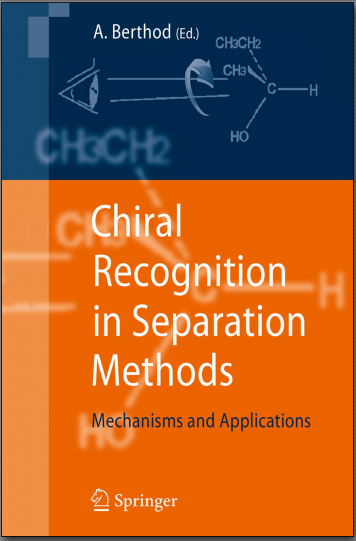 |
 回复此楼
回复此楼» 本帖附件资源列表
-
欢迎监督和反馈:小木虫仅提供交流平台,不对该内容负责。
本内容由用户自主发布,如果其内容涉及到知识产权问题,其责任在于用户本人,如对版权有异议,请联系邮箱:xiaomuchong@tal.com - 附件 1 : Chiral_Recognition_in_Separation_Methods.pdf
2014-04-27 11:35:36, 12.46 M
» 猜你喜欢
 修改论文,如何借助其他力量?
已经有4人回复
修改论文,如何借助其他力量?
已经有4人回复
-
中山大学潘越教授课题组2027级推免硕士研究生招生 新增一个专业医学技术名额
已经有21人回复
-
金属材料论文润色/翻译怎么收费?
已经有50人回复
-
哈尔滨工程大学国家级青年人才-27年申请考核制博士招生(材料、化学、生物医学专业)
已经有12人回复
-
HRTEM/原位TEM/HRSTEM检测|价格优·周期短·可加急
已经有0人回复
» 本主题相关价值贴推荐,对您同样有帮助:
0.8
| 顶一下,感谢分享! |
2楼2014-04-27 11:38:42
0.8
| 顶一下,感谢分享! |
3楼2014-04-27 12:45:42
hao-
铁杆木虫 (正式写手)
- MN-EPI: 4
- 应助: 10 (幼儿园)
- 金币: 7462.2
- 散金: 34
- 红花: 16
- 帖子: 909
- 在线: 464.9小时
- 虫号: 1069201
- 注册: 2010-08-04
- 性别: GG
- 专业: 金属非晶态、准晶和纳米晶
4楼2014-04-29 14:16:19