









| 查看: 12981 | 回复: 453 | ||
| 本帖产生 1 个 MN-EPI ,点击这里进行查看 | ||
| 当前只显示满足指定条件的回帖,点击这里查看本话题的所有回帖 | ||
[资源]
2013年新著——石墨烯的物理与化学(英文版)
|
||

|
Toshiaki Enoki, Tsuneya Ando - Physics and Chemistry of Graphene: Graphene to Nanographene Published: 2013-01-24 | ISBN: 9814241482 | PDF | 476 pages | 33 MB From a chemistry aspect, graphene is the extrapolated extreme of condensed polycyclic hydrocarbon molecules to infinite size. Here, the concept on aromaticity which organic chemists utilize is applicable. Interesting issues appearing between physics and chemistry are pronounced in nano-sized graphene (nanographene), as we recognize the importance of the shape of nanographene in understanding its electronic structure. In this book, the fundamental issues on the electronic, magnetic, and chemical properties of condensed polycyclic hyodrocarbon molecules, nanographene and graphene are comprehensively discussed. Contents Preface xi 1 Introduction 1 2 Theory of Electronic States and Transport in Graphene 9 Tsuneya Ando 2.1 Introduction 9 2.2 Electronic States of Monolayer Graphene 10 2.2.1 Massless Dirac Electron 10 2.2.2 Berry’s Phase and Topological Anomaly 15 2.2.3 Landau Levels in Magnetic Fields 17 2.2.4 Effects of Bandgap Opening 19 2.3 Magnetic Properties 20 2.3.1 Singular Diamagnetism 20 2.3.2 Effects of Bandgap Opening 23 2.3.3 Magnetic Screening and Mirroring 25 2.4 Optical Properties 28 2.5 Transport Properties 30 2.5.1 Boltzmann Conductivity 30 2.5.2 Charged Impurities 34 2.5.3 Self-Consistent Born Approximation and Zero-Mode Anomalies 36 2.5.4 Resonant Scattering by Lattice Defects 43 2.5.5 Crossover between Localization and Antilocalization 45 2.6 Phonons and Electron–Phonon Interaction 49 2.6.1 Acoustic Phonon 49 2.6.2 Optical Phonon 50 2.6.3 Zone-Boundary Phonon 53 2.7 Bilayer Graphene 55 2.7.1 Electronic States 55 2.7.2 Magnetic Properties 60 2.7.3 Optical Properties 61 2.7.4 Transport Properties 66 2.7.5 Phonons and Electron–Phonon Interaction 71 2.8 Multilayer Graphene 74 3 Experimental Approaches to Graphene Electron Transport for Device Applications 89 Akinobu Kanda 3.1 Introduction 89 3.2 Formation of Graphene 91 3.2.1 Scotch Tape Method 94 3.2.2 Determination of the Number of Layers 97 3.2.3 Other Techniques for Formation of Graphene 106 3.2.3.1 Thermal decomposition of SiC 107 3.2.3.2 Chemical vapor deposition on metallic substrates 109 3.3 Experiments on Transport Properties of Graphene for Device Applications 111 3.3.1 Sample Geometries 111 3.3.2 Gate Voltage Dependence of Conductance 118 3.3.3 Quantum Hall Effect 131 3.3.4 Klein Tunneling 134 3.3.5 Improving Mobility of Graphene 135 3.3.5.1 Effect of phonon scattering 135 3.3.5.2 Experimental techniques to improve mobility 143 3.3.6 Bandgap Engineering 147 3.3.6.1 Graphene nanoribbons 148 3.3.6.2 Bilayer graphene under perpendicular electric fields 157 3.3.6.3 Other methods for bandgap formation 162 3.3.7 Graphene Quantum Effect Devices: Mesoscopic Electron Transport in Graphene 163 3.3.8 Application to Chemical Sensors 165 3.3.9 Graphene Spintronics 167 3.3.9.1 Spintronics 167 3.3.9.2 Experimental techniques for determining spin relaxation length of graphene 171 3.3.9.3 Experimental values vs. theoretical expectations of the spin relaxation length 176 3.3.10 Cooper-Pair Transport 178 3.3.10.1 Superconducting proximity effect 178 3.3.10.2 Josephson effect in single-layer graphene: theoretical aspects 179 3.3.10.3 Josephson effect in single-layer graphene: experiments 184 3.4 Summary 191 4 Electronic Properties of Nanographene 207 Katsunori Wakabayashi 4.1 Introduction 207 4.2 Electronic States of Graphene 210 4.3 Graphene Nanoribbons and Edge States 214 4.4 Energy Spectrum and Wave Functions: Tight-Binding Model 222 4.4.1 Armchair Nanoribbons 222 4.4.2 Zigzag Nanoribbons 225 4.5 Energy Bandgap 232 4.5.1 Armchair Nanoribbons 232 4.5.2 Zigzag Nanoribbons 233 4.6 Energy Spectrum and Wave Function: Massless Dirac Equation 234 4.6.1 Semi-Infinite Graphene Sheet with a Zigzag Edge 235 4.6.2 Zigzag Nanoribbons 238 4.6.3 Armchair Nanoribbons 240 4.7 Bearded Edges and Cove Edges 243 4.8 Electronic States in a Magnetic Field 247 4.8.1 Tight-Binding Model with Peierls Phase 248 4.9 Orbital Diamagnetism and Pauli Paramagnetism 252 4.9.1 Orbital Magnetization and Susceptibility 252 4.9.2 Pauli Paramagnetism 257 4.10 Magnetic Instability 259 4.10.1 Electric Field-Induced Half-Metallicity 269 4.11 Electronic Transport Properties 272 4.11.1 One-Way Excess Channel System 273 4.11.2 Perfectly Conducting Channel: Absence of Anderson Localization 277 4.12 Summary 280 5 Spin Structure of Polycyclic Aromatic Hydrocarbons 289 Akihito Konishi and Takashi Kubo 5.1 Introduction 289 5.2 A Brief Introduction of PAHs 290 5.2.1 Categories of Polycyclic Aromatic Hydrocarbons 290 5.2.2 Brief History of Aromatic Sextet 292 5.2.3 Clar Sextet in Relation to the Property of PAHs 294 5.3 Recent Advanced Studies on PAHs: Synthesis, Property, and Application 298 5.4 Electronic Structure of PAHs 302 5.4.1 Effects of Edge Shapes on the Electronic Structure of PAHs 302 5.4.2 Prediction of the Spin Multiplicity in the Ground State: Ovchinnikov Rule 305 5.4.3 Non Kekule′ -Type PAHs 308 5.4.4 Kekule′ -Type PAHs 312 5.4.4.1 Theoretical treatment of singlet biradical character 312 5.4.4.2 Linear system: quantum chemical prediction of spin structure in the ground state 313 5.4.4.3 Linear system: isolation and characterization of large acenes 314 5.4.4.4 Two-dimensional system: quantum chemical prediction of spin structure in the ground state 317 5.4.5 Detailed Discussion on Spin-Polarized State at Zigzag Edges of Kekule′ -Type PAHs 320 5.4.5.1 Synthesis of bisanthene and teranthene 323 5.4.5.2 Geometrical consideration of singlet biradical character 326 5.4.5.3 Singlet–triplet energy gap 328 5.4.5.4 HOMO–LUMO energy gap 329 5.4.5.5 Transition probability from S0 to S1 state 331 5.5 Highly Stable Antiferromagnetic PAHs 332 5.5.1 Molecular Design for Thermodynamically Stabilized Antiferromagnetic Molecules 332 5.5.2 Theoretical Assessment of Singlet Biradical Character 333 5.5.3 Antiferromagnetic Couplings of Two Unpaired Electrons 335 5.5.4 Coexistence of Intra- and Intermolecular Antiferromagnetic Couplings 336 5.5.5 Non-Linear Optical Property 338 5.5.6 Experimental Estimation of the Amount of Singlet Biradical Character 340 5.6 Concluding Remarks 340 6 Experimental Approach to Electronic and Magnetic Properties of Nanographene 353 Toshiaki Enoki 6.1 Introduction 353 6.2 Fabrication of Graphene Nanostructures 355 6.2.1 Chemical Vapor Deposition 356 6.2.2 Graphene Oxides 358 6.2.3 Unzipping of Carbon Nanotubes 360 6.2.4 Heat-Induced Structural Changes 360 6.2.5 Electron Beam Lithography and STM/AFM Lithography 365 6.2.6 Chemical Reactions with Crystallographic Selectivity 368 6.2.7 Bottom-Up Fabrication from Aromatic Molecules 371 6.3 Electronic Structure of Nanographene and Graphene Edges 373 6.3.1 Theoretical Background of the Edge State 373 6.3.2 Experimental Evidence of Edge States 381 6.3.2.1 STM/STS observations 381 6.3.2.2 Angle-resolved photoemission spectroscopy 388 6.3.2.3 X-ray absorption spectroscopy 391 6.3.2.4 Transmission electron microscopy 395 6.3.3 Electron Confinement and Gap Opening in Nanographene 398 6.3.4 Electron Wave Interference: Theory and Experiments 404 6.3.4.1 Raman spectra: G and D bands 405 6.3.4.2 STM image of superlattice 410 6.4 Magnetic Structures of Nanographene 412 6.4.1 Theoretical Background 412 6.4.2 Experiments on Magnetic Properties of Edge-State Spins 418 6.4.2.1 Edge-state spins in defects 418 6.4.2.2 Edge-state spins in nanographene and nanographite 422 6.4.2.3 Interaction between edge-state spins and conduction π -electron carriers (Kondo effect) 427 6.5 Chemical Activity of Nanographene and Graphene Edges 429 6.5.1 Stability and Chemical Activity of Graphene Edges 429 6.5.2 Interaction of Guest Molecules with Nanographene 433 6.6 Summary 436 Index 451 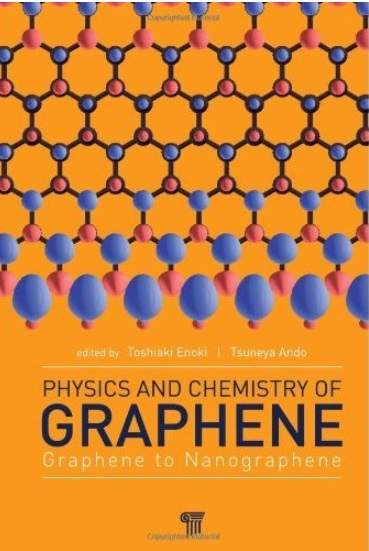 Published: 2013-01-24 | ISBN: 9814241482 | PDF | 476 pages | 33 MB |
 回复此楼
回复此楼» 本帖附件资源列表
-
欢迎监督和反馈:小木虫仅提供交流平台,不对该内容负责。
本内容由用户自主发布,如果其内容涉及到知识产权问题,其责任在于用户本人,如对版权有异议,请联系邮箱:xiaomuchong@tal.com - 附件 1 : Physics_and_Chemistry_of_Graphene.pdf
2014-02-12 18:46:52, 33.44 M
» 本帖已获得的红花(最新10朵)
 lc7410
» 猜你喜欢
 修改论文,如何借助其他力量?
已经有4人回复
修改论文,如何借助其他力量?
已经有4人回复
-
中山大学潘越教授课题组2027级推免硕士研究生招生 新增一个专业医学技术名额
已经有21人回复
-
金属材料论文润色/翻译怎么收费?
已经有69人回复
-
哈尔滨工程大学国家级青年人才-27年申请考核制博士招生(材料、化学、生物医学专业)
已经有12人回复
-
HRTEM/原位TEM/HRSTEM检测|价格优·周期短·可加急
已经有0人回复
-
大家平时也可以交流下
已经有1人回复
» 本主题相关商家推荐: (我也要在这里推广)



215楼2014-02-24 08:21:00

2楼2014-02-12 18:48:46
简单回复
2014-02-12 19:10
回复
五星好评 顶一下,感谢分享!
2014-02-12 19:16
回复
五星好评 顶一下,感谢分享!
zelatan5楼
2014-02-12 20:57
回复
五星好评 顶一下,感谢分享!
hittang6楼
2014-02-12 21:05
回复
五星好评 顶一下,感谢分享!
feng58007楼
2014-02-12 21:21
回复
五星好评 顶一下,感谢分享!
尛≡森≡蟲8楼
2014-02-12 22:41
回复
五星好评 顶一下,感谢分享!
zhixiaol9楼
2014-02-12 22:47
回复
五星好评 顶一下,感谢分享!
hiking594510楼
2014-02-12 22:55
回复
五星好评 顶一下,感谢分享!
leiqhd11楼
2014-02-13 00:39
回复
五星好评 顶一下,感谢分享!
zhqtang12楼
2014-02-13 01:05
回复
五星好评 顶一下,感谢分享!
xingkong9913楼
2014-02-13 05:14
回复
五星好评 顶一下,感谢分享!
wuyq650214楼
2014-02-13 06:36
回复
五星好评 