






| 查看: 1514 | 回复: 23 | |||||
| 【奖励】 本帖被评价17次,作者haijunniu增加金币 4 个 | |||||
| 当前只显示满足指定条件的回帖,点击这里查看本话题的所有回帖 | |||||
[资源]
materials today 2013 NOvember 最新一期的,有关太阳能电池 已有2人参与
|
|||||

最新一期的,有关太阳能电池,骨纳米结构非常值得一读,请多加鼓励啊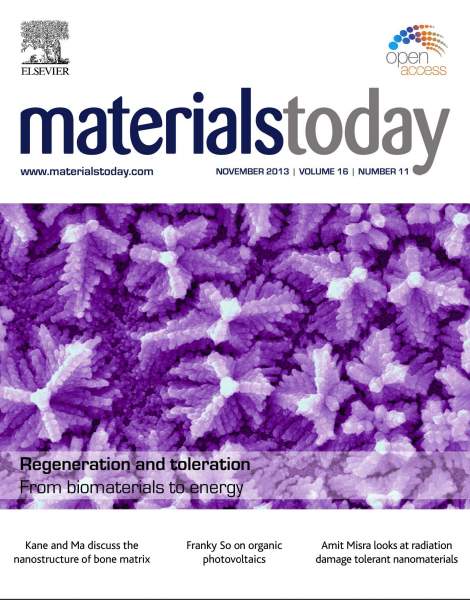 Flash3 (2).jpg Mimicking the nanostructure of bone matrix to regenerate bone 模拟骨基质的纳米结构到可再生骨 Robert Kane, Peter X. Ma Key features of bone tissue structure and composition are capable of directing cellular behavior toward the generation of new bone tissue. Bone tissue, as well as materials derived from bone, have a long and successful history of use as bone grafting materials. Recent developments in design and processing of synthetic scaffolding systems has allowed the replication of the bone's desirable biological activity in easy to fabricate polymeric materials with nano-scale features exposed on the surface. The biological response to these new tissue-engineering scaffold materials oftentimes exceeds that seen on scaffolds produced using biological materials. Properties of interlayer for organic photovoltaics 有机光伏器件中的界面特性 Tzung-Han Lai, Sai-Wing Tsang, Jesse R. Manders, Song Chen, Franky So Interfacial materials play an important role in determining the efficiency of an organic photovoltaic (OPV) cell. They are not only responsible for establishing ohmic contact, but also determining different device parameters such as the internal electric field, the film morphology, and the carrier recombination rate which are important to the device performance. Here, we will present the material properties and requirements for these interlayers used in high efficiency OPV cells. This paper aims to reveal the different roles of interlayers, introduce techniques for characterizing their properties, and provide an insight into the future development of novel interlayers for high efficiency organic photovoltaic cells. Recent advances in graphene quantum dots for sensing 用于传感器中石墨烯量子点的最新进展 Hanjun Sun, Li Wu, Weili Wei, Xiaogang Qu Graphene quantum dots (GQDs) are a kind of 0D material with characteristics derived from both graphene and carbon dots (CDs). Combining the structure of graphene with the quantum confinement and edge effects of CDs, GQDs possess unique properties. In this review, we focus on the application of GQDs in electronic, photoluminescence, electrochemical and electrochemiluminescence sensor fabrication, and address the advantages of GQDs on physical analysis, chemical analysis and bioanalysis. We have summarized different techniques and given future perspectives for developing smart sensing based on GQDs. Radiation damage tolerant nanomaterials 纳米材料的放射性损坏容忍度 I.J. Beyerlein, A. Caro, M.J. Demkowicz, N.A. Mara, A. Misra, B.P. Uberuaga Designing a material from the atomic level to achieve a tailored response in extreme conditions is a grand challenge in materials research. Nanostructured metals and composites provide a path to this goal because they contain interfaces that attract, absorb and annihilate point and line defects. These interfaces recover and control defects produced in materials subjected to extremes of displacement damage, impurity implantation, stress and temperature. Controlling radiation-induced-defects via interfaces is shown to be the key factor in reducing the damage and imparting stability in certain nanomaterials under conditions where bulk materials exhibit void swelling and/or embrittlement. We review the recovery of radiation-induced point defects at free surfaces and grain boundaries and stabilization of helium bubbles at interphase boundaries and present an approach for processing bulk nanocomposites containing interfaces that are stable under irradiation. [ Last edited by haijunniu on 2014-1-1 at 09:58 ] |
 回复此楼
回复此楼» 本帖附件资源列表
-
欢迎监督和反馈:小木虫仅提供交流平台,不对该内容负责。
本内容由用户自主发布,如果其内容涉及到知识产权问题,其责任在于用户本人,如对版权有异议,请联系邮箱:xiaomuchong@tal.com - 附件 1 : Flash3.pdf
- 附件 2 : Flash35.pdf
2013-12-24 20:31:54, 17.18 M
2013-12-24 20:32:51, 14.39 M
» 收录本帖的淘帖专辑推荐
 Nano&Micro Nano&Micro | 科研啊 努力啊 希望有用啊 | 导电物 |
» 本帖已获得的红花(最新10朵)
 xiaxue_zhang
» 猜你喜欢
 请问对标matlab的开源软件octave的网站https://octave.org为什么打不开?
已经有1人回复
请问对标matlab的开源软件octave的网站https://octave.org为什么打不开?
已经有1人回复
-
求助两种BiOBr晶体的CIF文件(卡片号为JCPDS 09-0393与JCPDS 01-1004 )
已经有0人回复
-
无机化学论文润色/翻译怎么收费?
已经有284人回复
-
哈尔滨工程大学材化学院国家级青年人才-26年硕士招生
已经有0人回复
» 本主题相关商家推荐: (我也要在这里推广)



22楼2015-05-06 10:06:00
简单回复
xiaxue_zhang21楼
2015-05-06 10:05
回复
五星好评 顶一下,感谢分享!