









| 查看: 511 | 回复: 6 | ||
| 【奖励】 本帖被评价4次,作者1949stone增加金币 3.2 个 | ||
[资源]
BIOGEOGRAPHY, TIME, AND PLACE
|
||

|
BIOGEOGRAPHY, TIME, AND PLACE DISTRIBUTIONS, BARRIERS, AND ISLANDS 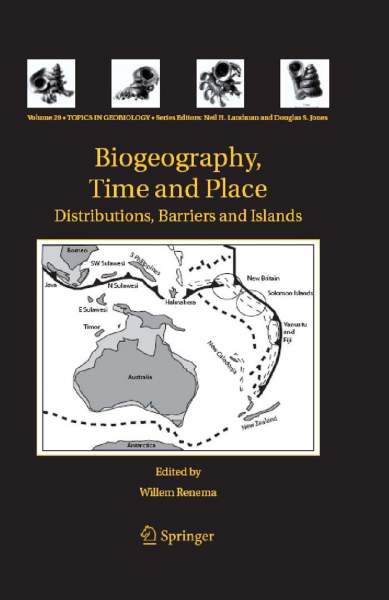 BIOGEOGRAPHY, TIME, AND PLACE-DISTRIBUTIONS, BARRIERS, AND ISLANDS.jpg Contributors xi Introduction 1 1 Global Disjunctions and Flying Insects 5 Rienk de Jong and Cees van Achterberg 1. Introduction 6 2. Conjecture and evidence 7 3. Evolution of continents 9 4. Butterfl ies (Hesperioidea and Papilionoidea) 12 5. Hymenoptera 30 6. Discussion 35 Acknowledgements 37 References 38 2 Zoogeography of Freshwater Invertebrates of Southeast Asia, with Special Reference to Odonata 45 Jan van Tol and Dirk Gassmann 1. Introduction 46 2. History of aquatic invertebrates 49 3. Geological history of Southeast Asia 51 4. Distribution patterns 59 5. Discussion 81 Acknowledgements 84 References 84 3 Distribution and Speciation of Megapodes (Megapodiidae) and Subsequent Development of their Breeding Behaviour 93 René W.R.J. Dekker 1. Introduction 93 2. Megapode phylogenies and other relevant publications 94 3. Possible scenario of current distribution and breeding strategies 95 Acknowledgements 100 References 101 4 The Infl uence of Land Barriers on the Evolution of Pontoniine Shrimps (Crustacea, Decapoda) Living in Association with Molluscs and Solitary Ascidians 103 Charles H.J.M. Fransen 1. Introduction 104 2. Pontoniine shrimps 105 3. Processes 106 4. Distributional patterns 109 References 113 5 Delineation of the Indo-Malayan Centre of Maximum Marine Biodiversity: The Coral Triangle 117 Bert W. Hoeksema 1. Introduction 118 2. The Indo-West Pacifi c Region 121 3. A triangular Indo-West Pacifi c biodiversity hotspot? 122 4. Marine biodiversity patterns among various taxa 125 5. Processes affecting marine biodiversity 141 6. Conclusions 154 Acknowledgements 155 References 155 6 Fauna Development of Larger Benthic Foraminifera in the Cenozoic of Southeast Asia 179 Willem Renema 1. Introduction 180 2. Genera included 183 3 The East Indian letter classifi cation 186 4 Correlation to plankton foraminifera zonal schemes and European stage names 190 5. Remarks on some stratigraphic occurrences 191 6. Generic diversity of the Indo-West Pacifi c as compared to Europe 198 7. Regional distribution and fauna provinces 205 8. Conclusions 207 References 209 7 The Role of Spain in the Development of the Reef Brachiopod Faunas During the Carboniferous 217 Cor F. Winkler Prins 1. Introduction 218 2. The Cantabrian Mountains 218 3. Discussion of the brachiopod faunas from the Cantabrian Mountains 224 4. Relation with other areas 231 5. Conclusions 238 Acknowledgements 238 References 238 8 Contrasting Patterns and Mechanisms of Extinction during the Eocene–Oligocene Transition in Jamaica 247 Stephen K. Donovan, Roger W. Portell, and Daryl P. Domning 1. Introduction 248 2. Tectonics and palaeogeography 249 3. Marine environment 251 4 Terrestrial environment 259 5. Discussion 262 6. Conclusions 266 Acknowledgements 266 References 267 9 Long-Lived Lake Molluscs as Island Faunas: A Bivalve Perspective 275 Frank P. Wesselingh 1. Introduction 276 2. Corbulid radiations in Miocene Lake Pebas (Western Amazonia) 277 3. An overview of long-lived lake bivalve radiations 288 4. Discussion 304 5. Conclusions 309 Acknowledgements 309 References 310 10 Patterns in Insular Evolution of Mammals: A Key to Island Palaeogeography 315 John de Vos, Lars W. van den Hoek Ostende, and Gert D. van den Bergh 1. Introduction 316 2. Gargano, island faunas on the present mainland 318 3. The Greek Isles, a developing archipelago 320 4. Southeast Asia 326 5. Observations and remarks 334 Acknowledgements 336 References 337 11 Islands from a Snail’s Perspective 347 E. Gittenberger 1. Introduction 348 2. Land surrounded by water 348 3. Highlands surrounded by lowlands 353 4. Stable versus varying temperature, humidity, and light conditions 355 5. Calcareous surrounded by non-calcareous soils or rocks 358 6. Discussion 358 Acknowledgements 360 References 360 12 Morphological and Genetical Differentiation of Lizards (Podarcis bocagei and P. hispanica) in the Ria de Arosa Archipelago (Galicia, Spain) resulting from Vicariance and Occasional Dispersal 365 J.W. Arntzen and P. Sá-Sousa 1. Introduction 366 2. Material and methods 369 3. Results 376 4. Discussion 383 Acknowledgements 394 References 394 Index 403 [ Last edited by 1949stone on 2013-7-1 at 09:49 ] |
 回复此楼
回复此楼» 本帖附件资源列表
-
欢迎监督和反馈:小木虫仅提供交流平台,不对该内容负责。
本内容由用户自主发布,如果其内容涉及到知识产权问题,其责任在于用户本人,如对版权有异议,请联系邮箱:xiaomuchong@tal.com - 附件 1 : BIOGEOGRAPHY,_TIME,_AND_PLACE-DISTRIBUTIONS,_BARRIERS,_AND_ISLANDS.pdf
2013-07-01 09:25:48, 10.31 M
» 猜你喜欢
 TYK2/JAK1 双靶点工具化合物 Brepocitinib:激酶选择性、研究进展与实验应用全解析
已经有0人回复
TYK2/JAK1 双靶点工具化合物 Brepocitinib:激酶选择性、研究进展与实验应用全解析
已经有0人回复
-
矢车菊素-3-O-葡萄糖苷质控实录:从一张HPLC图谱读懂纯度与稳定性
已经有0人回复
-
化学工程及工业化学论文润色/翻译怎么收费?
已经有212人回复
-
恩诺沙星(Enrofloxacin)科研解析:分子特征、LC-MS/MS 检测与实验室使用要点
已经有0人回复
-
Calderasib理化性质与实验操作技术笔记
已经有0人回复
-
RMC-6291怎么用?RAS(ON) 三重复合物工具化合物的实验室实操要点
已经有0人回复
-
苯并呋咱全解析:NBD 荧光衍生化试剂母核的化学特性与实验室应用
已经有0人回复
-
生物质炭与活化剂氢氧化钾混合注意事项
已经有0人回复
-
科研人必读:新一代 KRAS G12C 抑制剂 Olomorasib 的研究进展
已经有0人回复
-
BT-11(Omilancor)研究化合物全解析:从分子结构到实验应用要点
已经有0人回复
-
富马酸贝达喹啉:二芳基喹啉类工具化合物的化学特征
已经有0人回复
简单回复
2013-07-01 11:02
回复
五星好评 顶一下,感谢分享!
2013-11-29 17:15
回复
五星好评 顶一下,感谢分享!
2014-02-10 13:58
回复

闲闲人5楼
2014-10-30 17:58
回复
五星好评 顶一下,感谢分享!
2014-11-19 10:35
回复
顶一下,感谢分享!
scock7楼
2016-09-26 17:48
回复
五星好评 顶一下,感谢分享!