









| 查看: 4622 | 回复: 71 | |||||
| 【奖励】 本帖被评价63次,作者yj656增加金币 50.4 个 | |||||
| 当前只显示满足指定条件的回帖,点击这里查看本话题的所有回帖 | |||||
[资源]
MICROSYSTEM DESIGN(已搜索,无重复)
|
|||||

|
MEMS方面的一本很不错的书籍,黄庆安译著原版,建议大家读一读 By Stephen D. Senturia The goal of this book is to bring together into one accessible text the fun-damentals of the many disciplines needed by today’s microsystems engineer. The subject matter is wide ranging: microfabrication, mechanics, heat flow, electronics, noise, and dynamics of systems, with and without feedback. And because it is very difficult to enunciate principles of “good design” in the ab-stract, the book is organized around a set of Case Studies that are based on real products, or, where appropriately well-documented products could not be found, on thoroughly published prototype work. This book had its roots in a graduate course on “Design and Fabrication of MEMS Devices” which my colleague Prof. Martin Schmidt and I co-taught for the first time in the Fall of 1997. I then offered it as a solo flight in the Spring of 1999. Our goal was to exploit our highly interdisciplinary student mix, with students from electrical, mechanical, aeronautical, and chemical engineering. We used design projects carried out by teams of four students as the focus of the semester, and with this mix of students, we could assign to each team someone experienced in microfabrication, another who really understood system dynamics, another with background in electronics, and so on. Lectures for the first two-thirds of the semester presented the material that, now in much expanded form, comprises the first sixteen chapters of this book. Then, while the teams of students were hard at work on their own design problems (more on this below), we presented a series of lectures on various case studies from current MEMS practice. 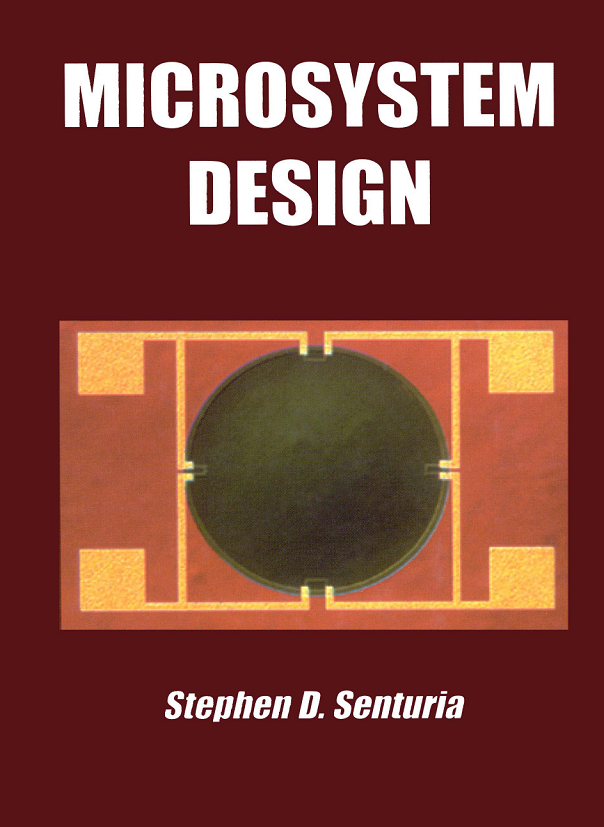 无标题.png Contents: Part I GETTING STARTED 1. Introduction.............................................................................3 2 An approach to MEMS design...................................................15 3 Microfabrication........................................................................29 4 Process integration...................................................................79 Part II MODELING STRATEGIES 5 Lumped modeling...................................................................103 6 Energy-conserving transducers..............................................125 7 Dynamics...............................................................................149 Part III DOMAIN-SPECIFIC DETAILS 8 Elasticity.................................................................................183 9 Structures..............................................................................201 10 Energy methods..................................................................239 11 Dissipation and the thermal energy domain..........................267 12 Lumped modeing of dissipative precesses.............................299 13 Fludis...................................................................................317 Part IV CIRCUIT AND SYSTEM ISSUES 14 Electronics............................................................................353 15 Feedback systems................................................................397 16 Nose.....................................................................................425 Part V CASE STUDIES 17 Packaging.............................................................................453 18 Apiezoresistive prsessure sensor............................................469 19 Acapacitive accelerometer.....................................................497 20 Electrostatic proiection displays.............................................531 21A piezoelectric rate gyroscope................................................561 22 DNA amplification..................................................................605 23 A microbridge gas sensor......................................................629 [ Last edited by yj656 on 2013-1-26 at 13:36 ] |
 回复此楼
回复此楼» 本帖附件资源列表
-
欢迎监督和反馈:小木虫仅提供交流平台,不对该内容负责。
本内容由用户自主发布,如果其内容涉及到知识产权问题,其责任在于用户本人,如对版权有异议,请联系邮箱:xiaomuchong@tal.com - 附件 1 : Microsystem_Design.part3.rar
- 附件 2 : Microsystem_Design.part1.rar
- 附件 3 : Microsystem_Design.part2.rar
2013-01-26 12:36:42, 3.53 M
2013-01-26 12:37:25, 7 M
2013-01-26 12:38:10, 7 M
» 收录本帖的淘帖专辑推荐
 国外专业电子书1 国外专业电子书1 | MEMS与传统机械 | 纳米 |
» 猜你喜欢
 修改论文,如何借助其他力量?
已经有4人回复
修改论文,如何借助其他力量?
已经有4人回复
-
中山大学潘越教授课题组2027级推免硕士研究生招生 新增一个专业医学技术名额
已经有21人回复
-
金属材料论文润色/翻译怎么收费?
已经有191人回复
» 本主题相关价值贴推荐,对您同样有帮助:
- 【分享】汽轮机设备检修技术问答(已搜索无重复)
已经有13人回复

26楼2013-11-27 22:57:40
简单回复
xzb3282楼
2013-01-27 08:43
回复
五星好评 顶一下,感谢分享!
xzb3283楼
2013-01-27 08:44
回复
顶一下,感谢分享!
xzb3284楼
2013-01-27 08:44
回复
顶一下,感谢分享!
yaahoo5楼
2013-01-27 11:52
回复
五星好评 顶一下,感谢分享!
yaahoo6楼
2013-01-27 11:53
回复
顶一下,感谢分享!
yaahoo7楼
2013-01-27 11:54
回复
顶一下,感谢分享!
2013-01-27 13:30
回复
五星好评 顶一下,感谢分享!
2013-01-27 13:31
回复
顶一下,感谢分享!
15923647810楼
2013-01-27 15:37
回复
五星好评 顶一下,感谢分享!
applesxj13楼
2013-02-19 15:56
回复
五星好评 顶一下,感谢分享!
applesxj14楼
2013-02-19 15:58
回复
顶一下,感谢分享!