









| 查看: 391 | 回复: 1 | |||
heta101铁杆木虫 (著名写手)
|
[交流]
猩猩都退休了,你还在做实验,你怎么看?
|

|
NIH told to retire most research chimpanzees Half of ongoing experiments would be ended. Meredith Wadman 23 January 2013 Most research chimpanzees would be retired under new recommendations. Tim Mueller/The New York Times/Redux/eyevine Article toolsPrint Rights & Permissions Share/bookmark Connotea Delicious Digg Friendfeed The US National Institutes of Health (NIH) should dismantle a decades-old colony of 360 chimpanzees, retiring all but roughly 50 of the animals to a national sanctuary, the biomedical agency was told on 22 January in a long-awaited report. The report, from a working group of external agency advisors, also counsels the NIH to end about half of 21 existing biomedical and behavioural experiments, saying they do not meet criteria established in a December, 2011 Institute of Medicine (IOM) report. “Clearly there is going to be a reduction in the use of chimpanzees in research,” says working group co-chair Kent Lloyd, the associate dean for research at the School of Veterinary Medicine at the University of California, Davis. The report says that the NIH should begin planning sanctuary housing for the retiring animals “immediately”, and that a colony of about 50 animals would be sufficient for future research. The report also sets high hurdles for new chimpanzee experiments in the future, calling for the establishment of an independent committee that would vet individual study proposals after they first pass routine NIH scientific review. In cases where the burden on the animals is high, the benefit to humanity should have to be “very high” to pass muster with the committee, says Daniel Geschwind, the other co-chair of the working group and a geneticist at the School of Medicine at the University of California, Los Angeles. The report suggests that three of nine ongoing invasive experiments, involving immunology and infectious diseases, could continue, because they meet the IOM criteria. These require that a study be needed for public health; that no alternative animal model exists; that performing the study in humans would be unethical; and that the animals be maintained in socially and physically appropriate habitats. The report also says that eight of 13 behavioural or comparative genomics studies could be allowed to continue, but in some cases only conditionally — meaning that funding for these experiments could not be renewed without passing the independent committee review. Related stories NIH faces chimp housing quandary NIH retires research chimps at troubled facility Lab-animal flights squeezed More related stories The working group — a subgroup of NIH’s Council of Councils, a trans-agency advisory body — was chartered by NIH director Francis Collins one year ago to advise the agency on how to implement the recommendations of the IOM report, which found that most chimpanzee research was not necessary. Its recommendations are not binding; Collins is expected to respond to them in late March, after a 60-day period of public comment. But they signal yet another significant step in an ongoing retrenchment. Last month, the agency announced that it will retire 110 chimpanzees to the national Chimp Haven sanctuary in Keithville, Louisiana, after they had been first slated to move to an active NIH-supported research centre in San Antonio, Texas. Today’s recommendations speak to the fate of an additional 360 research-eligible chimpanzees that are owned by the biomedical agency and housed at facilities in Texas and New Mexico.The fate of an additional 91 animals that the NIH pays to maintain, but does not own, was not clear; the agency cannot compel the retirement of these animals, housed at the Texas Biomedical Research Institute (TBRI) in San Antonio. Animal rights activists welcomed the report. “A chimpanzee should no more live in a laboratory than a human should live in a phone booth,” says Justin Goodman, the director of laboratory investigations at People for the Ethical Treatment of Animals in Washington, DC. But the TBRI issued a statement saying that the report’s recommendations “will slow urgently needed medical advances necessary to prevent and treat human diseases that afflict millions of Americans as well as hundreds of millions of people living in other countries.” Alice Ra’anan, director of government relations and science policy at the American Physiological Society in Bethesda, Maryland, says that, while the IOM report deems most chimpanzee research unnecessary, “the flip side of that is: some is necessary.” The report recognizes the need for the NIH to maintain a small chimpanzee colony, she says. “We have to have a sustainable capacity going into the future.” 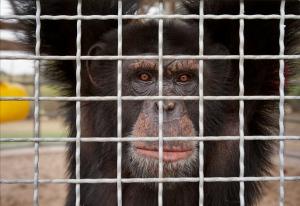 Marlon.jpg |
 回复此楼
回复此楼» 猜你喜欢
 售SCI一区T0P文章,我:8.O55.1.O.54,科目全,可十急
已经有5人回复
售SCI一区T0P文章,我:8.O55.1.O.54,科目全,可十急
已经有5人回复
-
售SCI一区T0P文章,我:8.O.55.1.O.54,科目齐全,可+急
已经有5人回复
-
filecode,4个jtjc了
已经有11人回复
-
欢迎发来filecode的Mz6后的代码验证其规律
已经有117人回复
-
filecode=后面第一个是大写字母
已经有12人回复
-
为什么余额宝的年化利率越来越低?主要原因有哪些?
已经有4人回复
-
今天放榜吗?
已经有13人回复
-
今天基金会出结果吗?20260819
已经有8人回复
-
2027广东省杰青
已经有10人回复
-
朋友圈看到的
已经有8人回复
heta101
铁杆木虫 (著名写手)
- 应助: 6 (幼儿园)
- 金币: 6564.4
- 散金: 2963
- 红花: 120
- 帖子: 2159
- 在线: 382.3小时
- 虫号: 100591
- 注册: 2005-11-12
- 专业: 生物化学
|
原文NATURE链接 NIH told to retire most research chimpanzees http://www.nature.com/news/nih-t ... chimpanzees-1.12277 |

2楼2013-01-23 15:34:06

