









| 查看: 1308 | 回复: 9 | ||
| 【奖励】 本帖被评价3次,作者clfu2000增加金币 2 个 | ||
| 当前主题已经存档。 | ||
[资源]
胶体纳米粒子形状的控制 ——Shape control of colloidal nanoparticles
|
||

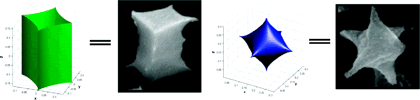 WorldSelf assembled structures from colloidal particles have many applications in biology, as chemical sensors and as photonic crystals. The control of shape and valency of the colloidal particle is very important since it will determine the 3D lattices of the assembled structure. There have been several prior effort to fabricating particles with complex shapes. Most particles with anisotropic shape are from the simple assembly of spheres or the modification of spherical particles. Interference lithography is one of the few techniques which can provide direct and systematic control over symmetry and volume fraction of the 3D structure. It involves the simple creation of interference patterns in a photoresist systems and subsequent pinch off of the parent structure through a drying process. Researchers at MIT have now presented a new facile and high-yield route for the fabrication of highly nonspherical complex multivalent nanoparticles. This technique exploits the ability of holographic interference lithography to control network topology. These research results could lay the groundwork for establishing and demonstrating control over particle shape in colloidal nanoparticles. "Compared to the previous techniques, such as microfilmed lithography and assembling and sintering spherical particles in a lithographically defined well (cavity), our approach gives us access to more complex and precisely controlled shapes with much higher through-put since we have a 3-dimensional yield" Dr. Edwin L. Thomas explains to Nanowerk. Thomas is the Morris Cohen Professor of Materials Science and Engineering at MIT and head of the department as well as the Founding Director of the MIT Institute for Soldier Nanotechnologies. In a recent paper in Nano Letters ("Shape Control of Multivalent 3D Colloidal Particles via Interference Lithography"  , he and his team report the use of holographic interference lithography (HIL) as an easy and high-throughput fabrication method for creating complex polymer particles with controlled symmetry, size, and highly nonconvex shapes.! , he and his team report the use of holographic interference lithography (HIL) as an easy and high-throughput fabrication method for creating complex polymer particles with controlled symmetry, size, and highly nonconvex shapes.!HIL involves the formation of a stationary spatial variation of intensity created by the interference of two or more beams of light. The pattern that emerges out of the intensity distribution is transferred to a light-sensitive medium, such as a photoresist, to yield structures.Importantly, by proper choice of beam parameters, one can control the geometrical elements and volume fraction of the structures" Dr. Ji-Hyun Jang, first author of the paper, points out. "Our multivalent particles are fabricated by creating disconnected HIL structures in a negative photoresist" she says. "Manipulation of the experimental parameters of intensity, polarization, phase, and wave vectors of the interfering beams allows one to target specific space group structuresAs a proof of concept, the MIT researchers demonstrate the fabrication of two types of concave multivalent polymer particles, 4-valent particles from a parent simple square lattice, and 6-valent particles from a parent simple cubic structure, via interference lithography.  SEM images of 2D and 3D structures before and after UV/ozonolysis. (a and b) Lightly connected structures after first strong development followed by CO2 supercritical drying. (c and d) Samples after UV/ozonolysis. Each lower inset shows the single unit cell with the calculated light intensity distributions corresponding to the SEM images. The upper insets in (c) and (d) are magnified individual “4-valent” and “6-valent” particles very similar to the theoretical model in the lower inset. The scale bars in the insets are 300 nm. (Reprinted with permission from American Chemical Society). "The control of the particle shape was hard" says Thomas. "Surface tension always favors convex particlesTo get around this effect and to retain the pronounced nature of the “valency” and a strongly concave particle shape, the researchers chose a dry process. After an initial exposure and development, an isotropic etch using a stronger solvent, followed by supercritical CO2 drying to prevent distortion of the structure due to high surface tension forces, results in particles with the desired shape. Finally, the particles can be fully disconnected at the thinnest part of the arms between neighboring nodes to obtain the discrete multivalent colloidal particles. The particles were separated either by O2 plasma or UV/ozonolysis. Because the whole structure has very thin connections, O2 plasma or UV/ ozonolysis does not affect the final shape of the particle, but only decreases the size of the polymer particle by 2-3%. Thomas says that, besides the common application of colloidal particles in self-assembled device, these "pointy" particles can be useful as a type of biological sensor. For example, magnetic nanoparticles with specific symmetry have been suggested as building blocks in supramolecular architecture as nanosensors for rapid detection of viruses with specific symmetry by providing the anchoring position. Another application has been suggested in the cosmetic industry where the concave particles can confer softness during their application and help to increase the adherence to the skin. "We are currently exploring multivalent particles out of inorganic materials such as silica or iron oxide by the infiltration of the parent polymer template" Thomas describes the direction of their ongoing research. "We expect this will greatly increase the potential of our multivalent particles." By Michael Berger, Copyright 2007 Nanowerk LLC [search]Shape control of colloidal nanoparticles[/search] http://www.box.net/shared/rjoxhudhqk [ Last edited by clfu2000 on 2007-7-14 at 21:48 ] |
 回复此楼
回复此楼» 猜你喜欢
 修改论文,如何借助其他力量?
已经有4人回复
修改论文,如何借助其他力量?
已经有4人回复
-
中山大学潘越教授课题组2027级推免硕士研究生招生 新增一个专业医学技术名额
已经有21人回复
-
金属材料论文润色/翻译怎么收费?
已经有263人回复
-
哈尔滨工程大学国家级青年人才-27年申请考核制博士招生(材料、化学、生物医学专业)
已经有12人回复
» 本主题相关商家推荐: (我也要在这里推广)

2楼2007-07-20 11:00:47
3楼2007-07-21 11:41:35