








| 查看: 523 | 回复: 1 | ||
贝芷苡铜虫 (小有名气)
|
[求助]
磁性计算
|

|
the picture shows the calculated local density of states (LDOS) for the carbon dopant and the neighboring Zn atoms. Strong coupling between the carbon s and p orbitals and the s orbital of Zn can be seen. The interaction causes the carbon 2s orbital around 9 eV and the carbon 2p orbital near 2.3 eV to split. The spin-up bands are fully occupied while the spin-down bands are partially filled, resulting in a magnetic moment of 2.02B per carbon dopant. The magnetic moment is mainly contributed by the carbon p orbitals (0.85B), while each of the neighboring Zn atoms and second nearest neighboring oxygen atoms also contribute a small part (0.11B and 0.05B, respectively), suggesting the Zn-C system as the origin of magnetism in C-doped ZnO. The estimated formation energy of the CO defect is 5.3 eV, with respect to bulk ZnO and an isolated carbon atom. Similar calculations on carbon substitution for Zn and interstitial carbon showed that they do not result in magnetism 红字部分中的数据值怎么得来的? 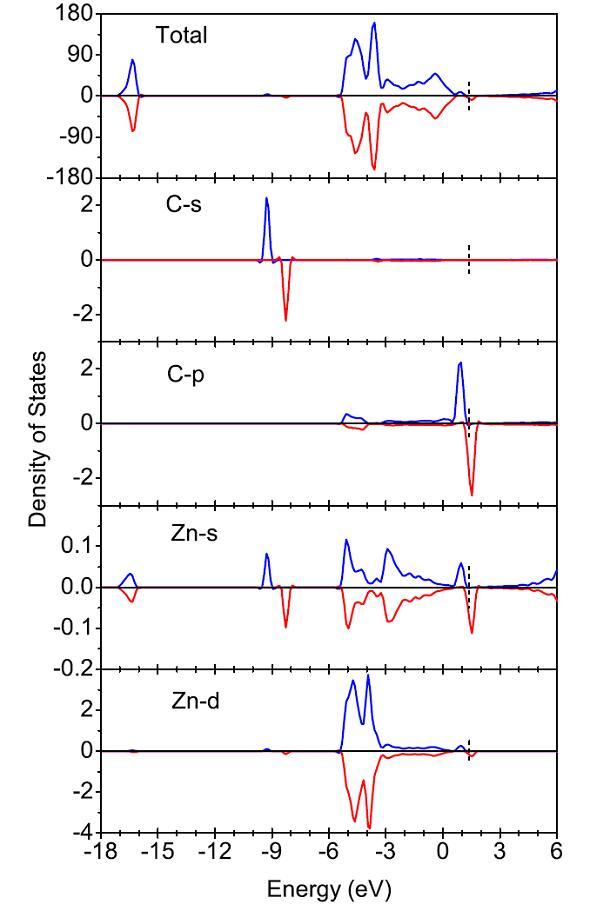 3.jpg |
 回复此楼
回复此楼» 猜你喜欢
 售SCI一区T0P文章,我:8O.55.1.O.5.4,科目齐全,可+急
已经有3人回复
售SCI一区T0P文章,我:8O.55.1.O.5.4,科目齐全,可+急
已经有3人回复
-
售SCI文章,我:8O5.5.1.O.54,科目齐全,可+急
已经有3人回复
-
售SCI文章,我:8O.5.5.1O.54,科目全,可十急
已经有3人回复
-
浙江师范大学是怎么坑我的
已经有4人回复
-
闲聊
已经有6人回复
-
江苏省自然基金 什么时候出结果
已经有7人回复
-
浙江师范大学是怎么坑我的
已经有10人回复
-
求教各位大神:2026教育部人文社科青年基金项目何时公示呀?
已经有6人回复
-
面上有专家说实验设备不是我们单位的
已经有8人回复
-
科研求助
已经有4人回复


2楼2012-11-04 20:50:21