









| 查看: 543 | 回复: 1 | ||
目标北大木虫 (正式写手)
|
[求助]
请教高人有关交流阻抗的问题,急!!!
|

|
这是我拟合时用的你和电路,以及一些参数的测定,请问一下Rs-R,Rs-T,Rs-P分别是什么?应该如何测定参数? 求高人指点啊!!!这里先谢过了~~~ 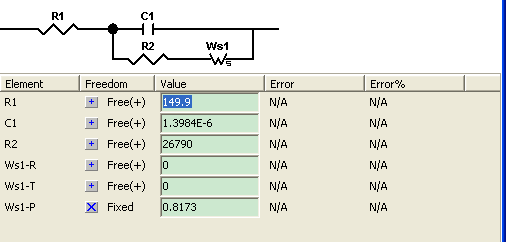 |
 回复此楼
回复此楼» 猜你喜欢
 电池测试中dQ/dV怎么理解
已经有2人回复
电池测试中dQ/dV怎么理解
已经有2人回复
-
精细化工浓水做零排放,前端到底该配什么氧化工艺?
已经有0人回复
-
分析化学论文润色/翻译怎么收费?
已经有191人回复
-
大湾区大学姚瑶课题组2027届博士生招生 (与中山大学联合培养)
已经有27人回复
-
氯离子浓度对电催化处理效果的双重影响实测与参数优化
已经有0人回复
-
阴极协同电催化技术处理高盐难降解化工废水的机理与工程应用研究
已经有0人回复
-
氧化铝浆液
已经有2人回复
-
铁基改性石墨催化电极的制备、表征及电催化降解性能研究
已经有0人回复
-
N2O分解催化
已经有1人回复
-
石墨电极生产缺陷成因及工艺优化控制技术研究
已经有0人回复
-
三维电极体系催化极板应用优势,大幅提升废水处理容积负荷
已经有0人回复
» 本主题相关价值贴推荐,对您同样有帮助:
- 电化学阻抗谱的分析,请高手指教,万分感谢!!
已经有32人回复
- 阻抗谱分析,高手进来帮帮忙吧!!!万分感激!!!
已经有13人回复
- 大家看看这交流阻抗对吗?请高人指点
已经有18人回复
- 求高手解决交流阻抗问题
已经有3人回复
- 交流阻抗高手:关于存在吸附电感的交流阻抗拟合等效电路
已经有4人回复
- 【求助】关于交流阻抗 求助高人
已经有10人回复
- 【求助】求助高手交流阻抗图 拟合等效电路的问题
已经有19人回复
- 【交流】交流阻抗图谱怎么拟合?请高手指点
已经有9人回复
- 【交流】交流阻抗图谱在高频下很乱,请高手指点
已经有12人回复
- 【求助】请教高手有关电化学阻抗谱问题-金币酬谢
已经有17人回复
- 【求助】求助,急!电化学工作站 恒电位 恒电流参数设置问题!!
已经有38人回复

电池小兵
铁杆木虫 (著名写手)
- ECEPI: 62
- 应助: 445 (硕士)
- 贵宾: 0.671
- 金币: 7604.9
- 散金: 100
- 红花: 64
- 帖子: 1021
- 在线: 286.6小时
- 虫号: 1881862
- 注册: 2012-07-06
- 性别: GG
- 专业: 电化学
【答案】应助回帖
★ ★ ★ ★ ★ ★ ★ ★ ★ ★ ★ ★ ★ ★ ★ ★ ★ ★ ★ ★ ★ ★ ★ ★
感谢参与,应助指数 +1
857688363: 金币+4, 感谢应助 2012-07-11 20:04:37
目标北大: 金币+20, ★★★很有帮助, 太谢谢了!! 2012-07-11 20:33:13
感谢参与,应助指数 +1
857688363: 金币+4, 感谢应助 2012-07-11 20:04:37
目标北大: 金币+20, ★★★很有帮助, 太谢谢了!! 2012-07-11 20:33:13
|
Rs-R,Rs-T,Rs-P? LZ指的是Ws-R,Ws-T,Ws-P吧~ 首先,Ws是Warburg扩散阻抗,是Finite Length Warburg。 公式1,扩散阻抗Z = R*tanh([I*T*w]^P) / (I*T*w)^P 其中含有三个参数R、T、P: Ws-R, Ws-T, Ws-P This element is also known as a Generalized Finite Warburg element (GFW). It is an extension of another more common element, the Finite-Length Warburg (FLW). To use the FLW equation, set Ws-P = 0.5 and set its freedom to 'fixed'. The FLW is the solution of the one-dimensional diffusion equation of a particle, which is completely analogous to wave transmission in a finite-length RC transmission line. In the diffusion interpretation Ws-T = L^2 / D. (L is the effective diffusion thickness, and D is the effective diffusion coefficient of the particle). The GFW is similar to this, but for it the square root becomes a continuously varying exponent Ws-P such that 0 < Ws-P < 1. If the data exhibits only the high frequency (45 degree slope) behavior and not the transition to low frequency behavior, either Wo-R or Wo-T must be set as Fixed(X). Alternately, a CPE can be used in this situation. This version of the Warburg element is terminates in a finite resistance. At very low frequencies, Z' approaches Ws-R and Z" goes to zero. |

2楼2012-07-11 20:03:24