









| 查看: 807 | 回复: 2 | ||
[求助]
求解流体方面的计算一例题
|

|
Sample Text 本人不是学流体方向的,现需要得出计算公式:希望广大友人帮助; 如附图:液体从D点注入,处理量恒定(已知量),经过A点有两个分流B和C,B点是液体泄出口,C点没有泄出口(C1和C2分别为两种条件下液面的高度),现需要得到一个计算公式:1、C点液面高度h2与B点液体流速的关系式. (液体可看做水,容器壁外形尺看做已知量);2、影响h2的因素及相关关系式!3、主要目的是想控制h2的值(即控制C点液面高度) 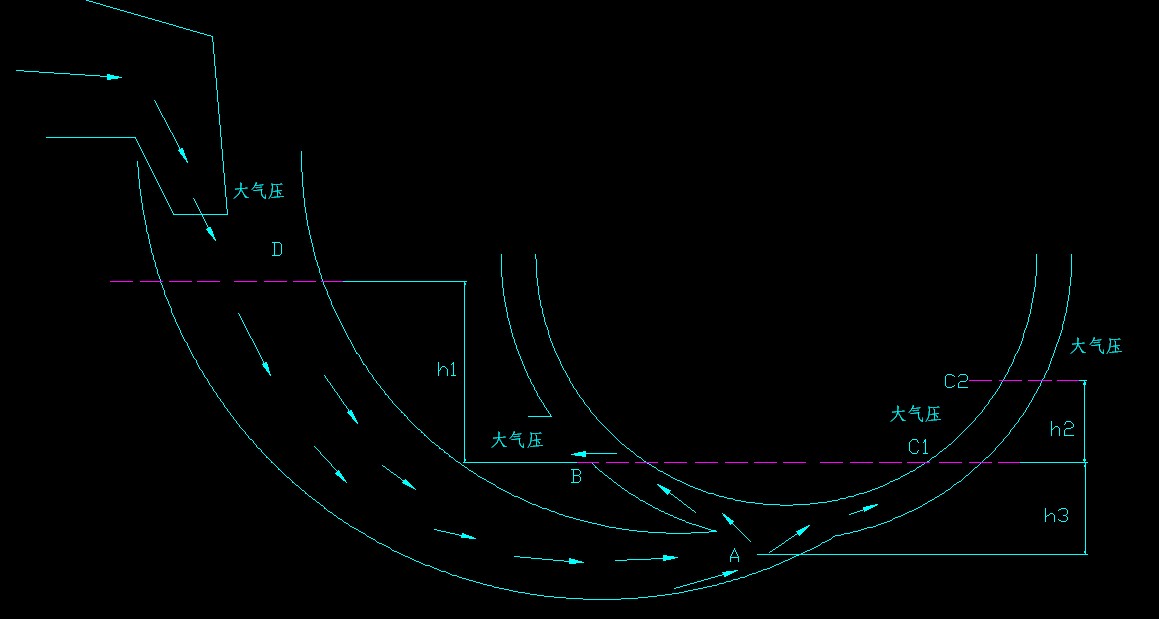 液体流程图 |
 回复此楼
回复此楼» 猜你喜欢
 27年申博自荐-能源/环境方向
已经有3人回复
27年申博自荐-能源/环境方向
已经有3人回复
-
闲聊
已经有3人回复
-
亲密关系
已经有13人回复
-
27秋申博自荐
已经有4人回复
» 本主题相关价值贴推荐,对您同样有帮助:
- 二元幂函数参数求解
已经有10人回复
- 《fluent-流体工程仿真计算实例与应用》一书中的疑问
已经有4人回复
- 求助---一道---流体力学数值模拟题---二元平流方程化简的题目---急急急急急急急
已经有7人回复
- 流体计算模拟方面的SCI杂志?
已经有11人回复
- 有没有什么方法精确计算集流体上面的活性物质质量?
已经有10人回复
- 【求助】计算流体力学
已经有6人回复
- 【求助】【微积分高手请进】求解一道积分题
已经有12人回复
- 【讨论】一道化工原理流体流动方面的题
已经有15人回复
- 【讨论】做(计算流体力学和计算传热学)相关的请进
已经有37人回复

2楼2012-02-13 22:31:00
【答案】应助回帖
感谢参与,应助指数 +1
|
Finite volume method Main article: Finite volume method The finite volume method (FVM) is a common approach used in CFD codes.[citation needed] The governing equations are solved over discrete control volumes. Finite volume methods recast the governing partial differential equations (typically the Navier-Stokes equations) in a conservative form, and then discretize the new equation. This guarantees the conservation of fluxes through a particular control volume. The finite volume equation yields governing equations in the form, where is the vector of conserved variables, is the vector of fluxes (see Euler equations or Navier–Stokes equations), is the volume of the control volume element, and is the surface area of the control volume element. [edit]Finite element method Main article: Finite element method The finite element method (FEM) is used in structural analysis of solids, but is also applicable to fluids. However, the FEM formulation requires special care to ensure a conservative solution. The FEM formulation has been adapted for use with fluid dynamics governing equations.[citation needed] Although FEM must be carefully formulated to be conservative, it is much more stable than the finite volume approach[4] However, FEM can require more memory than FVM.[5] In this method, a weighted residual equation is formed: where is the equation residual at an element vertex , is the conservation equation expressed on an element basis, is the weight factor, and is the volume of the element. [edit]Finite difference method Main article: Finite difference method The finite difference method (FDM) has historical importance[citation needed] and is simple to program. It is currently only used in few specialized codes.[citation needed] Modern finite difference codes make use of an embedded boundary for handling complex geometries, making these codes highly efficient and accurate.[citation needed] Other ways to handle geometries include use of overlapping grids, where the solution is interpolated across each grid. 利用流量方程和斯托克斯二维方程求解,上网搜一下 |
3楼2012-03-22 09:03:16