












| 查看: 4700 | 回复: 121 | ||||||||||||
| 【奖励】 本帖被评价100次,作者lchpy增加金币 78 个 | ||||||||||||
| 当前只显示满足指定条件的回帖,点击这里查看本话题的所有回帖 | ||||||||||||
[资源]
11月 Science最新的2篇文章, 转化CO2和分解水
|
||||||||||||

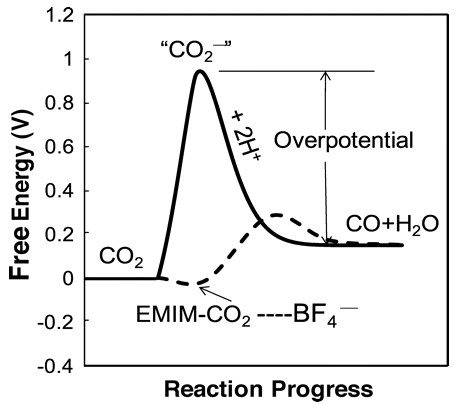 Ionic Liquid–Mediated Selective Conversion of CO2 to CO at Low Overpotentials Abstract Electroreduction of carbon dioxide (CO2)—a key component of artificial photosynthesis—has largely been stymied by the impractically high overpotentials necessary to drive the process. We report an electrocatalytic system that reduces CO2 to carbon monoxide (CO) at overpotentials below 0.2 volt. The system relies on an ionic liquid electrolyte to lower the energy of the (CO2)– intermediate, most likely by complexation, and thereby lower the initial reduction barrier. The silver cathode then catalyzes formation of the final products. Formation of gaseous CO is first observed at an applied voltage of 1.5 volts, just slightly above the minimum (i.e., equilibrium) voltage of 1.33 volts. The system continued producing CO for at least 7 hours at Faradaic efficiencies greater than 96%. Wireless Solar Water Splitting Using Silicon-Based Semiconductors and Earth-Abundant Catalysts Abstract We describe the development of solar water-splitting cells comprising earth-abundant elements that operate in near-neutral pH conditions, both with and without connecting wires. The cells consist of a triple junction, amorphous silicon photovoltaic interfaced to hydrogen- and oxygen-evolving catalysts made from an alloy of earth-abundant metals and a cobalt|borate catalyst, respectively. The devices described here carry out the solar-driven water-splitting reaction at efficiencies of 4.7% for a wired configuration and 2.5% for a wireless configuration when illuminated with 1 sun (100 milliwatts per square centimeter) of air mass 1.5 simulated sunlight. Fuel-forming catalysts interfaced with light-harvesting semiconductors afford a pathway to direct solar-to-fuels conversion that captures many of the basic functional elements of a leaf. 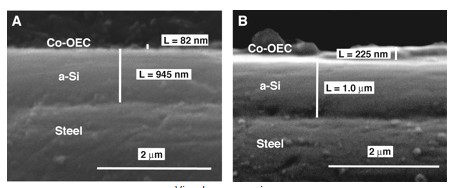 [ Last edited by lchpy on 2011-11-4 at 11:36 ] |
 回复此楼
回复此楼» 收录本帖的淘帖专辑推荐
 Nano&Micro Nano&Micro | 半导体光催化与纳米TiO2 | 纳米材料及生物材料前沿资源 | nano physics&chem |
| 文献 | 材料淘贴收录 | 二氧化碳减排&相关 | 纳米材料 |
| 杂七杂八-wy | 淘帖 |
» 猜你喜欢
 金属材料论文润色/翻译怎么收费?
已经有90人回复
金属材料论文润色/翻译怎么收费?
已经有90人回复

» 本主题相关价值贴推荐,对您同样有帮助:
 看看别人仅用VASP做DOS计算发好文章(两篇PRL)
已经有30人回复
看看别人仅用VASP做DOS计算发好文章(两篇PRL)
已经有30人回复- 精选新概念必背优秀文章20篇
已经有468人回复
- 11月nature communications上最新两篇关于石墨烯文章
已经有350人回复
- 微米纳米版2011年7月--12月资源帖汇总
已经有9人回复
- 6月Science杂志最受关注的文章(生物类)----ebio
已经有13人回复
- 去年独立打败nature和science的那篇文章, 今年继续蹂躏他们
已经有48人回复
- 博士研究方向转为计算机系统结构,有大虾知道入学前要准备哪些基础知识么
已经有3人回复
- 【分享】百年穿越-4月8号Science文章,牛津大学+华东理工大学
已经有28人回复
- 【分享转载】三伏天吃羊肉是否科学?
已经有10人回复
- 【转帖】非常牛的一篇Science文章,只有一个作者但有三个单位
已经有31人回复
- 【转帖】中国科学院化学研究所韩布兴研究员催化方面的文章发表在最新《science》上
已经有71人回复
25楼2011-11-04 22:44:11