









| 查看: 5031 | 回复: 70 | ||
| 当前只显示满足指定条件的回帖,点击这里查看本话题的所有回帖 | ||
[资源]
分子生物学-Gene Genealogies - Variation and Evolution
|
||

|
Gene Genealogies - Variation and Evolution 1 The basic coalescent 1 1.1 Introduction 1 1.2 A Y-chromosome data set 5 1.3 Data and theory 10 1.4 The Wright–Fisher model 11 1.4.1 Assumptions of the Wright–Fisher model 13 1.4.2 The number of descendants of a gene in one generation 14 1.4.3 An example 15 1.5 The geometric distribution 17 1.6 The exponential distribution 19 1.7 The discrete-time coalescent 21 1.7.1 Coalescence of a sample of two genes 21 1.7.2 Coalescence of a sample of n genes 22 1.7.3 Example: Effect of approximations 23 1.8 The continuous time coalescent 24 1.9 Calculating simple quantities on a coalescent tree 25 1.9.1 The height of a tree 25 1.9.2 The total branch length of a tree 27 1.9.3 The effect of sampling more sequences 28 1.10 The effective population size 29 1.11 The Moran model 31 1.12 Robustness of the coalescent 32 2 From genealogies to sequences 33 2.1 Mathematical models of alleles 33 2.1.1 The infinite alleles model 33 2.1.2 The infinite sites model 35 2.1.3 Finite sites model 37 2.2 The Wright–Fisher model with mutation 39 2.3 Algorithms for simulating sequence evolution 41 2.4 The probability of a sample configuration 45 2.4.1 Infinite alleles model 46 2.4.2 Infinite sites model 50 x Contents 2.4.3 Impossible ancestral states 55 2.5 Quantities related to the infinite sites model 58 2.5.1 The number of segregating sites 58 2.5.2 Haplotypes 60 2.5.3 Pairwise mismatch distribution 61 2.5.4 Estimators of θ and Tajima’s D 62 2.6 Evolutionary versus sampling variance 63 2.6.1 Example 1: The variable Sn 64 2.6.2 Example 2: Tajima’s estimator ˆπ 65 3 Trees and topologies 67 3.1 Some terminology 67 3.1.1 The jump process and the waiting time process 67 3.1.2 The coalescent and phylogenetic trees 67 3.2 Counting trees and topologies 70 3.3 Gene trees 72 3.3.1 How to build a gene tree 75 3.4 Nested subsamples 76 3.5 Hanging subtrees 78 3.5.1 Unbalanced trees 81 3.5.2 Example: Neanderthal sequences 81 3.6 A single lineage 82 3.7 Disjoint subsamples 83 3.7.1 Examples 86 3.8 A sample partitioned by a mutation 87 3.8.1 Unknown ancestral state 89 3.8.2 The age of the MRCA for two sequences 90 3.9 The probability of going from n ancestors to k ancestors 91 4 Extensions to the basic coalescent 95 4.1 Introduction 95 4.2 The coalescent with fluctuating population size 95 4.2.1 Stochastic and systematic changes 95 4.2.2 How to model population changes in the coalescent 96 4.3 Exponential growth 99 4.3.1 The genealogy under exponential growth 100 4.4 Population bottlenecks 104 4.4.1 Genealogical effect of bottlenecks 106 4.5 Effective population size revisited 107 Contents xi 4.6 The coalescent with population structure 108 4.6.1 The finite island model 108 4.6.2 The coalescent tree in the finite island model 110 4.6.3 General models of subdivision 114 4.6.4 Non-equilibrium models 116 4.7 Coalescent with balancing selection 118 4.7.1 Two allele balancing selection 118 4.7.2 Multiallelic balancing selection 120 4.8 Coalescent with directional selection 123 4.8.1 The ancestral selection graph 123 4.9 Summary 126 5 The coalescent with recombination 127 5.1 Introduction 127 5.2 Data example with recombination 128 5.3 Modelling recombination 130 5.3.1 Hudson’s model of recombination 130 5.3.2 Biological features of recombination 132 5.4 The Wright–Fisher model with recombination 137 5.5 Algorithms 139 5.5.1 The ancestral recombination graph 139 5.5.2 Sampling ARGs: Not back in time, but along sequences 144 5.5.3 Efficiency of different algorithms 147 5.6 The effect of a single recombination event 148 5.7 The number of recombination events 152 5.8 The probability of a data set 153 5.9 The number of segregating sites 155 5.10 The coalescent with gene conversion 156 5.11 Gene trees with recombination—from incompatibilities to minimal ARGs 158 5.11.1 Recombination as subtree transfer 159 5.11.2 Recombination inferred from haplotypes 165 5.11.3 From local to global bounds 166 5.11.4 Minimal ARGs 167 5.11.5 Topologies, recombination, and compatibility 169 6 Getting parameters from data 173 6.1 Introduction 173 6.2 Estimators of θ 174 6.2.1 Watterson’s estimator 175 6.2.2 Tajima’s estimator 176 6.2.3 Fu’s two estimators 178 xii Contents 6.3 Estimators of ρ 181 6.3.1 Estimators based on summary statistics 183 6.3.2 Pseudo-likelihood estimators 185 6.4 Monte Carlo methods 187 6.4.1 The likelihood curve 189 6.4.2 Monte Carlo integration and the coalescent 191 6.4.3 Markov chain Monte Carlo 195 7 LD mapping and the coalescent 199 7.1 The potential of LD mapping 199 7.2 Linkage versus LD mapping 200 7.3 Complex disease aetiology 202 7.4 Formulating the task 205 7.5 A role for the coalescent 206 7.6 Genealogical trees around a disease mutation 208 7.6.1 Qualitative measures 209 7.6.2 An example 210 7.6.3 Quantifying genealogical tree differences 213 7.7 The genealogical process reflected in data 216 7.8 Linkage disequilibrium (LD) 217 7.8.1 Testing for LD 220 7.8.2 Accounting for population admixture 220 7.8.3 Differences between human populations 221 7.9 Measuring association using single markers 223 7.10 Haplotype LD mapping 223 7.11 Model based LD mapping 224 7.11.1 Star shaped genealogy 225 7.11.2 Coalescent based genealogy 225 7.11.3 An example 227 7.11.4 Further challenges 228 8 Human evolution 231 8.1 Introduction 231 8.2 Our phylogenetic position and ancestral population genetics 232 8.2.1 The number of genetic ancestors to a genome 235 8.3 Human migrations and population structure 240 8.3.1 Our relationship to the Neanderthaler 242 8.3.2 Population growth 244 8.3.3 Structure within global modern human populations 244 8.3.4 Specific histories 245 8.3.5 Empirical pedigrees and the coalescent 246 Contents xiii 8.3.6 Other genealogical issues 250 8.3.7 Tracing genetic material within the parent genealogy 252 Appendix: Web based tools 255 Bibliography 259 Index 273-- 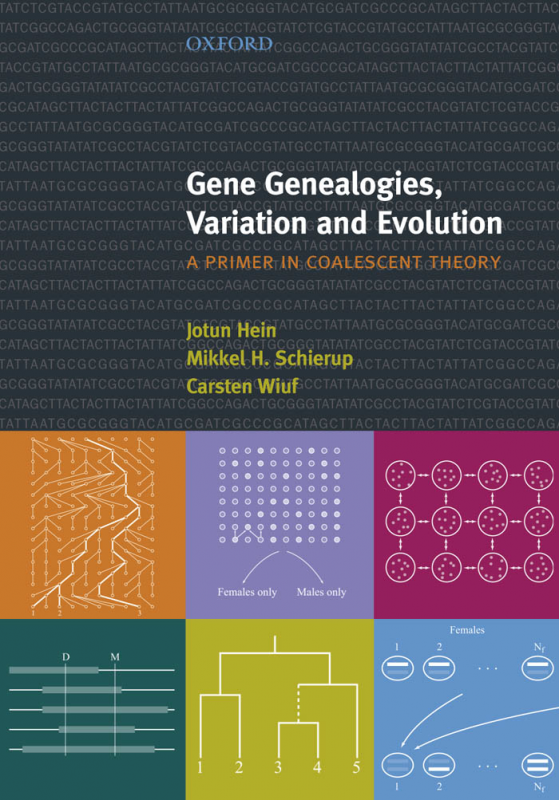 [ Last edited by 1949stone on 2014-2-12 at 12:45 ] ---[ Last edited by 1949stone on 2015-10-9 at 20:17 ] |
 回复此楼
回复此楼» 本帖附件资源列表
-
欢迎监督和反馈:小木虫仅提供交流平台,不对该内容负责。
本内容由用户自主发布,如果其内容涉及到知识产权问题,其责任在于用户本人,如对版权有异议,请联系邮箱:xiaomuchong@tal.com - 附件 1 : Gene_Genealogies_-_Variation_and_Evolution.pdf
2015-10-09 20:17:55, 2.18 M
» 猜你喜欢
 TYK2/JAK1 双靶点工具化合物 Brepocitinib:激酶选择性、研究进展与实验应用全解析
已经有0人回复
TYK2/JAK1 双靶点工具化合物 Brepocitinib:激酶选择性、研究进展与实验应用全解析
已经有0人回复
-
矢车菊素-3-O-葡萄糖苷质控实录:从一张HPLC图谱读懂纯度与稳定性
已经有0人回复
-
化学工程及工业化学论文润色/翻译怎么收费?
已经有186人回复
-
恩诺沙星(Enrofloxacin)科研解析:分子特征、LC-MS/MS 检测与实验室使用要点
已经有0人回复
-
Calderasib理化性质与实验操作技术笔记
已经有0人回复
-
RMC-6291怎么用?RAS(ON) 三重复合物工具化合物的实验室实操要点
已经有0人回复
-
苯并呋咱全解析:NBD 荧光衍生化试剂母核的化学特性与实验室应用
已经有0人回复
-
生物质炭与活化剂氢氧化钾混合注意事项
已经有0人回复
-
科研人必读:新一代 KRAS G12C 抑制剂 Olomorasib 的研究进展
已经有0人回复
-
BT-11(Omilancor)研究化合物全解析:从分子结构到实验应用要点
已经有0人回复
-
富马酸贝达喹啉:二芳基喹啉类工具化合物的化学特征
已经有0人回复
» 本主题相关商家推荐: (我也要在这里推广)

60楼2015-10-09 20:19:36


12楼2011-08-21 17:14:33
14楼2011-11-02 22:31:32
简单回复
西瓜2楼
2011-08-10 23:37
回复
五星好评 顶一下,感谢分享!
jinhx873楼
2011-08-11 07:32
回复
五星好评 顶一下,感谢分享!
jinhx878楼
2011-08-12 07:53
回复
顶一下,感谢分享!
hlhappycat11楼
2011-08-21 17:12
回复
五星好评 顶一下,感谢分享!