









| 查看: 1117 | 回复: 3 | ||
| 本帖产生 1 个 翻译EPI ,点击这里进行查看 | ||
[求助]
哪位大侠能告诉我下面这段文摘的大致意思吗?不要求全翻译。
|
||

|
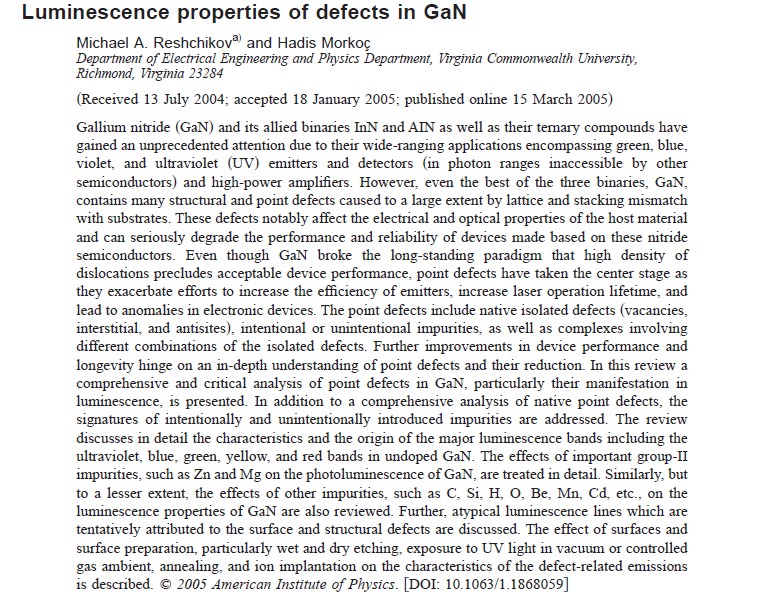
下面这段文摘说的是缺陷对氮化镓的发光有好处还是有坏处?谢谢 Point defects affect optical and electrical properties of GaN to a greater extent than perhaps recognized. Luminescence methods are particularly advantageous for detection and revealing the nature of point defects, however, great efforts must be extended to identify numerous defects in GaN. Even in unintentionally doped GaN a plethora of luminescence bands is discovered that are attributed to residual impurities, native defects, complexes, and structural defects. In this review, we provide a comprehensive analysis of the behavior of numerous luminescence bands associated with defects in GaN. Special attention was given to the notorious luminescence bands such as the yellow band in undoped GaN, and the blue band observed in undoped, Zn-, and Mgdoped GaN. It should be noted that the previous assignments as to the origin of most of the luminescence bands in GaN were very preliminary and often based largely on speculations without much basis or on controversial theoretical predictions rather than on convincing experimental evidence. By analyzing a large body of published literature, combined with “hands on experience” in this field we have attempted to shed light on the identity and properties of many point defects in GaN. Typical concentrations of uncontrolled acceptors, responsible for spontaneous emission in the visible part of the spectrum in undoped GaN, are of the order of 1015 cm−3, even in the purest available material. In doped GaN the situation is not much clearer because the doping universally results in the creation of yet unknown compensating defects. Among the defects in p-type GaN that are explored the most, properties of luminescence bands due to Mg doping are established with high degree of certainty. The importance of potential fluctuations, which are unavoidable in heavily Mg-doped GaN, has been treated in detail. A class of luminescence lines in GaN, most probably related in some way or another to structural defects, has been discussed in detail. The stability of several luminescence bands with time and ambient conditions has also been examined. 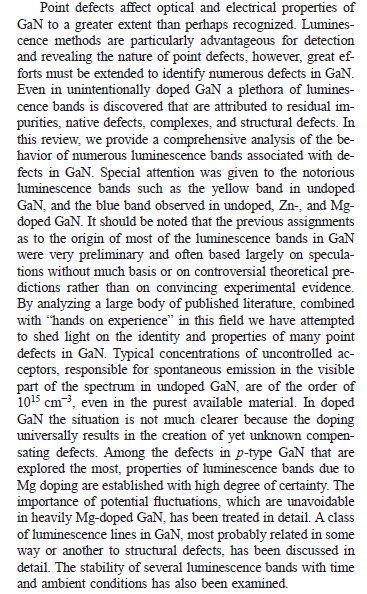 |
 回复此楼
回复此楼» 猜你喜欢
 我应该选哪条合成路线让实验成功率高一些?
已经有8人回复
我应该选哪条合成路线让实验成功率高一些?
已经有8人回复
-
烦躁
已经有8人回复
-
入职后第一次管课题组的专利缴费,对账才发现官费比别人多掏了一倍
已经有3人回复
-
各位大佬,路线设计求助
已经有7人回复
sltmac
荣誉版主 (知名作家)

- 翻译EPI: 161
- 应助: 10 (幼儿园)
- 贵宾: 4.557
- 金币: 31070.8
- 散金: 2687
- 红花: 47
- 沙发: 4
- 帖子: 5642
- 在线: 633.8小时
- 虫号: 996442
- 注册: 2010-04-14
- 性别: GG
- 专业: 无机纳米化学
- 管辖: 论文翻译


2楼2011-05-15 12:27:04
3楼2011-05-15 16:13:57
4楼2011-05-15 16:15:19