









| 查看: 44 | 回复: 0 | |||
[交流]
236、The Generation Mechanism of Neutrons Based on the Photon Origin Theory
|

|
preprint of cern doi :10.5281/zenodo.22256642 or https://doi.org/10.5281/zenodo.22256642 my academic identifier: orcid id: 0009-0005-2185-5790. you may go to the official academic website to retrieve and view relevant research content. readers may copy this number to search on the official zenodo website (search by english title or english keywords) to view the full english and chinese pdf texts. Abstract The universe operates under two sets of systems. Free photons travel at the speed of light and govern the energetic state of the universe. After photons are locked together by strong self locking forces to form matter, the three long range instantaneous action at a distance forces dominate the evolution of the material world. According to the framework of the Photon Origin Theory, free photons inherently propagate at the speed of light. Laboratory observations show that when gamma ray photons collide to produce physical particles, positive and negative particles are always created in pairs. Two gamma ray photons can complete strong self locking and condensation only if they have identical frequencies, matched energy levels and the same spin direction. When two gamma ray photons travelling toward each other at the speed of light collide, they condense through strong self locking and form a confined region. The term "confined region" is only a figurative description rather than a real solid shell; it merely means that photons are trapped within a tiny local space. Protons and electrons are stable photon concentrated regions formed by such strong self locking condensation. The concentrated region turns into a material particle and follows the motion rules of matter, being stationary or moving at low speeds. Nevertheless, the gamma ray photons confined in the tiny space keep moving circularly at the speed of light. The total energy carried by photons is preserved within the local space, and this intrinsic energy manifests externally as the mass of the particle, where mass equals energy divided by the square of the speed of light. Electric charge originates from the uniform spin orientation of photons within the tiny confined region. Therefore, fundamental particles newly generated by photon collisions inevitably carry electric charges. A neutron forms when a proton absorbs an electron. The concentrated structure of the electron disintegrates, and the electron reverts to free photons and merges into the original concentrated region of the proton. A neutron contains two groups of photon streams with opposite spin orientations. The two electric effects cancel each other out, leading to electrical neutrality. The coexistence of two opposite spin systems within the same tiny space cannot last permanently, which is the intrinsic source of neutron instability. In accordance with this strong self locking model, photon clusters with opposite spin orientations cannot directly condense into neutrons via gamma photon collisions. Up to now, no reliable experimental evidence has confirmed that neutrons can be directly produced by gamma photon collisions. The feasible generation mechanism for neutrons is proton capture of electrons. The original local concentrated structure of the electron breaks down and integrates into the proton in the form of photons, while the concentrated region of the proton remains intact. Eventually, an electrically neutral neutron structure forms within the original confined space of the proton. If measured by the number ratio of atomic nuclei, the initial neutron proportion in primitive nebulae is merely 7.7%. In stellar plasma environments, each collision between free protons and free electrons has a 25% probability of converting into neutrons, continuously supplementing neutrons and changing the ratio of nucleons. After heavy nuclei form, free protons are depleted and neutron production reaches equilibrium. Under extreme high pressure in the late stage of stellar evolution, protons can be universally converted into neutrons, and a neutron star is finally formed. Keywords Photon Origin Theory; strong self locking; photon concentrated region; speed of light; spin orientation; nature of electric charge; three long range forces; proton electron capture; neutron origin; nucleon abundance 1. Introduction Existing physical theories hold that high energy photons or high energy collisions can directly produce neutrons, without distinguishing neutrons stripped from atomic nuclei and neutrons created directly in vacuum. Free photons sustain the energetic world of the universe, and the three instantaneous action at a distance forces drive the evolution of the material world. Based on the core rules of the Photon Origin Theory, the inherent speed of photons is the speed of light. All fundamental physical particles are formed when gamma ray photons flying toward each other condense through strong self locking and are confined within tiny local spaces. The strong self locking described in this paper is a unique mechanism for photons to condense into matter, and it is not equivalent to the strong interaction in existing theories. The electric charge of a particle is determined by the uniform spin orientation of photons inside the tiny concentrated region, and the mass of a particle comes from the total energy stored in confined photons. Protons and electrons are stable primary concentrated structures in the universe, whereas neutrons are secondary composite products with a unique generation pathway. Starting from the speed of light property of photons, the condensation mechanism of strong self locking, the origin of electric charge, particle spin characteristics and photon absorption rules, this paper fully explains the original generation mechanism of neutrons and the evolution law of cosmic neutron abundance. 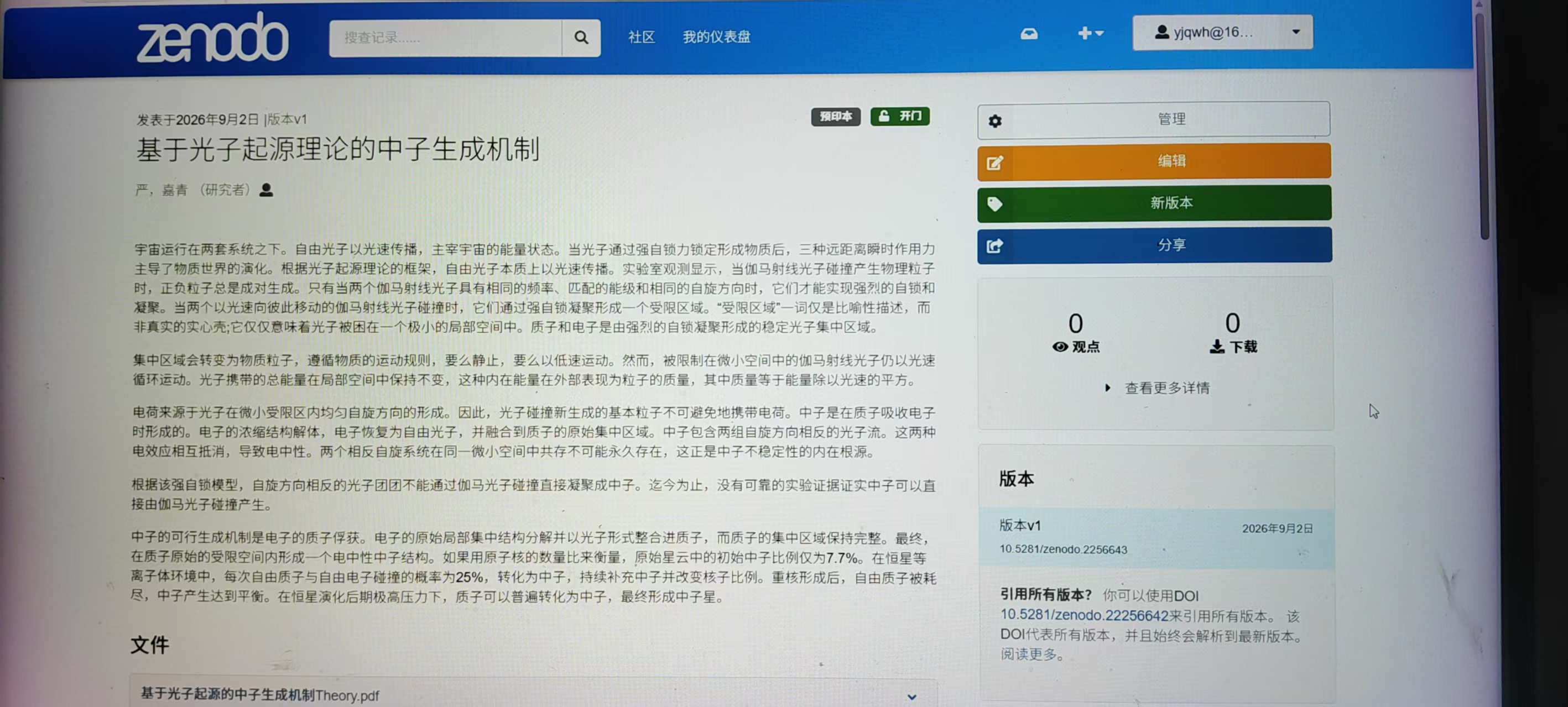 |
 回复此楼
» 猜你喜欢
 征友后感触
已经有10人回复
-
考博求助
已经有4人回复
-
憎水剂,表面活性剂
已经有3人回复
-
申博
已经有7人回复
-
食品与机械 编辑C处理稿子时间
已经有4人回复
-
注意啦!用基金购买打印纸、硒鼓、优盘、移动硬盘、个人计算机属于违规了
已经有4人回复
