









| 查看: 97 | 回复: 0 | |||
[交流]
206、The Essence of Electric Current
|

|
preprint of cern doi :10.5281/zenodo.21933372 or https://doi.org/10.5281/zenodo.21933372 my academic identifier: orcid id: 0009-0005-2185-5790. you may go to the official academic website to retrieve and view relevant research content. readers may copy this number to search on the official zenodo website (search by english title or english keywords) to view the full english and chinese pdf texts. Abstract Basic physics education defines electric current in metallic conductors as the long-distance directional migration of free electrons carrying negative electric charges. This simplified model only applies to basic circuit numerical calculations and fails to resolve the objective contradiction between the extremely slow drift velocity of electrons and the near-light-speed propagation of electrical signals. The Poynting vector theory has definitively verified that energy is the core medium capable of doing work in circuits. Based on this universally recognized conclusion, this paper integrates the microstructural differences between conductors and insulators, the complete mechanism of human electric shock, and the full reversible electromechanical energy conversion processes of generators and motors to construct a logically consistent and complete unified theoretical system of electromagnetic energy. Conventional solid substances are composed of only three fundamental particles: protons, neutrons, and electrons. Protons and neutrons are tightly bound by atomic nuclei and crystal lattices and cannot participate in energy transfer. Metal conductors such as copper and aluminum contain abundant free electrons, which act as fixed workstations on a production assembly line and only undergo tiny local offsets without traveling long distances along wires. Insulators like plastics and rubber lack free electron workstations for energy relay, so they cannot conduct electricity. Restricted by the inherent energy level constraints of electrons, energy cannot be transmitted in a continuous diffuse form and must be split into discrete energy units (energy packets) relayed directionally via electron workstations. Electrons possess an intrinsic negative charge property, which generates electric fields and potential differences. On one hand, this property establishes a unified transmission direction for energy packets; on the other hand, it is the root cause of the unique numbness and muscle convulsion sensations experienced during electric shock. The charring and carbonization of human skin and internal organs from electric shock arise from massive energy packets released inside the human body and converted into thermal energy. The higher the voltage, the greater the potential difference, the stronger the spatial electric field intensity, and the more energy packets transmitted per unit time, resulting in far more severe electric shock injuries, which explains why high-voltage lines are vastly more dangerous than low-voltage circuits. Generators and motors are reversible electromechanical devices sharing an identical magnetic field conversion mechanism. The air gap between the stator and rotor only transmits magnetic field interaction forces and does not convey any energy or energy packets. Driven by external mechanical kinetic energy, generators produce relative magnetic field cutting, which first converts mechanical energy into continuous stator magnetic field energy, then decomposes such field energy into line energy packets for external output. Motors receive line energy packets, convert them into dynamic magnetic field energy inside stator coils, and generate electromagnetic force through stator-rotor magnetic field coupling to pull the rotor and output mechanical kinetic energy. All load phenomena including light bulbs, resistors, electrolytic devices, and human electric shock essentially stem from different forms of energy transformation after energy packets arrive at the load. This paper strictly distinguishes the three physical boundaries: the intermediate carrier (electrons), the intrinsic particle property (negative charge), and the line transmission medium (energy packets). It uniformly interprets the underlying physical mechanisms of the entire chain including conduction, insulation, power transmission, power generation, electricity consumption, and electric shock. Keywords: electric current; free electrons; energy packets; potential difference; conductors; insulators; electric shock mechanism; generators; motors; magnetic field coupling; electromechanical energy conversion 1 Introduction Existing physical theoretical systems feature numerous fragmented and conceptually confusing points. Primary and secondary school textbooks simply summarize electric current as the directional movement of negative charges, misleading readers into believing electrons travel long distances from the power source to the load. Classical electromagnetism, via the Poynting vector, proves that circuit energy is stored in external electromagnetic fields, yet it fails to elaborate the micro-transmission form of energy between particles after energy enters wires. Textbooks only superficially differentiate conductors and insulators without explaining the underlying differences in conductive capacity combined with energy transfer logic. Meanwhile, they cannot fully and uniformly explain two critical practical questions: First, if only energy is transmitted inside wires, why does human electric shock produce unique numbness and cramping sensations distinct from pure energy impacts such as high-temperature burns or physical collisions? Second, how do generators convert mechanical rotational kinetic energy into line electrical energy, and how do motors convert line energy back into mechanical power? Can the two electromechanical conversion processes follow a unified set of underlying laws? Objective phenomena can directly corroborate the core viewpoint of this paper: the same wire can connect incandescent lamps, resistance wires, motors, and electrolytic devices. Although the transmission medium remains consistent, energy can be converted into light, heat, mechanical rotation, and chemical energy. Only energy possesses the characteristics of multi-morphology transformation and external work delivery. Meanwhile, measured data confirm that the drift velocity of free electrons inside wires is merely millimeters per second, while remote loads activate instantly after the switch is closed, sufficiently proving that long-distance circulating work is not performed by electron entities. This paper integrates the binding characteristics of micro-particles, conductive and insulating transmission mechanisms, the dual effects of electric field and energy during human electric shock, and reversible electromechanical conversion logic into a single complete theory. It conducts comprehensive elaboration based on the Poynting energy conclusion, electromagnetic induction law, and micro-electron energy level rules, eliminating long-standing conceptual misunderstandings in traditional theories. 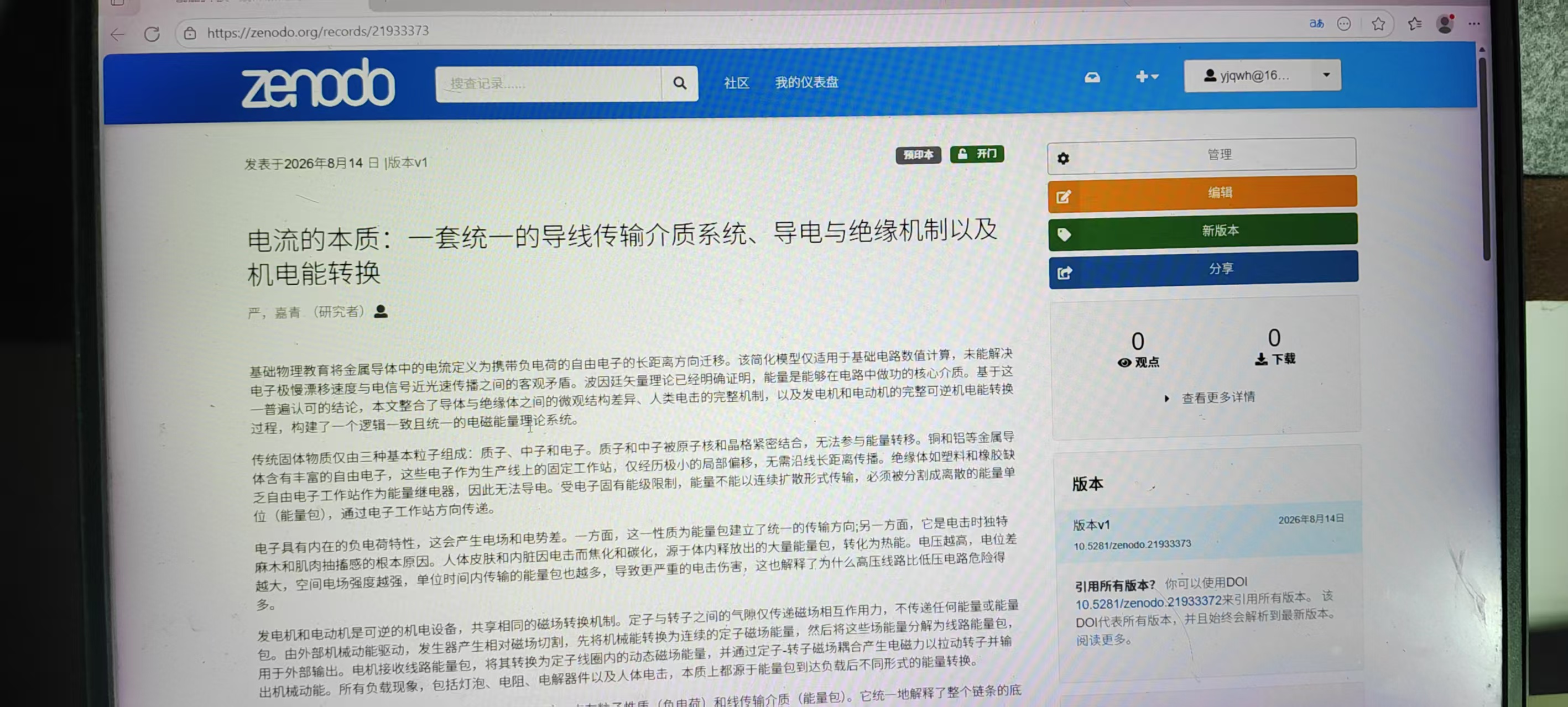 |
 回复此楼
» 猜你喜欢
 售SCI一区文章,我:8.O.551.O.5.4,科目全,可伽急
已经有9人回复
-
售SCI一区T0P文章,我:8O.55.1.O.5.4,科目齐全,可+急
已经有8人回复
-
售SCI-T0P文章,我:8O.5.5.1.O.54,科目齐全,可+急
已经有9人回复
-
售SCI一区T0P文章,我:8.O55.1.O.54,科目全,可十急
已经有6人回复
-
售SCI一区T0P文章,我:8.O.55.1.O.5.4,科目全,可+急
已经有6人回复
-
售SCI一区文章,我:8.O.551.O.5.4,科目全,可伽急
已经有5人回复
-
售SCI一区T0P文章,我:8.O.55.1.O54,科目全,可伽急
已经有5人回复
-
售SCI一区T0P文章,我:8O.55.1.O.5.4,科目齐全,可+急
已经有5人回复
-
27博士
已经有7人回复
-
售SCI文章,我:8O.5.5.1O.54,科目全,可十急
已经有10人回复

