









| 查看: 64 | 回复: 0 | |||
[交流]
205、Research on Energy Conversion Mechanism of Generators
|

|
preprint of cern doi :10.5281/zenodo.21916885 or https://doi.org/10.5281/zenodo.21916885 my academic identifier: orcid id: 0009-0005-2185-5790. you may go to the official academic website to retrieve and view relevant research content. readers may copy this number to search on the official zenodo website (search by english title or english keywords) to view the full english and chinese pdf texts. Abstract Faraday’s law of electromagnetic induction can describe the macroscopic law of induced current generated by magnetic field cutting conductors, yet it fails to reveal the microscopic process of electromagnetic energy conversion. Taking the change of electron potential energy inside conductors as the entry point, this paper analyzes the physical process of energy generation in generators, and successively discusses the energy conversion paths of motors, transformers and incandescent lamps. The study shows that free electrons inside conductors are inherent components of matter, and no new charges are generated during the operation of electromagnetic systems. Generators do work on electrons through magnetic fields to raise electron potential energy, and energy is transmitted along wires in a directional manner relying on the interaction between adjacent electrons. This energy exists as bound energy packets locked by the electron system, which conduct directionally along lines without outward divergence, thoroughly negating the wrong viewpoint that energy is transmitted by external electromagnetic waves outside wires. Bound energy packets travel strictly directionally inside circuits, with a conduction mode analogous to light beams confined by optical fibers, and can only flow along conductor channels without arbitrary diffusion into surrounding space. When there is an imbalance between power supply and demand in the power grid or phase deviation occurs during unit grid connection, accumulation and collision of bound energy packets will appear, which are macroscopically manifested as heating of lines and coils, as well as large impulse currents. After reaching different loads, energy is converted into mechanical energy and photon radiant energy respectively, forming a complete chain of electromagnetic energy conversion. Keywords generator; magnetic field cutting; electron potential energy; directional energy transfer; bound energy packet; internal conductor conduction; electric motor; transformer; photothermal energy release; optical fiber light transmission analogy; grid synchronization; Joule heat under unbalanced load Introduction Since the discovery of electromagnetic induction, relevant theories have been widely applied in power generation, power transmission and electromechanical drive fields. Conventional electromagnetic theories focus on establishing macroscopic quantitative relations, lacking a unified microscopic description of energy transmission paths inside conductors and the internal physical connections between various electromagnetic devices. Moreover, traditional theories mistakenly hold that circuit energy propagates via electromagnetic waves outside wires, deviating from the real microscopic energy transmission path. In addition, existing electromagnetic theories only provide macroscopic calculation formulas for Joule heat and grid synchronization, without explaining heating and current impact caused by overload and phase misalignment from the perspective of energy carriers. As the source of electric energy supply, the energy conversion process of generators has a continuous energy flow relationship with transformers, motors, electrical loads and large interconnected power grids. Starting from the power generation process of generators, this paper sorts out the energy conversion mechanism of various electromagnetic devices layer by layer, refines the energy propagation path inside wires, and establishes a coherent electromagnetic energy conversion model. Meanwhile, optical fiber light conduction is introduced as an intuitive reference to clearly distinguish two completely different forms of energy motion: "bound directional transmission" and "free scattering propagation in space", which verifies the core viewpoint that electric energy is only transmitted inside conductors. Combined with two engineering scenarios including grid connection of large power stations and power load regulation, this paper explains practical phenomena such as heating and phase matching synchronization with the bound energy packet model, and improves the correspondence between the theory and industrial reality. 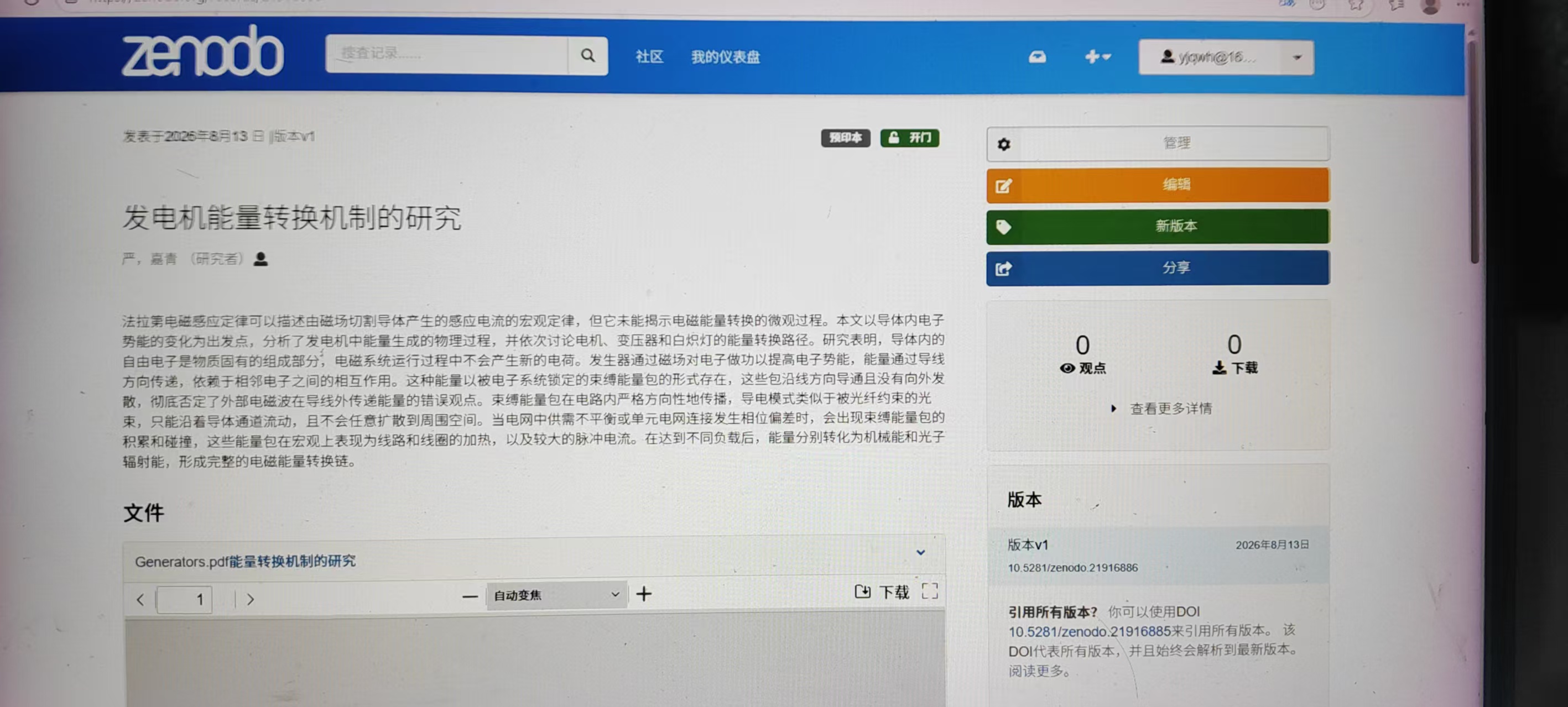 |
 回复此楼
» 猜你喜欢
 售SCI一区文章,我:8.O.551.O.5.4,科目全,可伽急
已经有9人回复
-
售SCI一区T0P文章,我:8O.55.1.O.5.4,科目齐全,可+急
已经有8人回复
-
售SCI-T0P文章,我:8O.5.5.1.O.54,科目齐全,可+急
已经有9人回复
-
售SCI一区T0P文章,我:8.O55.1.O.54,科目全,可十急
已经有6人回复
-
售SCI一区T0P文章,我:8.O.55.1.O.5.4,科目全,可+急
已经有6人回复
-
售SCI一区文章,我:8.O.551.O.5.4,科目全,可伽急
已经有5人回复
-
售SCI一区T0P文章,我:8.O.55.1.O54,科目全,可伽急
已经有5人回复
-
售SCI一区T0P文章,我:8O.55.1.O.5.4,科目齐全,可+急
已经有5人回复
-
27博士
已经有7人回复
-
售SCI文章,我:8O.5.5.1O.54,科目全,可十急
已经有10人回复

