









| 查看: 64 | 回复: 0 | |||
[交流]
202、On the Essence of Circuit Transmission
|

|
preprint of cern doi :10.5281/zenodo.21910691 or https://doi.org/10.5281/zenodo.21910691 my academic identifier: orcid id: 0009-0005-2185-5790. you may go to the official academic website to retrieve and view relevant research content. readers may copy this number to search on the official zenodo website (search by english title or english keywords) to view the full english and chinese pdf texts. Abstract For more than one hundred years, classical electricity has adopted the model of “energy transfer through electron collision and kinetic energy transmission” to explain circuit energy transmission, terminal luminescence, heat generation and mechanical work. This theoretical framework contains a long neglected fundamental logical defect: kinetic energy is merely a physical quantity describing the state of object motion rather than an independent substantial energy entity, and it lacks the physical basis for direct conversion into photons. If circuits transmit electron kinetic energy, radiation of photons at terminals would mean converting a motion state descriptor into substantial photons, which is an unfeasible conversion path. Even if such conversion is hypothetically permitted, resources available for conversion inside terminals would continuously dissipate with persistent photon emission and soon become exhausted. Nevertheless, lamps and electric motors can operate continuously for long periods in reality without spontaneous energy depletion, which directly disproves the kinetic energy transmission model. Based on the Theory of Light Origin, this paper reconstructs the micro mechanism of circuit conduction. The transmitted entity in circuits consists of discrete, volume free photon energy packets propagating at the speed of light. Electrons inside conductors keep high speed spin at fixed positions and only act as relay media for transferring energy packets without long range displacement or kinetic energy transfer via collision. Metals such as copper and aluminium possess weakly bound, highly active electrons that facilitate smooth transfer of energy packets, whereas electrons in insulators are tightly bound and cannot participate in relay transmission. All electrical terminals are pure energy converters without intrinsic energy storage. Upon continuous arrival of homogeneous photon energy packets, different energy forms including visible light, infrared heat and mechanical kinetic energy are generated according to micro structural differences of terminal carriers. Organic materials suffer molecular cleavage and carbonization when their lattice structures cannot withstand high energy conversion. Terminal failure never arises from interrupted energy supply, but from lattice fatigue, aging, fusing and wear of solid carriers under long term high energy conversion impact. Replacing damaged carriers restores energy conversion. This paper clarifies the physical nature of kinetic energy, resolves the logical paradox of kinetic photon conversion, and achieves self consistent unification of theories on electrical conduction, photon radiation and energy transformation. Keywords: Theory of Light Origin; photon energy packet; circuit conduction; electron relay medium; physical essence of kinetic energy; energy converter; terminal carrier loss 1. Introduction For centuries, classical conduction theory has taken kinetic energy transfer by colliding electrons as the underlying mechanism of circuit energy transmission, while evading the most fundamental question: what exactly is kinetic energy, and can kinetic energy convert directly into photons? Kinetic energy is a physical descriptor quantifying motion intensity. It is an attribute generated by motion instead of an independent substantial energy entity. Kinetic energy cannot exist separately from moving objects and vanishes once motion ceases. According to conventional deduction, wires transmit electron kinetic energy which converts into radiated photons at filament terminals. Two insurmountable contradictions emerge immediately. First, kinetic energy is a state description quantity without substantial carrier. No physical channel permits direct conversion from state describing quantities into substantial photons. Second, hypothetically allowing kinetic to photon conversion, photons continuously escape from terminals through radiation. Without external energy replenishment, convertible resources inside terminals will keep decreasing and become depleted rapidly. Lights should go out almost instantly. Actual observations contradict this prediction. Electric lamps can burn for thousands of consecutive hours and motors run for dozens of days as long as power supply remains stable. It firmly proves that wires never transmit electron kinetic energy. From the perspective of the Theory of Light Origin, the continuously flowing entity in circuits is externally supplied photon energy packets. Electrons serve as fixed relays transferring energy packets. Terminals act merely as conversion channels that transform incoming photon energy packets into light, heat and mechanical power without consuming internal resources to produce photons. Equipment shutdown results from degradation of solid carriers rather than energy exhaustion. This paper decomposes the physical attributes of kinetic energy, identifies conversion barriers between kinetic energy and photons, and establishes a fully self consistent theory of circuit energy transmission. 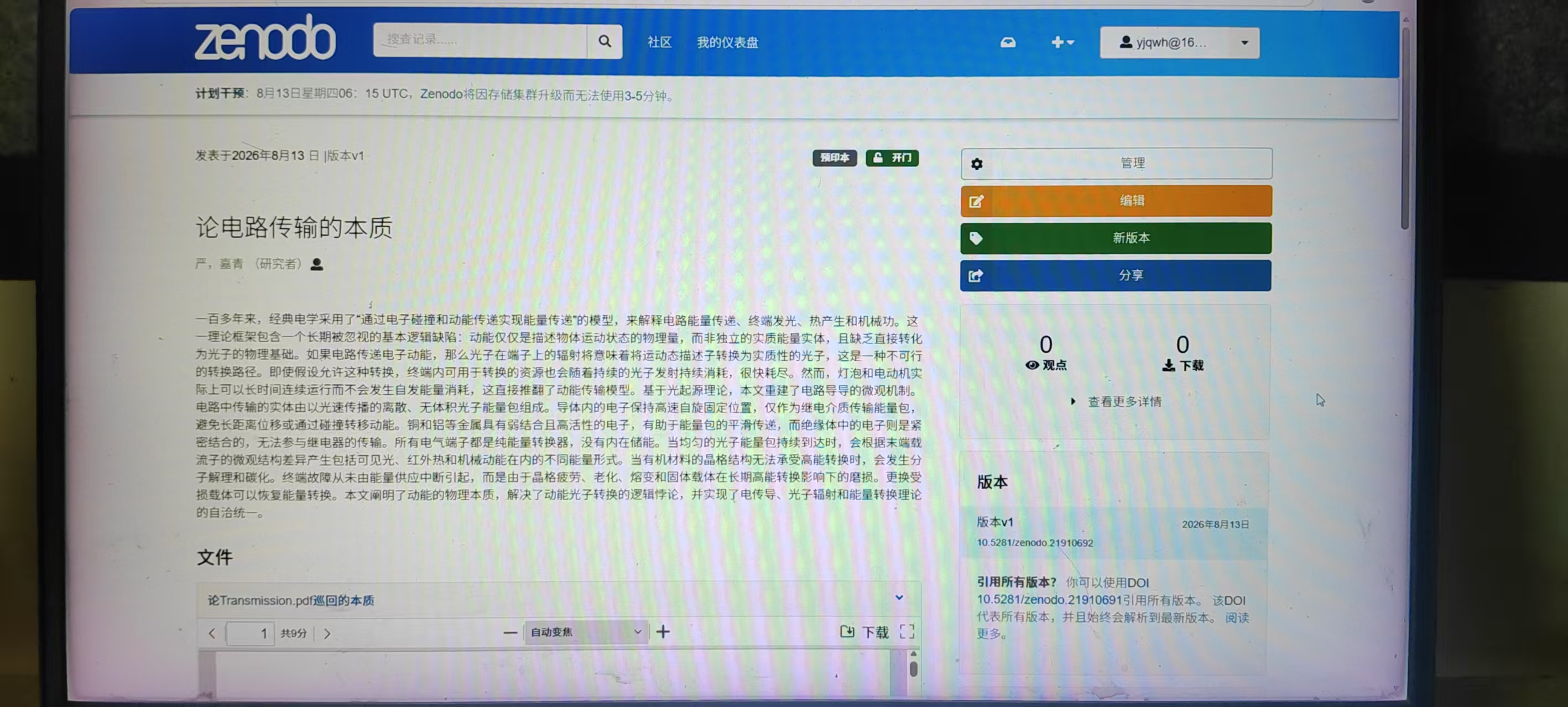 |
 回复此楼
» 猜你喜欢
 售SCI一区文章,我:8.O.551.O.5.4,科目全,可伽急
已经有9人回复
-
售SCI一区T0P文章,我:8O.55.1.O.5.4,科目齐全,可+急
已经有8人回复
-
售SCI-T0P文章,我:8O.5.5.1.O.54,科目齐全,可+急
已经有9人回复
-
售SCI一区T0P文章,我:8.O55.1.O.54,科目全,可十急
已经有6人回复
-
售SCI一区T0P文章,我:8.O.55.1.O.5.4,科目全,可+急
已经有6人回复
-
售SCI一区文章,我:8.O.551.O.5.4,科目全,可伽急
已经有5人回复
-
售SCI一区T0P文章,我:8.O.55.1.O54,科目全,可伽急
已经有5人回复
-
售SCI一区T0P文章,我:8O.55.1.O.5.4,科目齐全,可+急
已经有5人回复
-
27博士
已经有7人回复
-
售SCI文章,我:8O.5.5.1O.54,科目全,可十急
已经有10人回复

