









| 查看: 69 | 回复: 0 | |||
[交流]
196、A New Interpretation of Transient Resonance Signals
|

|
preprint of cern doi :10.5281/zenodo.21837298 or https://doi.org/10.5281/zenodo.21837298 my academic identifier: orcid id: 0009-0005-2185-5790. you may go to the official academic website to retrieve and view relevant research content. readers may copy this number to search on the official zenodo website (search by english title or english keywords) to view the full english and chinese pdf texts. Abstract High-energy electron-positron collision experiments continuously detect abundant transient high-energy resonance signals. Among them, high-energy peaks represented by the X(2370) structure are interpreted within mainstream paradigms as core evidence for glueballs, supporting the gluon-binding theory of quantum chromodynamics. Breaking away from conventional particle-physics models, this paper adopts the frameworks of the photon-origin theory, photon self-lock configuration, energy-threshold rules and survivorship-bias screening for material persistence to reconstruct a self-consistent underlying interpretation of experimental observations. This paper proposes a strict persistence-threshold screening rule governing cosmic material systems: all material structures are formed by photon self-locking. Only configurations matching specific energy-threshold ranges and standard charge states can persist stably over long periods. The long-lived material forms are limited to positive-/negative-electrons, positive-/negative-protons, and positive-/negative-neutrons. All transient photon clusters generated in high-energy collisions, regardless of their energy scale or size, are unstable transitional structures that rapidly disintegrate back into free photons. The transient high-energy structure X(2370) has an energy of 2370 MeV, approximately 2.5 times the rest-energy of a proton (938 MeV). This experimental fact demonstrates that gamma-ray photons produced by electron-positron annihilation can gain substantial energy through successive collisions, easily exceeding the energy thresholds of protons and neutrons. The conventional assumption that electron-positron collisions cannot reach proton-forming energy levels contradicts experimental data. Even when collision energies exceed the threshold for proton generation, stable protons are not observed to form. Reasonable inference suggests that the limiting factor is insufficient matching of internal photon self-lock configurations and unfavorable transient-collision environmental constraints rather than insufficient energy. Meeting the energy threshold is a necessary but not sufficient condition for stable-proton formation. Publicly available experimental literature does not report whether protons are produced within this high-energy channel, leaving potential observational gaps caused by paradigm-driven interpretation. Based on experimental data, this paper proposes prospective directions for improved experimental observation, offering a new self-consistent theoretical framework for research into particle origins and matter-formation mechanisms while preserving an independent physical interpretation. Keywords photon origin theory; photon self lock; energy threshold; survivorship bias; transient high energy cluster; electron positron collision; matter formation mechanism Introduction Modern high energy physics experiments using electron positron and proton collisions continuously capture transient resonance peak signals. Mainstream theories assign new particle identities to each short lived energy peak, introducing hypotheses such as gluons, glueballs and numerous short lived hadronic resonances and constructing an elaborate, complex particle spectrum. Traditional paradigms exhibit fundamental logical inconsistencies: many designated “new particles” lack long term persistence, cannot reconstruct macroscopic matter, and participate in no conventional material evolution, existing only for extremely brief instants during collisions. Whether such ephemeral structures merit designation as independent particles remains an open academic question. Furthermore, conventional theories cannot unify explanations for material origins. They fail to explain why electrons, protons and neutrons persist stably while all other high energy structures decay rapidly, nor can they clarify energy evolution limits and boundary conditions for matter formation in electron positron collision systems. Using public experimental data for the X(2370) high energy resonance from the BES Ⅲ detector, this paper takes photon self locking as the sole underlying logic combined with survivorship bias screening to reinterpret the physical nature of transient collision signals. It clarifies causal chains connecting energy gain, photon self locking and stable matter formation, objectively analyzes observational blind spots and limitations within existing paradigms, and proposes directions for future experimental verification. 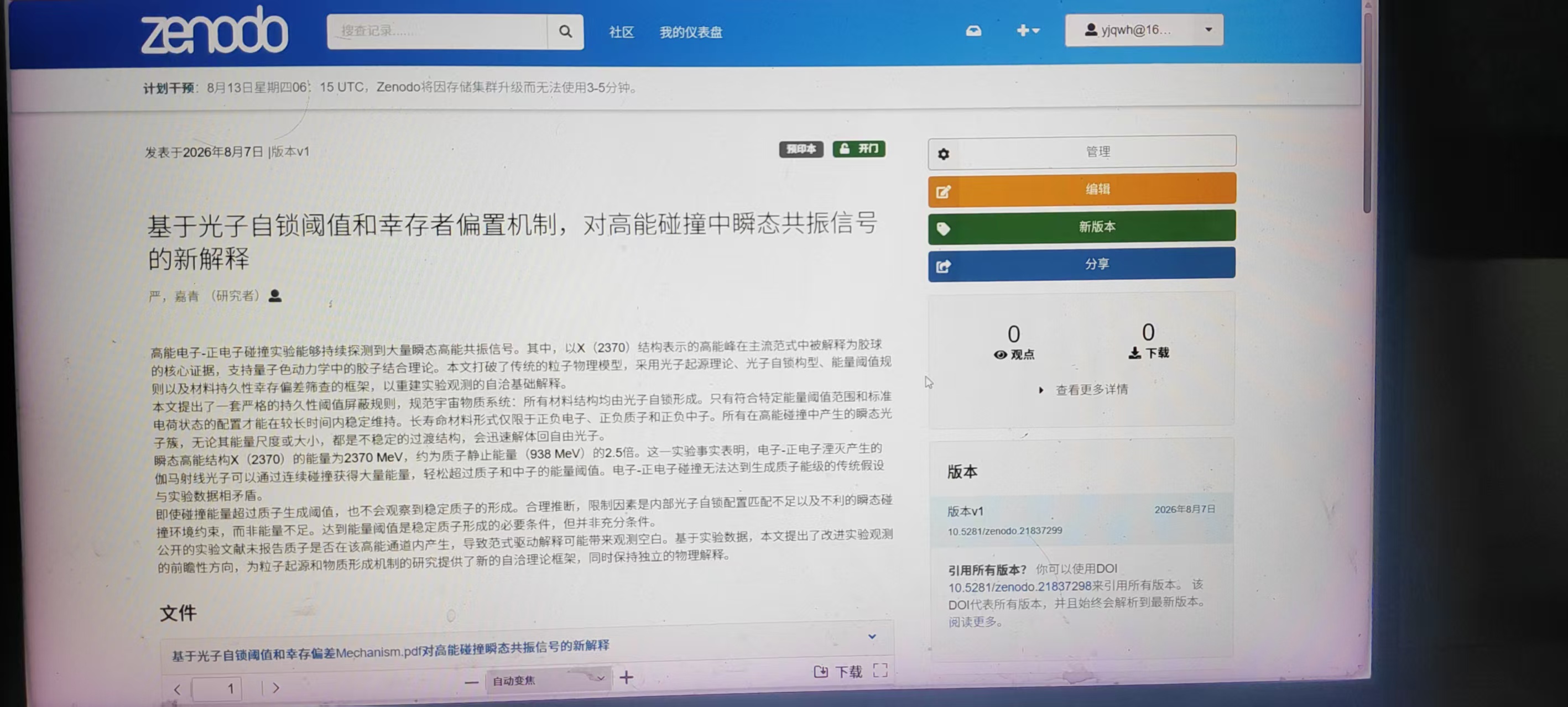 |
 回复此楼
» 猜你喜欢
 售一区SCI文章T0P,我:8O.551.O54,科目全,可十急
已经有3人回复
-
售SCI一区文章,我:8.O.551.O.5.4,科目全,可伽急
已经有3人回复
-
售SCI一区T0P文章,我:8.O55.1.O.54,科目全,可十急
已经有3人回复
-
售SCI一区T0P文章,我:8O.55.1.O.54,科目全,可伽急
已经有4人回复
-
售SCI一区T0P文章,我:8O.55.1.O.5.4,科目齐全,可+急
已经有3人回复
-
售SCI一区文章,我:8O5.5.1.O5.4,科目全,可伽急
已经有3人回复
-
售SCI一区T0P文章,我:8.O.55.1.O.5.4,科目全,可+急
已经有3人回复
-
售SCI-T0P文章,我:8O.5.5.1.O.54,科目齐全,可+急
已经有3人回复
-
售SCI一区T0P文章,我:8.O.55.1.O.5.4,科目全,可+急
已经有3人回复
-
售一区SCI文章T0P,我:8O.551.O54,科目全,可十急
已经有3人回复

