









| 查看: 73 | 回复: 0 | |||
[交流]
162、Mechanism of Low-Energy Dual Resonant Lattice Coupled Fusion
|

|
preprint of cern doi :10.5281/zenodo.21204200 or https://doi.org/10.5281/zenodo.21204200 my academic identifier: orcid id: 0009-0005-2185-5790. you may go to the official academic website to retrieve and view relevant research content. readers may copy this number to search on the official zenodo website (search by english title or english keywords) to view the full english and chinese pdf texts. Abstract Conventional high-temperature plasma deuterium-tritium fusion relies on ultra-high temperatures of hundreds of millions of degrees and strong magnetic confinement to drive nuclear reactions, which inherently suffers from high operating energy consumption, poor reaction controllability, long-term radioactive activation of chamber materials, and difficulty in achieving stable net energy gain. Based on a unified underlying physical model of electromagnetic fields and space particle coupling, this paper constructs a complete low-energy dual resonant lattice fusion system matched with an optimized external particle feeding engineering scheme. The system adopts an isolated confined structure for single protons under vacuum, and uses zero-angular-momentum coaxial electron incidence to produce neutrons at room temperature. A 0.782 MeV intrinsic energy barrier exists for the conversion of protons and electrons into neutrons in free space; to address this issue, localized coaxial vortex photonic resonant fields are adopted to realize effective mass correction of electrons under specific boundary conditions, whose physical picture is analogous to quasiparticle effects in intense laser fields, without macroscopic high-energy acceleration of electrons. The generated cold neutrons are uncharged and free of Coulomb barriers when contacting protons, enabling spontaneous close-range coupling to form deuterium nuclei with a single reaction releasing 2.22 MeV of intrinsic nuclear binding energy. Compared with conventional deuterium-tritium fusion that releases 17.6 MeV per reaction, the proposed system operates without extreme high-temperature conditions and generates no high-energy activating neutrons. A multi-layer gradient dense spherical dielectric structure is designed to progressively downconvert high-energy photons emitted from nuclear reactions into usable thermal energy via coherent scattering, realizing fully enclosed radiation recovery. The entire particle supply adopts an external independent preparation architecture, where protons and neutrons are directionally fed into the main reaction chamber through vacuum pipelines, greatly simplifying the internal core structure and supporting long-term steady-state continuous operation of the device. Bare deuterium nuclei generated from coupling can be extracted from the chamber, neutralized to form deuterium gas, and deliver dual benefits of power/heat generation and added-value industrial raw materials. The system only uses ordinary water as the basic raw material, featuring safe operation, flexible regulation and low engineering implementation thresholds. Refined engineering practices including precision vacuum chamber machining, coaxial electron beam calibration and particle timing synchronization are reserved for iterative optimization in subsequent applied research. Keywords: dual resonant lattice; zero-angular-momentum incidence; external particle feeding; barrier-free spontaneous coupling; low-energy nuclear fusion; coherent energy downconversion; effective mass correction; quasiparticle effect; deuterium resource utilization; 2.22 MeV; 17.6 MeV 1. Introduction Nuclear fusion is a core research direction for clean energy. For decades, mainstream research has focused on high-temperature magnetically confined deuterium-tritium fusion, whose core logic is to raise particle kinetic energy via extreme high temperatures to overcome Coulomb repulsion between atomic nuclei for fusion energy release. However, this technical path contains structural drawbacks that cannot be fundamentally eliminated. Existing observations of low-energy nuclear reactions confirm that protons capturing neutrons can release nuclear binding energy at room temperature, yet current relevant studies lack a complete self-consistent theoretical framework covering controllable neutron generation, pure low-noise reaction environments, harmless radiation treatment, and steady continuous particle supply. A critical physical bottleneck exists in existing low-energy neutron generation schemes: in an open free vacuum, the total static intrinsic energy of protons and free electrons is lower than the static energy of neutrons, forming a fixed 0.782 MeV energy threshold. Conventional linear accelerators used to boost electron kinetic energy to fill the gap feature bulky equipment and extremely high sustained energy consumption, which completely conflicts with the design goal of room-temperature low-energy fusion. To solve this problem, this paper utilizes localized resonant electromagnetic fields to realize effective mass correction of electrons under specific boundaries, with a physical analogy to quasiparticle behavior in intense laser fields, breaking the energy limit imposed by free vacuum. Integrating microscopic particle coupling mechanisms and external particle feeding engineering layouts, this study establishes a fully closed-loop theory spanning microscopic particle interactions to industrial steady-state operation. Quantitative comparisons of single-reaction energy release between two fusion routes are also carried out to fill gaps in the incomplete theoretical system of low-energy fusion research, providing a complete original theoretical support for a new generation of low-cost, high-safety controllable nuclear fusion. 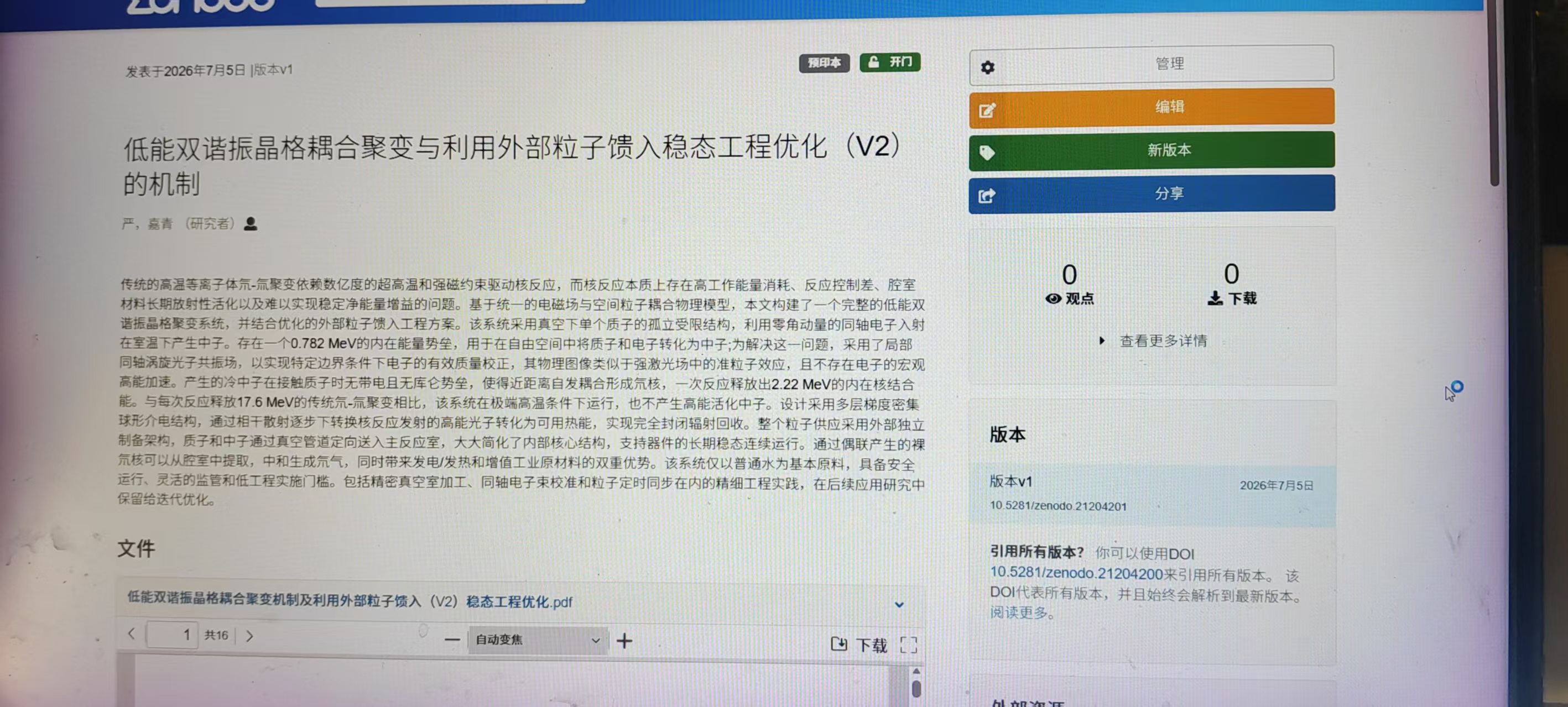 |
 回复此楼
» 猜你喜欢
 售一区SCI文章T0P,我:8O.551.O54,科目全,可十急
已经有5人回复
-
售SCI一区T0P文章,我:8.O55.1.O.54,科目全,可十急
已经有8人回复
-
售SCI一区T0P文章,我:8O.55.1.O.54,科目全,可伽急
已经有9人回复
-
售SCI-T0P文章,我:8O.5.5.1.O.54,科目齐全,可+急
已经有4人回复
-
售SCI一区T0P文章,我:8.O.55.1.O.54,科目齐全,可+急
已经有9人回复
-
售SCI一区文章,我:8.O.55.1.O.54,科目齐全,可伽急
已经有11人回复
-
售SCI文章,我:8O5.5.1.O.54,科目齐全,可+急
已经有13人回复
-
售SCI一区T0P文章,我:8.O.55.1.O.5.4,科目全,可+急
已经有6人回复
-
售SCI一区T0P文章,我:8O.55.1.O.5.4,科目齐全,可+急
已经有7人回复
-
售SCI一区T0P文章,我:8O.55.1.O.54,科目全,可伽急
已经有9人回复
