









| 查看: 35 | 回复: 0 | |||
[交流]
87、New Hypothesis on Polarization Mechanism Based on Photon Spin Matching
|

|
Preprint of CERN doi :10.5281/zenodo.20361477 or https://doi.org/10.5281/zenodo.20361477 My academic identifier: orcid id: 0009-0005-2185-5790. You may go to the official academic website to retrieve and view relevant research content. Readers may copy this number to search on the official zenodo website (search by English title or English keywords) to view the full English and Chinese pdf texts. Abstract Aiming at the controversies between traditional interpretations of polarization optics and mainstream theoretical explanations of the quantum entanglement CHSH experiment, this paper proposes a new physical hypothesis: the light transmission and blocking effects of polarizers are essentially the direction-matching screening effect between the intrinsic spin direction of photons and the atomic arrangement structure of the polarizer grating. Photon spin direction and the atomic barrier exhibit a 90° directional interaction switching: weak interaction and transmission when parallel, strong interaction and blocking when deflected 90° perpendicular, and recovery of transmission when rotated another 90°. The CHSH experiment, currently used to prove the existence of quantum entanglement, does not verify superluminal quantum correlation, quantum state superposition, collapse, or other theories. Its experimental phenomena entirely stem from the intrinsic opposite spin-matching property of photon pairs at the moment of generation. Like electron-positron pairs, photons naturally carry opposite spin states when excited in pairs. Polarization detection is only the screening and observation of the pre-existing spin states of photons, rather than a measurement that alters the quantum state of photons. Based on this, all polarization experiments and CHSH observations can be reasonably explained by a classical microscopic spin mechanism, avoiding the logical paradox of action-at-a-distance in quantum entanglement theory. Keywords: photon spin; polarization mechanism; direction matching; 90° interaction switching; atomic barrier; CHSH experiment; quantum entanglement; photon pair generation 1. Introduction In modern physics, polarization optics is regarded as core experimental support for quantum entanglement. CHSH inequality experiments have long been recognized by the mainstream academic community as key evidence proving the existence of quantum entanglement and negating local hidden-variable theories. Mainstream theories hold that paired photons have a superluminal quantum entanglement correlation, and measuring the polarization state of one photon instantly collapses the quantum state of its distant partner, forming the core theoretical system of quantum entanglement and wave-particle duality. However, this theory always has unavoidable fundamental logical flaws: there is no natural absolute coordinate system in the universe; horizontal, vertical, and other polarization reference directions are all human-defined observational coordinates, and photons cannot change their physical states relying on artificial coordinates. Meanwhile, although modern technology can achieve precise single-photon emission and observation, basic verification experiments on the intrinsic vibration and spin states of photons are still lacking. Mainstream theories have long deduced abstract conclusions such as quantum superposition and action-at-a-distance from observational phenomena, without exploring the essential microscopic physical mechanism behind the phenomena. Based on the above, this paper proposes a spin-matching hypothesis, abandons assumptions such as quantum entanglement action-at-a-distance and quantum state collapse, takes the intrinsic spin direction of photons as the core, combines the mechanism of atomic barriers and 90° directional interaction strength switching, and reinterprets the polarization mechanism and CHSH experimental phenomena, providing a more self-consistent classical physical explanation for related microscopic optical phenomena. 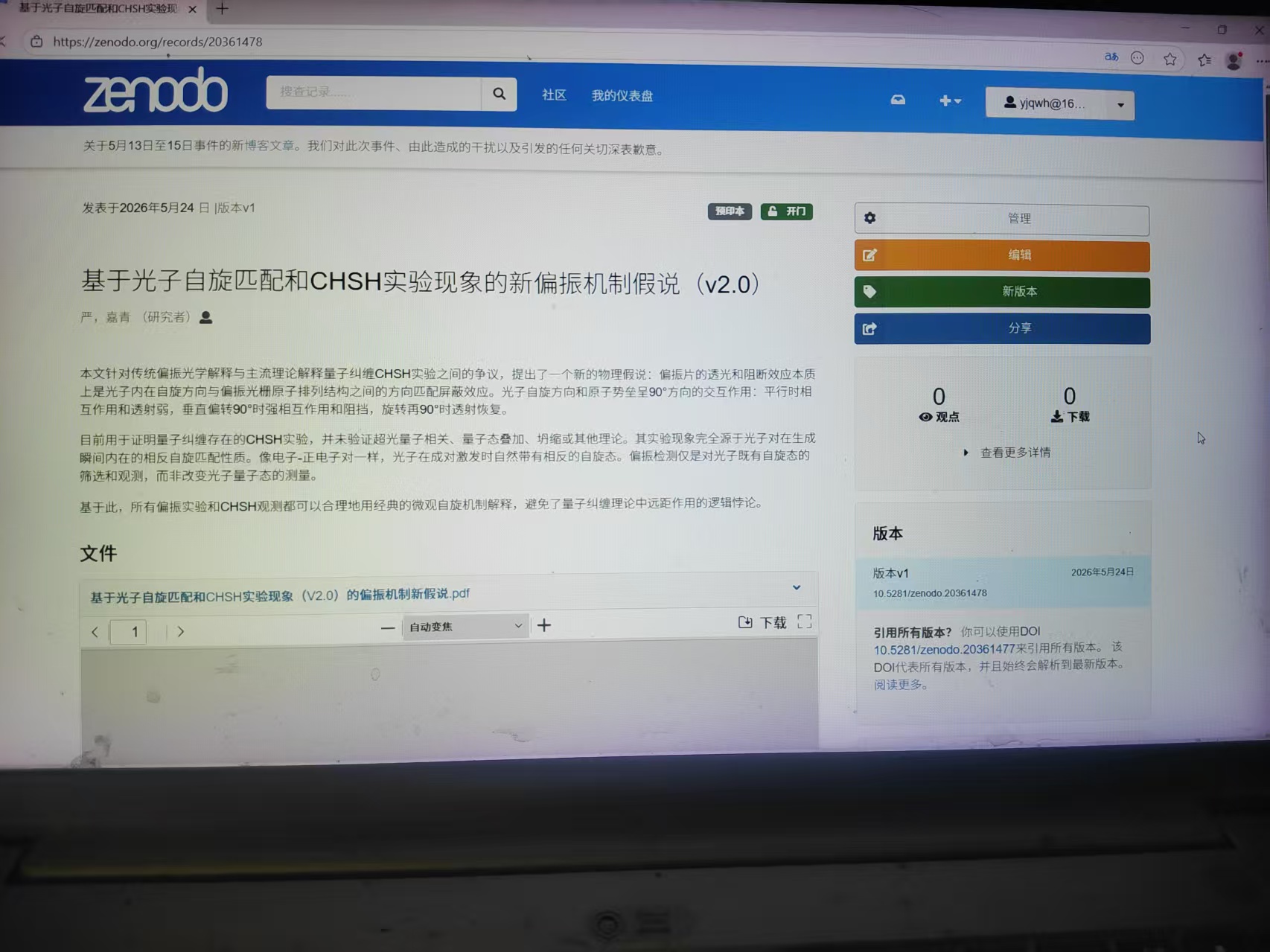 |
 回复此楼
回复此楼» 猜你喜欢
 我应该选哪条合成路线让实验成功率高一些?
已经有8人回复
我应该选哪条合成路线让实验成功率高一些?
已经有8人回复
-
烦躁
已经有8人回复
-
入职后第一次管课题组的专利缴费,对账才发现官费比别人多掏了一倍
已经有3人回复
-
各位大佬,路线设计求助
已经有7人回复
