









| 查看: 64 | 回复: 0 | |||
[交流]
75、Reconstruction of Galactic Dynamics Based on the Mutual Gravitational
|

|
Preprint of CERN doi :10.5281/zenodo.20107840 or https://doi.org/10.5281/zenodo.20107840 My academic identifier: orcid id: 0009-0005-2185-5790. You may go to the official academic website to retrieve and view relevant research content. Readers may copy this number to search on the official zenodo website (search by English title or English keywords) to view the full English and Chinese pdf texts. Abstract Current research in galactic dynamics commonly adopts the single center gravitational model developed for the solar system, which is well justified and highly accurate within the solar system. This paper shows through comparative analysis that the validity of the solar system model arises from the highly concentrated central mass: the Sun accounts for 99.86% of the total mass of the solar system, so the single center approximation reliably describes planetary motion. In the Milky Way and spiral galaxies, however, matter is diffusely distributed, and the central mass fraction is far too low to justify the single center approximation. Directly extending the solar system model to galactic scales—while ignoring mutual gravitational interactions between stars, universal gravitational superposition, and chain dragging between adjacent stars—leads to systematic discrepancies between theoretical calculations and observations, and has indirectly motivated hypothetical concepts such as dark matter. Based on the fundamental law of universal gravitation, this paper presents a galactic dynamics model incorporating universal gravitational superposition and chain dragging. The model demonstrates that the motion of outer stars is dominated by gravity from nearby stars, with distant gravity playing only a secondary role; spiral arm structures in spiral galaxies arise naturally from nearby gravitational dragging; and the long term stability and integrity of galaxies are maintained by chain like constraints in which inner layers pull middle layers, and middle layers pull outer layers. The model can be implemented via numerical simulation, uses no unseen matter or free parameters, and relies only on visible matter and classical gravity to explain key observational features including flat rotation curves and stable spiral arms. It thus provides a physically consistent framework for galactic dynamics research. Keywords: galactic dynamics; single center model; gravitational superposition; stellar interaction; chain dragging; spiral arm structure; numerical simulation 1. Introduction The theory of planetary motion in the solar system has achieved great success within classical gravity, with a simple structure, stable calculations, and excellent agreement with observations. Influenced by this successful framework, modern galactic dynamics often uses the single center gravitational approach of the solar system. However, celestial systems at different scales differ sharply in mass distribution, structure, and dominant gravitational behavior, so the applicability of the same model deserves careful examination. Starting from basic physical facts, this paper compares the mass distributions of the solar system and galaxies, analyzes the limitations of the traditional model across different systems, identifies the problems of directly extending the solar system model to galactic scales, and develops a more realistic dynamical framework that includes short range chain dragging, universal gravitational superposition, and the formation mechanism of spiral arms. 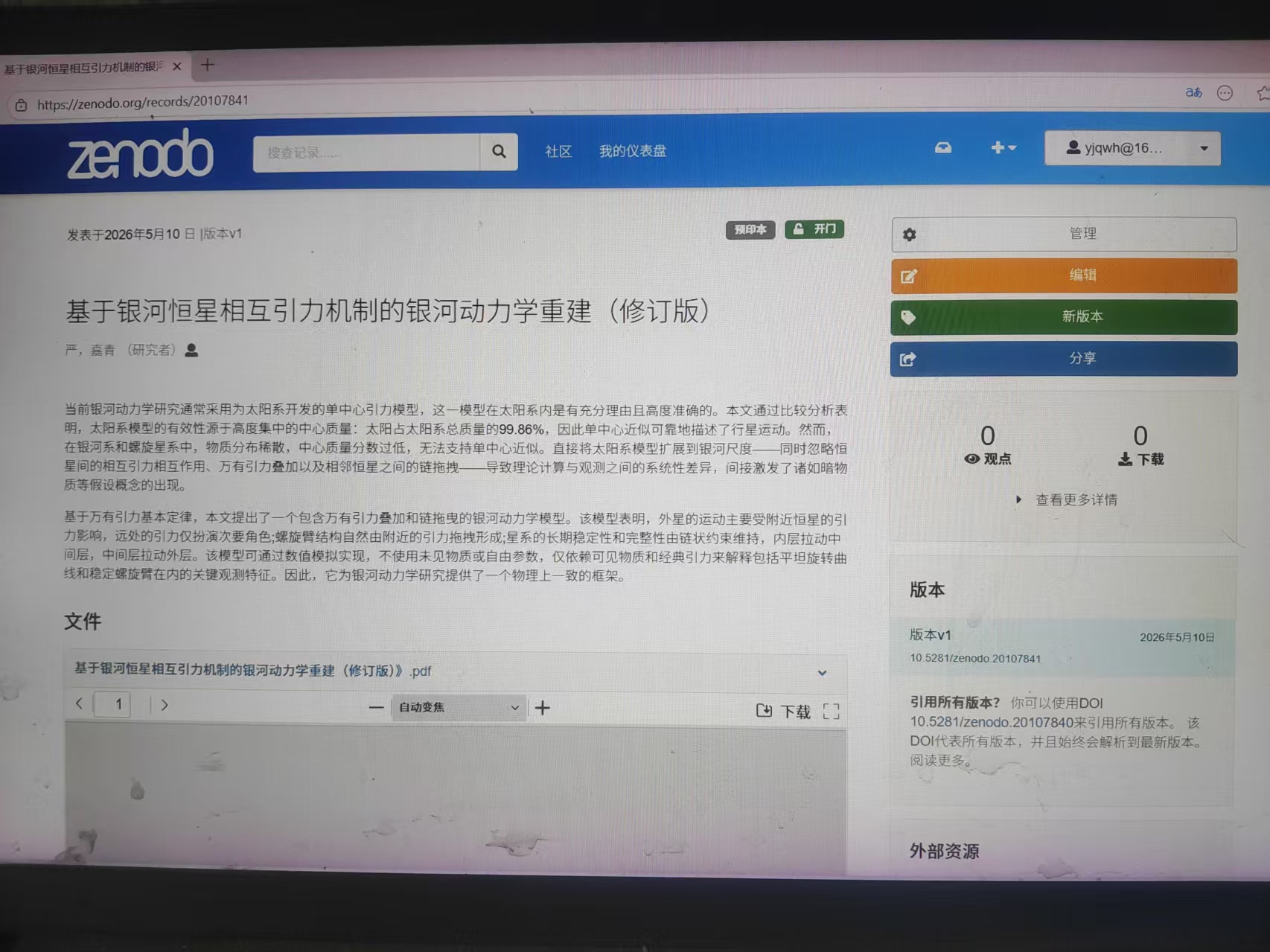 |
 回复此楼
回复此楼» 猜你喜欢
 售SCI一区文章,我:8.O.551.O.5.4,科目全,可伽急
已经有3人回复
售SCI一区文章,我:8.O.551.O.5.4,科目全,可伽急
已经有3人回复
-
售SCI一区T0P文章,我:8.O.55.1.O.54,科目齐全,可+急
已经有3人回复
-
售一区SCI文章T0P,我:8O.551.O54,科目全,可十急
已经有3人回复
-
售SCI一区T0P文章,我:8.O.55.1.O.54,科目齐全,可+急
已经有3人回复
-
售SCI一区T0P文章,我:8.O.55.1.O54,科目全,可伽急
已经有3人回复
-
售SCI一区文章,我:8O5.5.1.O5.4,科目全,可伽急
已经有3人回复
-
售SCI文章,我:8O.5.5.1O.54,科目全,可十急
已经有3人回复
-
售一区SCI文章T0P,我:8O.551.O54,科目全,可十急
已经有3人回复
-
售SCI一区T0P文章,我:8.O55.1.O.54,科目全,可十急
已经有9人回复
-
售SCI一区T0P文章,我:8O.55.1.O.5.4,科目齐全,可+急
已经有8人回复

