









| 查看: 70 | 回复: 0 | |||
[交流]
56、Mechanism of Supernova Explosion and Neutron Star Formation
|

|
Preprint of CERN doi :10.5281/zenodo.19692513 or https://doi.org/10.5281/zenodo.19692513 My academic identifier: orcid id: 0009-0005-2185-5790. You may go to the official academic website to retrieve and view relevant research content. Readers may copy this number to search on the official zenodo website (search by English title or English keywords) to view the full English and Chinese pdf texts. Abstract Current mainstream theories of astrophysics generally explain the late collapse of massive stars, neutron star formation, and supernova explosions based on quantum effects such as electron degeneracy pressure. However, existing models suffer from logical inconsistencies in dynamic mechanisms, shell structure, and material evolution pathways, failing to systematically describe the complete physical picture of atomic disruption, neutronization, heavy-element synthesis, and mass ejection. This paper abandons quantum resistance hypotheses such as electron degeneracy pressure and takes the spherical gradient of gravitational force as the core driving force. From the perspective of macroscopic mechanics, we systematically deduce the whole process of stellar core compression, atomic gap collapse, dense arrangement of atomic nuclei, loss of electron motion space, and proton-electron combination to form neutrons. The stellar structure is divided into concentric shells to clarify the stratified evolution: heavy elements are synthesized in the high-pressure middle layer near the core, while the outer layer retains primordial material. The model is verified by observational evidence of SN 1987A. It is self-consistent and consistent with observations, remedying the ambiguities of shell division and heavy-element production mechanisms in current theories. Keywords: Supernova explosion; neutron star; gravitational gradient; atomic collapse; heavy-element synthesis; shell ejection 1. Introduction The late core collapse of massive stars, neutron star formation, and supernova explosions are key processes of cosmic heavy-element production and interstellar matter circulation. Mainstream theories are based on the balance between electron degeneracy pressure and gravity, claiming that collapse occurs when the core mass exceeds the Chandrasekhar limit and degeneracy pressure can no longer resist gravity. This explanation has obvious shortcomings: as a quantum effect, the “sudden failure” of electron degeneracy pressure lacks a clear physical mechanism; existing models insufficiently consider the radial pressure gradient inside stars, making it difficult to uniformly explain the observed pattern of “neutron star at the center, heavy elements in the middle layer, and primordial material ejected from the outer layer”. To address these issues, this paper returns to classical gravity and proposes a gravitational gradient-dominated shell model. Gravity and pressure peak at the core and decrease outward. Different pressure thresholds determine distinct evolutionary paths: the extreme pressure in the core fully collapses atoms and drives neutronization; the middle layer near the core provides sufficient pressure for nuclear rearrangement and heavy-element synthesis; the outer layer has weak gravity and largely retains original structures. The rapid core collapse generates a strong shock wave that ejects stratified material outward, forming a complete supernova explosion scenario. 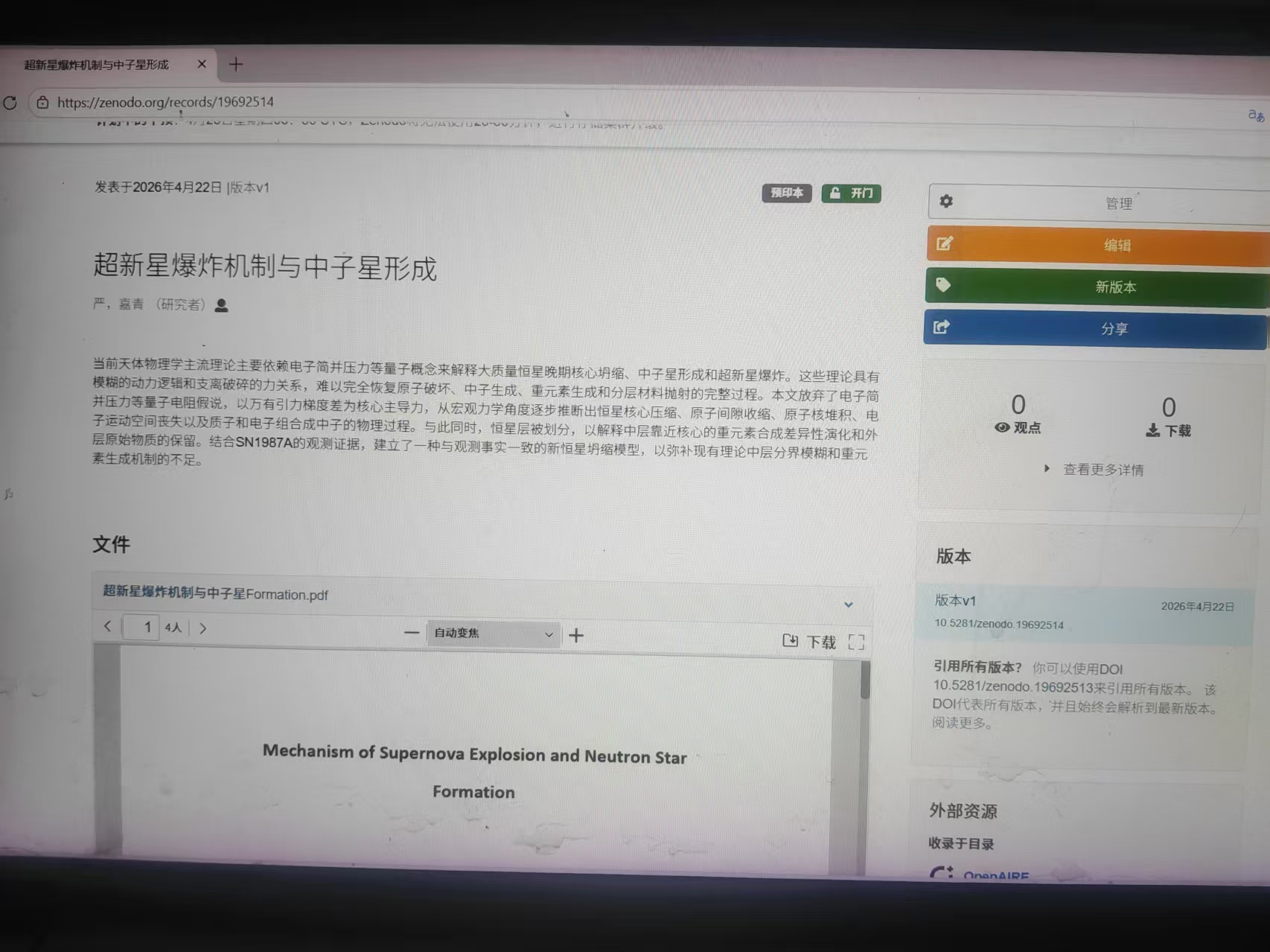 |
 回复此楼
回复此楼» 猜你喜欢
 售SCI一区T0P文章,我:8.O55.1.O.54,科目全,可十急
已经有9人回复
售SCI一区T0P文章,我:8.O55.1.O.54,科目全,可十急
已经有9人回复
-
售SCI一区T0P文章,我:8O.55.1.O.5.4,科目齐全,可+急
已经有8人回复
-
售SCI一区T0P文章,我:8O.55.1.O.54,科目全,可伽急
已经有9人回复
-
售SCI一区T0P文章,我:8O.55.1.O.54,科目全,可伽急
已经有8人回复
-
售SCI一区T0P文章,我:8O.55.1.O.5.4,科目齐全,可+急
已经有7人回复
-
售SCI-T0P文章,我:8O.5.5.1.O.54,科目齐全,可+急
已经有10人回复
-
售一区SCI文章T0P,我:8O.551.O54,科目全,可十急
已经有11人回复
-
售SCI一区T0P文章,我:8.O.55.1.O.5.4,科目全,可+急
已经有8人回复
-
售SCI一区T0P文章,我:8.O.55.1.O.5.4,科目全,可+急
已经有9人回复
-
售SCI一区T0P文章,我:8.O.55.1.O54,科目全,可伽急
已经有13人回复

