









| 查看: 803 | 回复: 0 | |||
[交流]
【文章分享】【带通滤光片】用于激光雷达和天文学的亚纳米带通镀膜
|

|
Sub-nanometer band pass coatings for lidar and astronomy ABSTRACT Ultra-narrow band pass filters are used to maximize lidar range and sensitivity. alternate designs and measured fabrication results are presented for sub-nanometer band pass filters down to quarter nanometer bandwidths with 95% transmission. thermal and angle sensitivity have been minimized. the filters are fabricated using dual source, plasma assisted magnetron sputtering. single and multi-cavity designs are presented. keywords: narrow band pass coatings, lidar, astronomy 1. INTRODUCTION ultra-narrow band pass filters transmit a narrow spectral band and attenuate all other wavelengths. these filters maximize the sensitivity of both laser ranging and astronomical applications. light detection and ranging (often called lidar) is done by reflecting a pulsed laser beam from a target and detecting the round-trip propagation time between the source and the target. combinations of the transit times with position and orientation generate detailed maps of, for example, the earth’s surface1. rapid continuous measurement enables the tracking of moving objects. during a lidar measurement, narrow band filters pass the laser beam while blocking most of the ambient radiation. interference filters always shift to smaller wavelengths with increasing angles of incidence. as a result, narrow filters pass a given wavelength for f/numbers above some limit. three nanometer wide filters can function down to about f/5. sub-nanometer filters operate at large f/numbers with fixed laser wavelengths, but can scan various f/numbers if the laser wavelength is ramped. the narrowest filter rejects more of the solar band and allows for optimal sensitivity. astronomical observations of the sun and planetary nebulae are also enabled by ultra-narrow band filters. in this case, the filters are designed to pass specific absorption/emission lines such as the hydrogen-alpha or calcium-k lines while blocking the continuum generated by the sun and galaxies. filtered images exhibit detailed structures in the sun’s chromosphere and deep sky nebulae2. as with lidar, the f/number of the telescopic optics must be matched with the off-axis performance of the filter. this paper presents the design, fabrication, testing, and performance of sub-nanometer band pass filters down to quarter nanometer bandwidths. the thermal and angular dependences are also discussed. 2. NARROW BANDDESIGNS fabry-perot filters are straightforward designs using two dielectric reflectors (a stack of high/low index quarter wave pairs) surrounding a spacer (composed of multiple half waves) 3,4. a high finesse design will transmit a narrow pass band with high transmission. figure 1 shows the sequence of layers in a typical single cavity design. the overlaid curve depicts the associated run trace that is observed by the monitoring system. the final two layers are optimized to bring peak transmission close to unity ╟ basically an anti-reflecting layer for the stack. multi-cavity designs are used when steeper edge slopes and flat tops are required. these are implemented by depositing a sequence of cavities separated by transition layers. 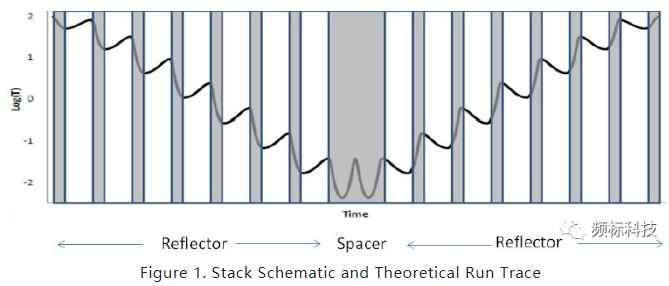 high index spacers and/or higher index quarter wave layers increase the effective index of the stacks, thereby decreasing spectral shifts that occur with increasing angles of incidence. the curves in figure 2 show how the spectral performance changes with f/number for a 1-nm design with a high index spacer. the filter design must clearly be matched to the overall instrument design. our hard oxides also exhibit a small (< 0.003 nm/c) thermal dependence. 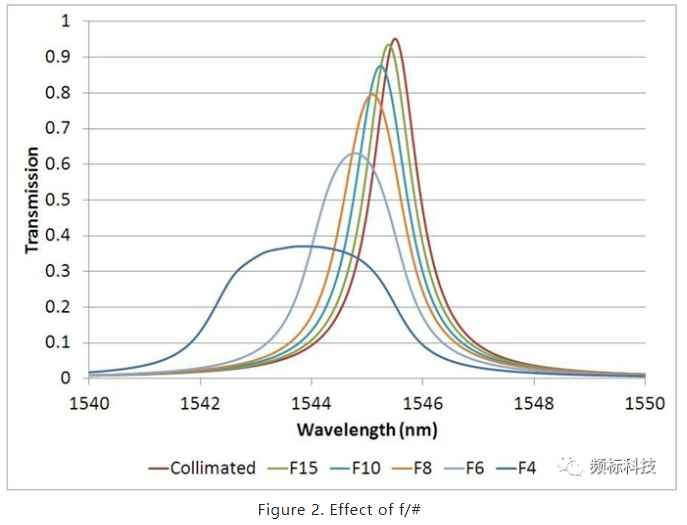 3. NARROW BANDFABRICATION The films in this paper were deposited using two high volume plasma assisted reactive dual magnetron sputtering (parms) systems. these units employ an ion plasma in a reactive dual magnetron process controlled by the latest advancements in programmable logic. the result of this high velocity fabrication, combined with state-of-the-art monitoring capable of in-process self-correction, yields a cost-effective finished product with exceptional uniformity and spectral discrimination. the optical layers produced with these helios systems are of the highest quality, with very low absorption and dispersion. these excellent optical properties are achieved by depositing extremely dense, smooth, stoichiometric and amorphous layers. the precise layer composition is measured on the substrate in-situ by an advanced optical thickness measuring device (oms5000). the filters reported below were fabricated from hard oxides of niobium and silicon on either 130 or 200 mm diameter glass substrates. an automated spectroscopy system maps these plates, showing that center wavelength is uniform to 0.25%. maps of transmission and bandwidth are even more uniform - all due to the control of thickness and index across the substrates. 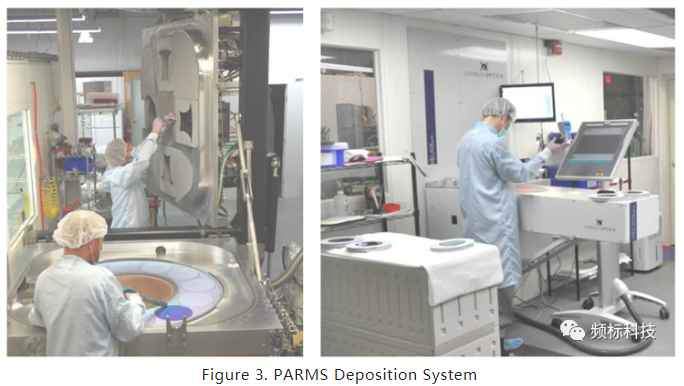 4 NARROW BANDTESTING Ultra-narrow band filters present a formidable challenge to conventional spectrophotometers. these fundamental issues center on the spectral bandwidth and angular distributions within spectrophotometers. the spectral bandwidth is related to the dispersion of gratings, and the angular distribution is constrained by the fact that lamps in these instruments are extended rather than point sources. agilent has explained5 that accurate placement of apertures can reduce the angle of incidence to 0.6 degrees ╟ leaving a 0.05 nm blue shift in filter performance. further, slit width can be reduced and integration times increased to allow for a spectral bandwidth of 0.04 nm. this blue shifting of 0.05 nm and spectral blurring of 0.04 nm make measurements of a 0.25 nm filter rather difficult. we address these issues by using lasers in two ways ╟ as shown in figure 4. a quality laser has a spectral bandwidth approaching a delta function, and a collimated laser’s angular distribution is negligible for these purposes. 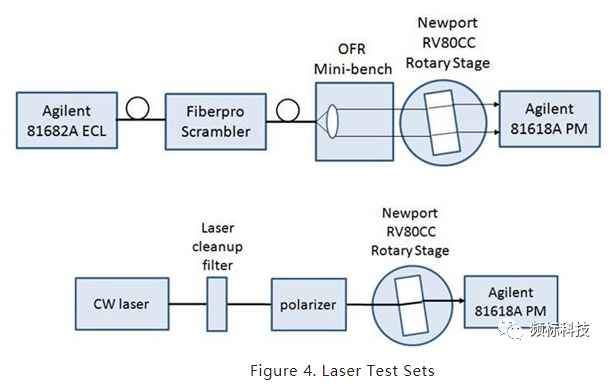 The top of figure 4 shows our system for testing ultra-narrow bands in the near infrared with a tunable laser and a rotary stage. the laser wavelength is scanned, with picometer resolution, while the sample is positioned at a given angle. the bottom of figure 4 shows our approach for testing ultra-narrow bands in the visible where tunable lasers are either bulky or not available. in this second case, the laser is set to a given wavelength and the sample is rotated in angle space. 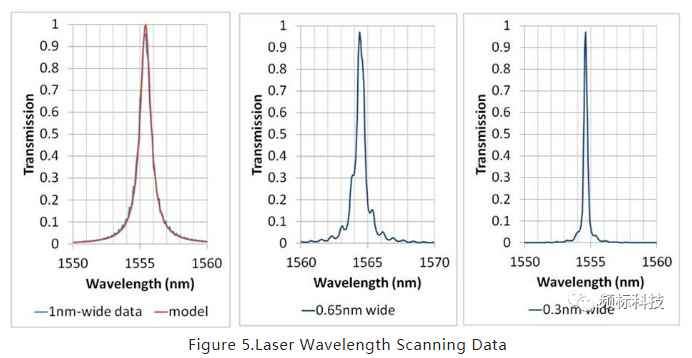 Figure 5 shows data for three filters scanned by the tunable laser method. our deposition equipment can reproducibly fabricate filters with specified bandwidths ╟ from 1 nm to 0.65 nm to 0.25 nm wide filters. a model for the 1 nm wide filter is also included. each filter has minor ripple, which is caused by reflections from the back of the substrates. these filters are sputtered hard oxides useful in near infrared applications. additional data has shown expected performance from 0 to 6 degrees (associated with na = 0.104 and f/number = 4.7). Figure 6 shows data for a hydrogen-alpha filter scanned by the laser rocking method. on the left is a wavelength scan of a narrow band filter using a 5 mm aperture to reduce the aoi hitting the sample. the narrowest possible slits were used (approximately 0.05 nm) with significant integration to reduce noise. a fringe pattern is observable near the baseline due to interference from the thin glass substrates. in the middle is a trace representing raw data from an angle rocking experiment along with a model that fits the data. the data (crosses) were acquired using a 632.8 nm hene laser with angle steps of 0.01 deg. fringes from the substrate are clearly visible throughout the trace. the model (red line) was computed using the angle rocking data as targets in the essential mcleod software. both density (refractive index) and thickness of the layers in the original stack design were optimized simultaneously to fit the rocking data. the resulting fit is transformed from angle space to wavelength space and plotted on the right. the fitting procedure effectively removes fringes from the data and results in a slightly narrower and higher transmitting peak. this filter is an evaporated zns/cryolite stack with a 0.23 nm spectral width useful in solar imaging. astronomers often rock two 0.07 nm etalons against each other to create a 0.03 nm passband. two of our h-alpha filters can be rocked against each other to create a 0.1 nm passband. 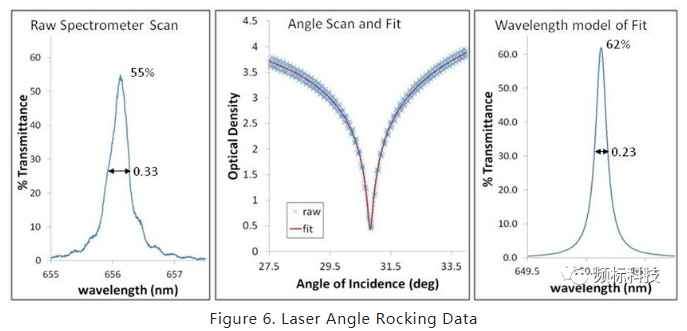 Our hard oxide sputtering system has also deposited filters for passing the calcium k line at 393.37 nm. these filters exhibit transmission over 60% and a bandwidth of 0.3 nm. this wavelength is useful for imaging granulation cells in the solar chromosphere. all of the above ultra-narrow bandpass filters are configured to block6 out of band light at high attenuation levels- up to od9. both transmitted and reflected wavefront distortion are measured on either a tymann-green interferometer or a shack-hartmann system. 5. CONCLUSIONS this paper has addressed the design, fabrication, and testing of various ultra-narrowband interference filters.hard oxides are deposited with a high throughput parms system. testing of these filters was performed with a tunable laser. these near infrared filters exhibit high transmission for 1 nm, 0.65 nm, and 0.25 nm wide designs.? applications of these robust filters include laser range finding and remote sensing.softer materials are deposited with conventional evaporators. testing of these filters was performed with the laser rocking method. these visible filters exhibit moderate to high transmission for 0.23 nm wide designs. applications of these filters include solar and nebula imaging.future work includes further improvements in monitoring, multiple cavity depositions, sem and afm assessments of the interfaces with various starting substrates, and full maps of narrow band performance. ACKNOWLEDGEMENTS we wish to thank: richard rieth, steven lynde, mark dubuke, john herron, norman forget, dana grover, sean auth. REFERENCES [1]https://oceanservice.noaa.gov/facts/lidar.html [2]https://www.nasa.gov/content/goddard/hubble-goes-high-definition-to-revisit-iconic-pillars-of-creation [3]h.a. macleod, [thin-film optical filters], taylor and francis group, abingdon, uk(2001). [4]p. baumeister, [optical coating technology], spie press monograph; pm 137, bellingham, washington(2004). [5]burt, t., “characterizing sub-nanometer narrow bandpass filters using a cary 400/500,” publication # si-a-1193, agilent technologies inc.(2011). [6]m. ziter, g.e. carver, s.a. locknar, t. upton, r.l. johnson, “laser-based assessment of optical interference filters with sharp spectral edges and high optical density”, surface and coatings technology, 241, 54-58(2014). proc. spie 9612, lidar remote sensing for environmental monitoring xv, 96120k (september 1, 2015);?doi:10.1117/12.2208368 copyright 2019 society of photo-optical instrumentation engineers. one print or electronic copy may bemade for personal use only. systematic reproduction and distribution, duplication of any material in thispaper for a fee or for commercial purposes, or modification of the content of the paper are prohibited.  上海频标科技有限公司作为一家专业的实验室仪器设备及试剂耗材类产品的综合服务提供商,可提供实验室各类测量测试设备及分析仪器、生命科学试剂及耗材、光谱学测量、半导体微电子运动控制及振动控制等多个领域产品。 联系我们:官网:https://www.pb-tek.com/电话:021-6053 1205/137 9543 3295 发自小木虫Android客户端 |
 回复此楼
回复此楼» 猜你喜欢
 售SCI文章,我:8O.5.5.1O.54,科目全,可十急
已经有4人回复
售SCI文章,我:8O.5.5.1O.54,科目全,可十急
已经有4人回复
-
售SCI一区T0P文章,我:8O.55.1.O.54,科目全,可伽急
已经有4人回复
-
售SCI一区T0P文章,我:8.O.55.1.O54,科目全,可伽急
已经有4人回复
-
售SCI一区文章,我:8O5.5.1.O5.4,科目全,可伽急
已经有6人回复
-
售SCI一区文章,我:8O5.5.1.O5.4,科目全,可伽急
已经有6人回复
-
售一区SCI文章T0P,我:8O.551.O54,科目全,可十急
已经有4人回复
-
某top大学教授说“能够在市场中兑现的能力才是真能力”无比同意!
已经有13人回复
-
同一个分子,一条来自文献,一条来自AI——不告诉你答案,你会选哪条?
已经有7人回复
-
售SCI文章,我:8O.5.5.1O.54,科目全,可十急
已经有4人回复
-
售SCI一区T0P文章,我:8.O.55.1.O54,科目全,可伽急
已经有4人回复
» 本主题相关商家推荐: (我也要在这里推广)



