








| 查看: 925 | 回复: 6 | |||
| 当前只显示满足指定条件的回帖,点击这里查看本话题的所有回帖 | |||
[交流]
基于可解释性AI的工业系统故障诊断与健康管理技术研究
|
|||

|
法国图卢兹综合理工大学,塔布国家工程师学院,工业生产过程实验室诚招全奖博士。 1.导师kamal medjaher: phm方向谷歌高被引学者,fmesto研究所资深研究院,lgp实验室主任,和善可亲,帅气可爱。 2.导师khanh nguyen: 全法优秀研究员,基于深度学习的phm技术研究及xai方向的杰出青年教师,宛如耐心温婉的师姐,温柔细致。 3.项目由anr jcjc资助,英文交流,可来法后选择性接受法语培训。 4.工作地点主要位于法国塔布,生活成本极低,工资喜人,办公条件优渥,与会法语或多国语言的同学双人混搭,双人办公室办公,不push,工业及学术会议频繁,学生个人学术或工业发展助益明确。 5.硬性条件,参见附件图片,主要需要在项目截止日期前取得硕士学位。 6. 有意者尽快联系: 微信:dwkkakaka, 邮箱:kamal.medjaher@enit.fr, thi-phuong-khanh.nguyen@enit.fr 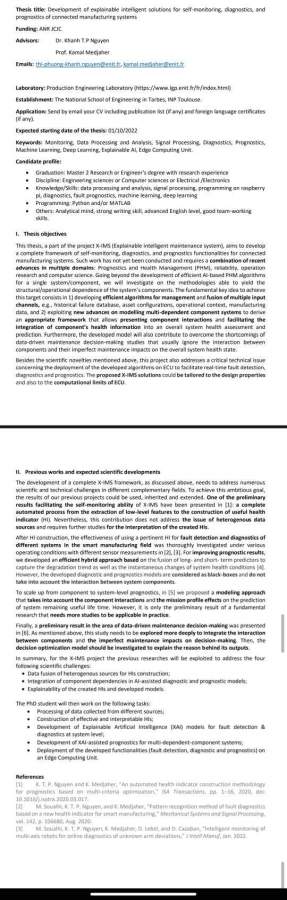 发自小木虫Android客户端 |
 回复此楼
回复此楼» 猜你喜欢
 有多少人是今天查系统知道结果的?
已经有19人回复
有多少人是今天查系统知道结果的?
已经有19人回复
-
国社科又开始会评了,不知道这次命运如何
已经有9人回复
-
能否申诉?
已经有5人回复
-
为什么到现在没收到通知?
已经有5人回复
-
有没有仍没收到信息的
已经有8人回复
-
售SCI一区文章,我:8O5.5.1.O5.4,科目全,可伽急
已经有5人回复
-
售SCI一区文章,我:8O5.5.1.O5.4,科目全,可伽急
已经有4人回复
-
售SCI一区T0P文章,我:8.O.55.1.O54,科目全,可伽急
已经有4人回复
-
售SCI文章,我:8O5.5.1.O.54,科目齐全,可+急
已经有5人回复
-
售SCI一区文章,我:8.O.55.1.O.54,科目齐全,可伽急
已经有4人回复

7楼2022-07-11 17:08:58
|
Laboratory: Production Engineering Laboratory (https://www.lgp.enit.fr/fr/index.html) Establishment: The National School of Engineering in Tarbes, INP Toulouse. Application: Send by email your CV including publication list (if any) and foreign language certificates (if any). Expected starting date of the thesis: 01/10/2022 Keywords: Monitoring, Data Processing and Analysis, Signal Processing, Diagnostics, Prognostics, Machine Learning, Deep Learning, Explainable AI, Edge Computing Unit. Candidate profile: ? Graduation: Master 2 Research or Engineer's degree with research experience ? Discipline: Engineering sciences or Computer sciences or Electrical /Electronics ? Knowledge/Skills: data processing and analysis, signal processing, programming on raspberry pi, diagnostics, fault prognostics, machine learning, deep learning ? Programming: Python and/or MATLAB ? Others: Analytical mind, strong writing skill, advanced English level, good team-working skills. I. Thesis objectives This thesis, a part of the project X-IMS (Explainable intelligent maintenance system), aims to develop a complete framework of self-monitoring, diagnostics, and prognostics functionalities for connected manufacturing systems. Such work has not yet been conducted and requires a combination of recent advances in multiple domains: Prognostics and Health Management (PHM), reliability, operation research and computer science. Going beyond the development of efficient AI-based PHM algorithms for a single system/component, we will investigate on the methodologies able to yield the structural/operational dependence of the system’s components. The fundamental key idea to achieve this target consists in 1) developing efficient algorithms for management and fusion of multiple input channels, e.g., historical failure database, asset configurations, operational context, manufacturing data, and 2) exploiting new advances on modelling multi-dependent component systems to derive an appropriate framework that allows presenting component interactio 发自小木虫Android客户端 |
2楼2022-07-09 01:24:28
|
interactions and facilitating the integration of component’s health information into an overall system health assessment and prediction. Furthermore, the developed model will also contribute to overcome the shortcomings of data-driven maintenance decision-making studies that usually ignore the interaction between components and their imperfect maintenance impacts on the overall system health state. Besides the scientific novelties mentioned above, this project also addresses a critical technical issue concerning the deployment of the developed algorithms on ECU to facilitate real-time fault detection, diagnostics and prognostics. The proposed X-IMS solutions could be tailored to the design properties and also to the computational limits of ECU. II. Previous works and expected scientific developments The development of a complete X-IMS framework, as discussed above, needs to address numerous scientific and technical challenges in different complementary fields. To achieve this ambitious goal, the results of our previous projects could be used, inherited and extended. One of the preliminary results facilitating the self-monitoring ability of X-IMS have been presented in [1]: a complete automated process from the extraction of low-level features to the construction of useful health indicator (HI). Nevertheless, this contribution does not address the issue of heterogenous data sources and requires further studies for the interpretation of the created HIs. After HI construction, the effectiveness of using a pertinent HI for fault detection and diagnostics of different systems in the smart manufacturing field was thoroughly investigated under various operating conditions with different sensor measurements in [2], [3]. For improving prognostic results, we developed an efficient hybrid approach based on the fusion of long- and short- term predictors to capture the degradation trend as well as the instantaneous changes of system health conditions [4]. However, the developed diagnostic and prognostics models are consid 发自小木虫Android客户端 |
3楼2022-07-09 01:26:33
|
However, the developed diagnostic and prognostics models are considered as black-boxes and do not take into account the interaction between system components. To scale up from component to system-level prognostics, in [5] we proposed a modeling approach that takes into account the component interactions and the mission profile effects on the prediction of system remaining useful life time. However, it is only the preliminary result of a fundamental research that needs more studies to be applicable in practice. Finally, a preliminary result in the area of data-driven maintenance decision-making was presented in [6]. As mentioned above, this study needs to be explored more deeply to integrate the interaction between components and the imperfect maintenance impacts on decision-making. Then, the decision optimization model should be investigated to explain the reason behind its outputs. In summary, for the X-IMS project the previous researches will be exploited to address the four following scientific challenges: ? Data fusion of heterogenous sources for HIs construction; ? Integration of component dependencies in AI-assisted diagnostic and prognostic models; ? Explainability of the created HIs and developed models. The PhD student will then work on the following tasks: ? Processing of data collected from different sources; ? Construction of effective and interpretable HIs; ? Development of Explainable Artificial Intelligence (XAI) models for fault detection & diagnostics at system level; ? Development of XAI-assisted prognostics for multi-dependent-component systems; ? Deployment of the developed functionalities (fault detection, diagnostic and prognostics) on an Edge Computing Unit. 发自小木虫Android客户端 |
4楼2022-07-09 01:27:43

