












| 查看: 1927 | 回复: 17 | |||
| 【有奖交流】积极回复本帖子,参与交流,就有机会分得作者 yuan0806 的 46 个金币 ,回帖就立即获得 1 个金币,每人有 1 次机会 | |||
| 当前只显示满足指定条件的回帖,点击这里查看本话题的所有回帖 | |||
[交流]
夏幼南课题组纳米钯的制备
|
|||

|
hydroquinone-based synthesis of pd nanostructures and the interplay of surface capping, reduction kinetics, attachment, diffusion, and fusion 基于对苯二酚的 pd 纳米结构的合成以及表面覆盖、还原动力学、附着、扩散和融合的相互作用 abstract the rational synthesis of nanostructured materials with desired properties calls for a thorough understanding of the growth mechanism. here we report a mechanistic case study of pd nanostructures synthesized by reducing a pd(ii) precursor with hydroquinone in the presence of kbr. as the reaction temperature was decreased from 100 to 20 °c, sub-10 nm cubes, concave nanocubes, and cube-like aggregates of much smaller particles were sequentially obtained. our time-lapse experiments and a set of controls indicated that primary particles of 1╟4 nm in size were formed during the initial stage of the synthesis, followed by their aggregation into cube-like structures through an attachment process. in addition to the influence of surface capping, the reaction temperature played a vital role in determining the exact shape or morphology of the final products by affecting the reduction kinetics, fusion of the attached particles, and surface diffusion of atoms. at 100 °c, corresponding to a quick depletion of the pd(ii) precursor, the primary particles in each aggregate could easily fuse together to form nanocubes with flat faces owing to adequate surface diffusion. at 60 °c, the constituent particles also fused into cubes and then evolved into concave cubes through atomic deposition at the corners. at 20 °c, although fusion did not occur due to the substantially decreased diffusion rate, the primary particles in each aggregate still grew through atomic deposition for the formation of larger, cube-like aggregates. explicating the growth mechanism, this work offers a mechanistic understanding of the nonclassical growth mode involved in the formation of various metal nanostructures. 合理合成具有所需特性的纳米结构材料需要对生长机制有透彻的了解。在这里,我们报告了通过在 kbr 存在下用氢醌还原 pd(ii) 前体合成的 pd 纳米结构的机械案例研究。随着反应温度从 100°c 降低到 20°c,依次获得亚 10 nm 立方体、凹面纳米立方体和小得多的立方体状聚集体。我们的延时实验和一组对照表明,在合成的初始阶段形成了 1-4 nm 大小的初级粒子,然后通过附着过程将它们聚集成立方体状结构。除了表面封盖的影响外,反应温度通过影响还原动力学、附着粒子的融合和原子的表面扩散,在确定最终产品的确切形状或形态方面起着至关重要的作用。在 100 °c 时,对应于 pd(ii) 前驱体的快速消耗,由于足够的表面扩散,每个聚集体中的初级粒子可以很容易地融合在一起形成具有平面的纳米立方体。在 60 °c 时,组成粒子也融合成立方体,然后通过角落处的原子沉积演变成凹立方体。在 20 °c 时,虽然由于扩散速率显着降低而没有发生融合,但每个聚集体中的初级粒子仍然通过原子沉积生长,以形成更大的立方体状聚集体。解释生长机制,这项工作提供了对各种金属纳米结构形成所涉及的非经典生长模式的机械理解。 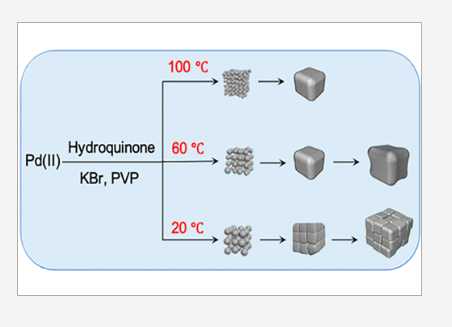 [ last edited by yuan0806 on 2021-10-26 at 08:59 ] doi.org/10.1021/acs.chemmater.1c02791 https://pubs.acs.org/doi/10.1021 ... _ASAP_cmatex_v0_i0_ [ Last edited by yuan0806 on 2021-10-26 at 09:02 ] |
 回复此楼
回复此楼» 猜你喜欢
 无机化学论文润色/翻译怎么收费?
已经有213人回复
无机化学论文润色/翻译怎么收费?
已经有213人回复

» 本主题相关商家推荐: (我也要在这里推广)


» 抢金币啦!回帖就可以得到:
 Ei期刊青年编委招募(工程设计方向)
 +1/374
-
上市公司招聘电解液添加剂研发人员
+1/84
-
转录组数据求助
+1/83
-
想要有个家
+1/80
-
西交利物浦大学黄彪院士招收26年全奖博士生1名(工业智能方向)
+1/39
-
中国科学院理化所微纳材料与技术前沿交叉研究中心诚聘英才加盟
+1/36
-
郑州大学农业与生物制造学院博士后招聘
+1/34
-
山东大学机械工程学院“先进加工装备”课题组博士招生
+1/33
-
QS TOP100英国南安普顿大学数字健康与生医工招博后,博士,Fellowship,访问学者
+1/32
-
上海交通大学-化学化工学院-邱惠斌教授课题组招聘博士后
+1/32
-
2026年博士招生--北京理工大学交叉学科(航空,力学,能动,计算机等方向)
+1/27
-
北京科技大学鲁启鹏招收2026年博士生1名
+1/26
-
鄢勇课题组2026年拟招收项目聘用人员1名,方向:1. 具身智能;2. 智能感知;3. 忆阻器
+1/22
-
今年的函评专家费收到了吗
+1/16
-
2026年博士申请-全固态锂金属电池方向-聚合物电解质+硫化物电解质
+1/12
-
博士/硕士招生
+1/10
-
2026年-中国科学院分析化学方向“申请考核”博士生
+1/6
-
东江实验室招聘~本科及以上可报~急聘!
+1/5
-
北理工柔性电子国家杰青团队招【博士后】【科研助理(读博意向)】
+1/2
-
华中农业大学生命科学技术学院 “酶智能设计与农药生物合成”课题组招聘启事
+1/1
8楼2021-10-26 07:17:09