









| 查看: 1117 | 回复: 1 | |||
[交流]
【原版教材•中英对照】化学热力学介绍 Chemical Thermodynamics 已有1人参与
|

|
Chemical Thermodynamics An Introduction 化学热力学介绍 Author: Erno˝ Keszei 下载地址:https://www.zhisci.com/pdfshow/17567 This course-derived undergraduate textbook provides a concise explanation of the key concepts and calculations of chemical thermodynamics. Instead of the usual ‘classical’ introduction, this text adopts a straightforward postulatory approach that introduces thermodynamic potentials such as entropy and energy more directly and transparently. 本课程衍生的本科教科书提供了化学热力学的关键概念和计算的简明解释。与通常的“经典”介绍不同,本文采用了一种直接的假设方法,更直接、更透明地引入了热力学势,如熵和能量。 Structured around several features to assist students’ understanding, Chemical Thermodynamics  evelops applications and methods for the ready treatment of equilibria on a sound quantitative basis.Requires minimal background in calculus to understand the text and presents formal derivations to the student in a detailed but understandable way.Offers end-of-chapter problems (and answers) for self-testing and review and reinforcement, of use for self- or group study. evelops applications and methods for the ready treatment of equilibria on a sound quantitative basis.Requires minimal background in calculus to understand the text and presents formal derivations to the student in a detailed but understandable way.Offers end-of-chapter problems (and answers) for self-testing and review and reinforcement, of use for self- or group study.围绕几个特征构建,以帮助学生理解化学热力学:发展应用和方法,准备处理平衡在一个健全的定量基本要求微积分的基本知识,能理解课文,并以详细但可理解的方式向学生呈现形式推导好吧。优惠自测、复习和强化的期末问题(和答案),用于自我或小组学习。 This book is suitable as essential reading for courses in a bachelor and master chemistry program and is also valuable as a reference or textbook for students of physics, biochemistry and materials science. 本书适用于化学学士和硕士课程的基础阅读,也可作为物理、生物化学和材料科学学生的参考或教科书。 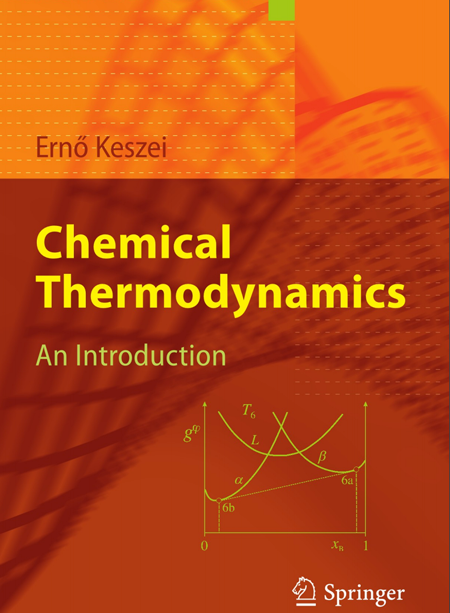 |
 回复此楼
回复此楼» 本帖已获得的红花(最新10朵)
 ljb197211
» 猜你喜欢
 PDMS膜在溶液中的离子透过率
已经有0人回复
PDMS膜在溶液中的离子透过率
已经有0人回复
-
攒人品 论文祈福
已经有139人回复
-
有机高分子材料论文润色/翻译怎么收费?
已经有250人回复
-
science advances的AAAS系统上返修
已经有0人回复
-
science advances的AAAS系统上返修问题
已经有4人回复
-
LDPE黑十字为什么那么大
已经有0人回复
-
西南交通大学医学院2027年接收推荐免试攻读研究生(含直博生)
已经有159人回复
-
西南交通大学医学院2027年接收推荐免试攻读研究生(含直博生)
已经有159人回复
-
西南交通大学医学院2027年接收推荐免试攻读研究生(含直博生)
已经有157人回复
-
西南交通大学医学院2027年接收推荐免试攻读研究生(含直博生)
已经有152人回复
-
博士申请
已经有14人回复
» 本主题相关商家推荐: (我也要在这里推广)

2楼2020-08-07 00:08:49