









| 查看: 3054 | 回复: 13 | ||
| 当前只显示满足指定条件的回帖,点击这里查看本话题的所有回帖 | ||
gengjusha新虫 (小有名气)
|
[求助]
DFT+ VASP模拟计算氢吸附自由能!!!!求助机构、个人或学者等
|
|

|
打扰各位前辈: 本人做了一个超薄Fe2P纳米片修饰CdS纳米棒,打算模拟计算纯CdS纳米棒以及Fe2P-CdS复合物的氢能。希望可以模拟的机构联系我报价,想合作的同学老师联系我,报要求。 计算的内容如下: 1、分别优化CdS和Fe2P的晶格结构,得到晶格常数(其中CdS与Fe2P的标准模型MS数据库里有,则需要切晶面,优化结构) 2、构建CdS(101)表面和CdS(101)/Fe2P(111)异质结,并进行结构优化 3、分别计算H原子在CdS(101)表面和CdS(101)/Fe2P(111)异质结上的吸附自由能 计算的方法直接套用文献:《Insight into iron group transition metal phosphides (Fe2P, Co2P, Ni2P) for improving photocatalytic hydrogen generation》 具体步骤如下:该方法模拟计算了氮化碳与磷化铁,氮化碳与磷化镍等复合物的氢吸附自由能.The spin-polarization first-principles calculations were performed using the Vienna ab initio Software Package (VASP) [3]. The projector augmented wave potential was used with a plane-wave cutoff energy of 400 eV. The exchange correlation energy was described by the generalized gradient approximation (GGA) within the Perdew-Burke-Ernzerhof (PBE) [4]. The model of TMPs deposition on S-CN was constructed by employing a slab model to mimic the surface and interface of TMPs/S-CN system. 2×2 S-CN and √3×√3 TMPs supercells were employed. The model contains ~100 atoms in total as shown in Figure S9. For geometry optimization and electronic structures calculations, the Brillouin-zone integration was performed using 3×3×1 and 8×8×1 Monkhorst-Pack mesh, respectively. To avoid the layer-layer interactions due to the use of periodic boundary conditions, a vacuum space was set to ~20 Å.The free energies of the intermediate H* adsorption were obtained by [5] ∆GH = ∆EH + ∆EZPE – T∆SH where ∆EH denotes the adsorption energy of H atoms, which is calculated by ∆EH = EnH – E(n–1)H – 1/2EH2. ∆EZPE and ∆SH are the difference in zero-point energy and the entropy between atomic adsorption and hydrogen in the gas phase, respectively. The contribution of entropies and ZPE for ∆GH were obtained as previous works reported [5], in which finally expressed by ∆GH = ∆EH + 0.35. The charge transfer was calculated by subtracting the charge density of isolated TMPs slab and S-CN from the total charge density of the TMPs/S-CN systems. 结果与结构如图所示, 图1 Top and side views of (a) Fe2P/S-CN, (b) Co2P/S-CN and (c) Ni2P/S-CN systems. 图2(a) The free-energy diagram of the photocatalytic H2 generation on S-CN, Fe2P/S-CN, Co2P/S-CN and Ni2P/S-CN. (b) The charge density distributions of Ni2P/S-CN system. Blue and yellow colors show the charge losing and gaining, respectively (For interpretation of the references to colour in this figure legend, the reader is referred to the web version of this article). 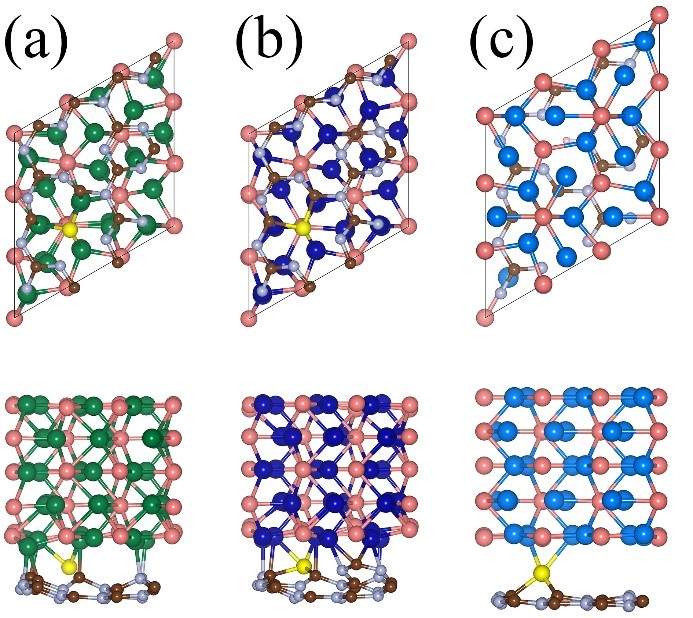 1.jpg 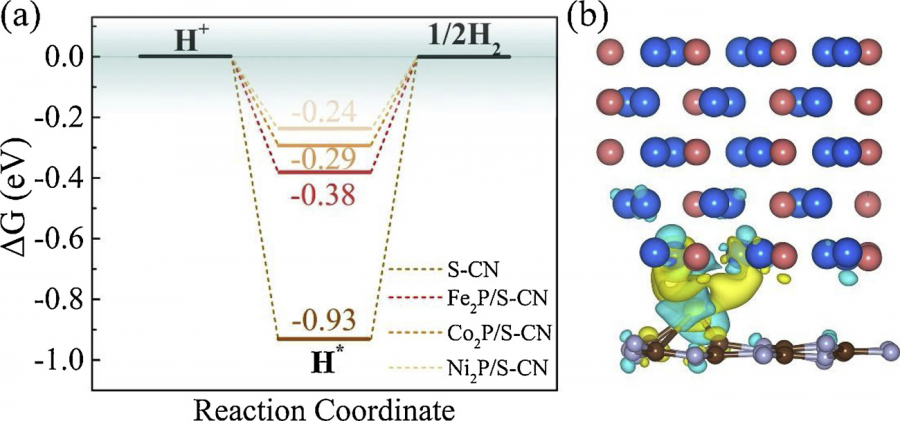 2.png |
 回复此楼
回复此楼» 猜你喜欢
 售SCI一区文章,我:8O5.5.1.O5.4,科目全,可伽急
已经有3人回复
售SCI一区文章,我:8O5.5.1.O5.4,科目全,可伽急
已经有3人回复
-
售SCI一区文章,我:8.O.55.1.O.54,科目齐全,可伽急
已经有3人回复
-
某top大学教授说“能够在市场中兑现的能力才是真能力”无比同意!
已经有6人回复
» 本主题相关商家推荐: (我也要在这里推广)

gengjusha
新虫 (小有名气)
- 应助: 0 (幼儿园)
- 金币: 177.8
- 散金: 183
- 帖子: 59
- 在线: 24.8小时
- 虫号: 13020446
- 注册: 2018-11-30
- 专业: 化学反应工程

7楼2020-07-28 18:51:54
gengjusha
新虫 (小有名气)
- 应助: 0 (幼儿园)
- 金币: 177.8
- 散金: 183
- 帖子: 59
- 在线: 24.8小时
- 虫号: 13020446
- 注册: 2018-11-30
- 专业: 化学反应工程
2楼2020-07-28 16:30:21
123dingyc
新虫 (知名作家)
- 应助: 0 (幼儿园)
- 金币: 16124.1
- 红花: 44
- 帖子: 6584
- 在线: 571小时
- 虫号: 2516270
- 注册: 2013-06-21
- 专业: 凝聚态物性I:结构、力学和
3楼2020-07-28 18:20:04
4楼2020-07-28 18:35:40