









| 查看: 418 | 回复: 0 | ||
| 【悬赏金币】回答本帖问题,作者wangbi3077将赠送您 300 个金币 | ||
[求助]
有关EDX问题求助
|
||

|
恳求各位大佬帮我看一下审稿人的意思。 "- For SEM/EDX accuracy and sum of mass% is missing. If the latter is more than a few at.% away from 100 the measurement cannot considered to be reliable. In “Experimental Procedure” there is not any information to the calibration for EDX measurements. Please add all this information to Table 2+3. 我后来在表中添加了每个相测量后的标准差。回复如下 Re: The results of the element analysis were obtained with INCA Energy software by Oxford Instruments. The XPP matrix correction scheme of Pouchou and Pichoir provided by the software is used, for its favorable performance when tilted samples consisting light elements in a heavy matrix. The standards referencing used in this EDS system is virtual standard sample library. And, the instrument is corrected every two years with the Oxford SPI standard samples by the professional engineer. To minimize the error, the compositions reported in this paper were the averages of at least five measurement 审稿人还是不满意,回复如下 The sum of mass% which is easily available from INKA is still not given in Table 2. This information is important! The given errors are partly unrealistic, e.g. C4, at% of Al in "MnSn2" is given as 0.5(0.1). This error comes may be from statistics of several measurements but does not include systematic errors. The determination of light elements within a matrix of rather heavy elements has for sure an error of more than 0.5 at.%, which is considered to be the minimum error of conventional SEM/EDX method. 我不太懂他是什么意思,是在表中加入每个相的质量总和吗?可是这总和不都是100%吗?恳求大神帮忙解惑。 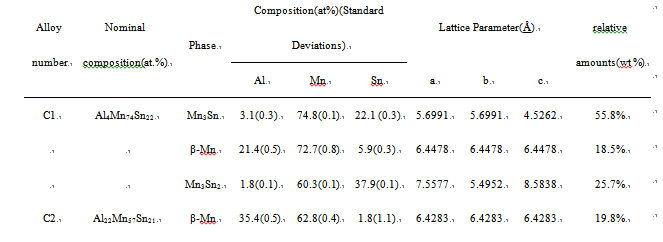 1111111111111111111111.png |
 回复此楼
回复此楼» 猜你喜欢
 实名举报:华南理工大学物理与光电学院副院长李志远婚内两次出轨女学生(博士)
已经有14人回复
实名举报:华南理工大学物理与光电学院副院长李志远婚内两次出轨女学生(博士)
已经有14人回复
-
上海工程技术大学激光智能制造课题组招收博士研究生
已经有9人回复
-
上海工程技术大学激光智能制造课题组|2027级博士研究生招生公告
已经有9人回复
-
申博发邮件
已经有11人回复
-
现代”学阀”该如何界定
已经有7人回复
-
各位大神,目前国内有哪些比较好用的逆合成软件?
已经有12人回复
-
我的奶奶
已经有3人回复
-
国社科系统bug了,是不是要放榜了?
已经有9人回复