









| 查看: 912 | 回复: 1 | ||
[求助]
求大神翻译,跪谢
|

|
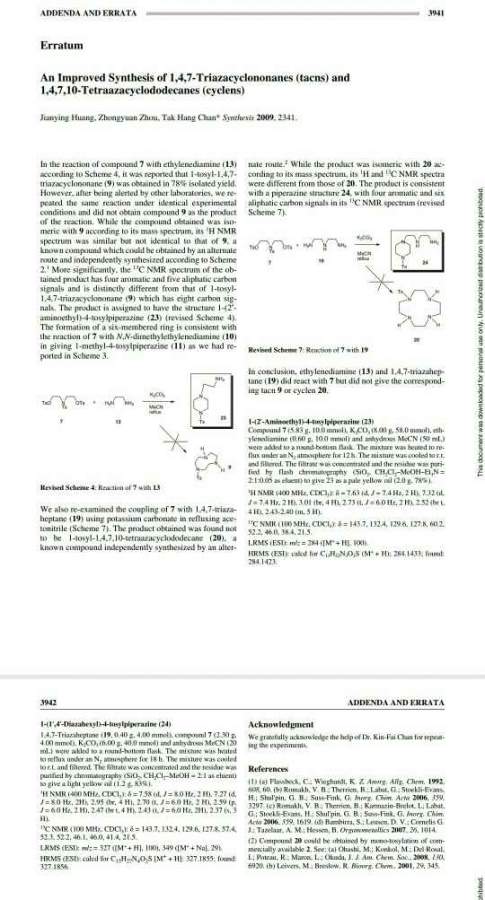
In the reaction of compound 7 with ethylenediamine (13) according to Scheme 4, it was reported that 1-tosyl-1,4,7- triazacyclononane (9) was obtained in 78% isolated yield. However, after being alerted by other laboratories, we re?peated the same reaction under identical experimental conditions and did not obtain compound 9 as the product of the reaction. While the compound obtained was iso?meric with 9 according to its mass spectrum, its 1 H NMR spectrum was similar but not identical to that of 9, a known compound which could be obtained by an alternate route and independently synthesized according to Scheme 2.1 More significantly, the 13C NMR spectrum of the ob?tained product has four aromatic and five aliphatic carbon signals and is distinctly different from that of 1-tosyl- 1,4,7-triazacyclononane (9) which has eight carbon sig?nals. The product is assigned to have the structure 1-(2?- aminoethyl)-4-tosylpiperazine (23) (revised Scheme 4). The formation of a six-membered ring is consistent with the reaction of 7 with N,N-dimethylethylenediamine (10) in giving 1-methyl-4-tosylpiperazine (11) as we had re?ported in Scheme 3. Revised Scheme 4: Reaction of 7 with 13 We also re-examined the coupling of 7 with 1,4,7-triaza?heptane (19) using potassium carbonate in refluxing ace?tonitrile (Scheme 7). The product obtained was found not to be 1-tosyl-1,4,7,10-tetraazacyclododecane (20), a known compound independently synthesized by an alter?nate route.2 While the product was isomeric with 20 ac?cording to its mass spectrum, its 1 H and 13C NMR spectra were different from those of 20. The product is consistent with a piperazine structure 24, with four aromatic and six aliphatic carbon signals in its 13C NMR spectrum (revised Scheme 7). Revised Scheme 7: Reaction of 7 with 19 In conclusion, ethylenediamine (13) and 1,4,7-triazahep?tane (19) did react with 7 but did not give the correspond?ing tacn 9 or cyclen 20. 1-(2?-Aminoethyl)-4-tosylpiperazine (23) Compound 7 (5.83 g, 10.0 mmol), K2CO3 (8.00 g, 58.0 mmol), eth?ylenediamine (0.60 g, 10.0 mmol) and anhydrous MeCN (50 mL) were added to a round-bottom flask. The mixture was heated to re?flux under an N2 atmosphere for 12 h. The mixture was cooled to r.t. and filtered. The filtrate was concentrated and the residue was puri?fied by flash chromatography (SiO2, CH2Cl2–MeOH–Et3N = 2:1:0.05 as eluent) to give 23 as a pale yellow oil (2.0 g, 78%). 1 H NMR (400 MHz, CDCl3): d = 7.63 (d, J = 7.4 Hz, 2 H), 7.32 (d, J = 7.4 Hz, 2 H), 3.01 (br, 4 H), 2.73 (t, J = 6.0 Hz, 2 H), 2.52 (br t, 4 H), 2.43-2.40 (m, 5 H). 13C NMR (100 MHz, CDCl3): d = 143.7, 132.4, 129.6, 127.8, 60.2, 52.2, 46.0, 38.4, 21.5. LRMS (ESI): m/z = 284 ([M+ + H], 100). HRMS (ESI): calcd for C13H22N3O2S (M+ + H); 284.1433; found: 284.1423. 1-(1?,4?-Diazahexyl)-4-tosylpiperazine (24) 1,4,7-Triazaheptane (19, 0.40 g, 4.00 mmol), compound 7 (2.30 g, 4.00 mmol), K2CO3 (6.00 g, 40.0 mmol) and anhydrous MeCN (20 mL) were added to a round-bottom flask. The mixture was heated to reflux under an N2 atmosphere for 18 h. The mixture was cooled to r.t. and filtered. The filtrate was concentrated and the residue was purified by chromatography (SiO2, CH2Cl2–MeOH = 2:1 as eluent) to give a light yellow oil (1.2 g, 83%). 1 H NMR (400 MHz, CDCl3): d = 7.58 (d, J = 8.0 Hz, 2 H), 7.27 (d, J = 8.0 Hz, 2H), 2.95 (br, 4 H), 2.70 (t, J = 6.0 Hz, 2 H), 2.59 (p, J = 6.0 Hz, 2 H), 2.47 (br t, 4 H), 2.43 (t, J = 6.0 Hz, 2H), 2.37 (s, 3 H). 13C NMR (100 MHz, CDCl3): d = 143.7, 132.4, 129.6, 127.8, 57.4, 52.3, 52.2, 46.1, 46.0, 41.4, 21.5. LRMS (ESI): m/z = 327 ([M+ + H], 100), 349 ([M+ + Na], 29). HRMS (ESI): calcd for C15H27N4O2S [M+ + H]: 327.1855; found: 327.1856. 发自小木虫Android客户端 |
 回复此楼
回复此楼» 猜你喜欢
 售一区SCI文章T0P,我:8O.551.O54,科目全,可十急
已经有9人回复
售一区SCI文章T0P,我:8O.551.O54,科目全,可十急
已经有9人回复
-
售SCI一区T0P文章,我:8.O55.1.O.54,科目全,可十急
已经有8人回复
-
售SCI一区文章,我:8O5.5.1.O5.4,科目全,可伽急
已经有10人回复
-
售SCI一区T0P文章,我:8.O55.1.O.54,科目全,可十急
已经有9人回复
-
售SCI一区文章,我:8.O.55.1.O.54,科目齐全,可伽急
已经有7人回复
-
售SCI一区T0P文章,我:8.O.55.1.O54,科目全,可伽急
已经有9人回复
-
售SCI文章,我:8O5.5.1.O.54,科目齐全,可+急
已经有10人回复
-
OpenAI又攻克数学难题了,离AI做有机合成还有多远?
已经有6人回复
-
售SCI一区T0P文章,我:8.O.55.1.O.5.4,科目全,可+急
已经有10人回复
-
售SCI文章,我:8O.5.5.1O.54,科目全,可十急
已经有7人回复

2楼2018-01-06 23:39:20

