








| 查看: 533 | 回复: 1 | ||
| 【奖励】 本帖被评价1次,作者bio-polymer增加金币 0.5 个 | ||
| 当前主题已经存档。 | ||
[资源]
【转帖】Built by Animals: The Natural History of Animal Architecture
|
||

|
Built by Animals: The Natural History of Animal Architecture By Mike Hansell 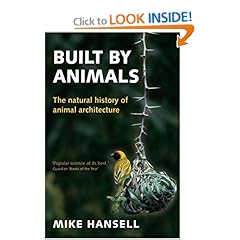 Publisher: Oxford University Press, USA Number Of Pages: 280 Publication Date: 2009-03-15 ISBN-10 / ASIN: 0199205574 ISBN-13 / EAN: 9780199205578 Product Description: From termite mounds and caterpillar cocoons to the elaborate nests of social birds and the deadly traps of spiders, the constructions of the animal world can amaze and at times even rival our own feats of engineering. But how do creatures with such small brains build these complex structures? What drives them to do it? In this fascinating volume, Mike Hansell looks at the extraordinary structures that animals build--whether homes, traps, or courtship displays--and reveals what science can tell us about this incredible behavior. We look at wasp's nests, leaf-cutting ants, caddis flies and amoebae, and even the extraordinary bower bird, who seduces his mate with a decorated pile of twigs, baubles, feathers, and berries. We discover how some animals produce their own building materials, such as the silk secreted by spiders to weave an array of different web and traps, or the glue some insects produce to hold their buildings together. And we learn how a vast colony of social insects can create nests which may penetrate up to twenty feet into the ground and house millions of individuals--all built by tiny-brained animals repeating many simple actions as they roam randomly around the structure. Hansell also sheds light on how animal buildings have evolved over time, how insect societies emerged, how animals can alter their wider habitat, and even whether some animals have an aesthetic sense. Built by Animals offers a colorful account of a facet of animal behavior that will delight anyone interested in the natural world. Now Available in Paperback Summary: "You don't need brains . . . Rating: 5 . . . to be a builder", says Hansell, and goes on to demonstrate that with a photo of a house built by "Difflugia coronata". It's a spiked sphere with a nicely decorated front entry - tasteful, if rather enigmatic. One looks in vain for the resident. Not one of those clever wasps that pulps paper to tuck a nest under your eaves or one of the swallows that brings mud to accomplish a similar task, D. coronata is a micro-organism: an amoeba that collects tiny sand grains to build itself a shelter. An amoeba?? How does it accomplish this? Hansell responds, as he must do often in this fine study, "we don't know". Animal building hasn't been a topic of intense study as the author frequently reminds us. However, he's good at demonstrating what we do know and what further work needs doing. He poses several good questions - how much of an animal's building skill is genetically inherited? How important to animals is the idea of standardised material [think "bricks" in human construction]? Which animals produce structures the equivalent of three times the size of any human office building? What planning steps are required for an orb spider to form its web? Finally, and what might be the most pertinent of all, what is a tool and is that what distinguishes human builders from the other animals? As Hansell poses these questions, he goes on to show how some of the answers have been obtained. He explains the varieties of construction behaviour - how an African rat may have an extended burrow system with up to several hundred entries, for example. Logic demands this is an indication of a group endeavour, but the entire system is inhabited by one rat. We think birds intuitively construct complex nests from their first try. Many weaver birds, however, may fall out of the tree on their first effort to fashion a hanging nest. Orb spiders, on the other hand, weave their webs with much variation - some species even know the best time of day to construct a particular type of web for a specific prey. An the web material is an engineering masterpiece - flexible enough to catch the prey and strong enough to hold it. How it manages this is a fascinating section of this book. Hansell warns the reader against falling victim to "heavy eyelids" prior to the description, noting that the solution is too "elegant" to miss. He's correct in that. What does an animal "think" as it's building a structure?, he reflects. Some prompt leads bees to form comb relating to their body size, as do many nesting birds - especially weavers. Is there "thinking" involved when one of the bolas spiders shifts the issuing of a pheromone for one moth species to that of another - at a specific time of night? Termites built immense, complex towers - Hansell compares them to the Petronas Towers in Kuala Lumpur. Yet, although there are millions of construction jobs in erecting the mounds, not one of the termites appears to be in charge. Does each termite carry a mental blueprint in that miniscule brain? Further, why do some termite species ventilate the mound with one method, while others in a similar environment do it differently? Hansell poses these questions as much to himself as to the reader. He calls for research into various areas throughout the narrative. There are even topics he declares he will be investigating in the coming years. That's another thing that makes this book a prime gift to a young student. Building is not merely a human endeavour and variety and innovation isn't limited to our species. It's important to understand how life works and this is one significant indicator in that quest. Try this book and find out why. [stephen a. haines - Ottawa, Canada] Summary: "We Really Don't Know" Rating: 1 Built by Animals It's a captivating title and a captivating cover photo. And anyone who makes the effort to understand the natural world will come to this book with some appreciation of animal architecture, if not from personal observation, then from nature TV. Moreover author Mike Hansell's credentials are exactly those you would expect. So why is this book so unsatisfying? After all, the author treats us to some of the animal construction that we expect, caterpillar cocoons, beaver lodges and dams, ant tunnels, and mud dauber nests. And he introduces us to much that we do not expect, naked mole rats tunnels, hairy-nosed wombat warrens, European badger setts, "magnetic" termite mounds, and amoeba shells. And, although it doesn't relate to animal construction, Hansell also includes a very good chapter on tool use by animals. It also asks, in a chapter-long unanswered question, who makes the design decisions in a colony of hundreds or thousands of residents. But the reader expects Professor Hansell to answer as well as ask the questions. Unfortunately the answers are all too infrequent. The treatment of the construction of the web of the orb web spider, Araneus diadematus is a rare exception. It is truly excellent, and very satisfying, but it appears to have been written by a different person (a graduate student, perhaps?). Overall the book fails for three reasons. The first is Hansell's painfully self-conscious writing style. We are not reading about animal architecture, we are reading about Hansell writing about animal architecture. We even catch him writing to himself, as in "but let me not get carried away..." The second reason is the pointless digression, as when he describes the nerve centers for avian vocalization. Ultimately, though, the book fails because it does not explain what we wanted explained. How do the filter nets of the Oikopleura dioica get built? "Well, they just appear." How do the stones comprising the shell of the Difflugia coronata amoeba get put in place by a one celled organism which doesn't possess a central nervous system? "...the stones arrange themselves." Professor Hansell, those stones are inorganic; they are inanimate; they do not simply arrange themselves. Perhaps a hundred times throughout the book Hansell simply states, "we really do not know," or that something happens "in a manner not yet studied." This book addresses a most fascinating topic, but the enthusiastic naturalist will be disappointed that it doesn't live up to its billing. Summary: The Minds of Animal Builders Rating: 5 If you look at a skyscraper made by humans, you can't help being impressed by the complexity of the construction and the coordination of hundreds of planners and workers that went into it. And yet termites build proportionately bigger structures which show planning in such things as ventilation and heat regulation. How is it that animals with such tiny brains can create such massive and complicated structures? If building by a group of creatures is remarkable, then surely also remarkable are the webs built by spiders, or the nests (especially the woven ones) built by birds. What is going on in the brains of creatures who build? We don't have firm answers, but in _Built by Animals: The Natural History of Animal Architecture_ (Oxford University Press), biologist Mike Hansell tries to make sure we are asking the right questions, and he describes research accomplished and proposed to get the answers. He has written academic works on this subject, and this is his first one for the non-specialist. He dips into technical discussions just enough, and the topic is inherently fascinating. Animals build homes all over the place, for protection from weather and predators, but they also build traps, and male bowerbirds make structures that have no purpose other than impressing potential mates. This is an excellent overview of what animals build, with plenty of examples and with fascinating discussions about the experiments used to tease out answers to how the creatures learned construction. Hansell first introduces the Central American caterpillar _Aethria carnicauda_, which uses the same sort of protective gadget. When it is ready to make itself into a pupa, it first picks a straight plant stem. Then it starts plucking hairs out of its body, hairs that it will not need within its pupa or as a moth. It has tweezer jaws to pluck hairs one by one, and each hair it sticks with silk to the stem it has selected. It makes a disk of radiating bristles, and may make four of these defense lines, obstacles to anything coming along the stem that might disturb its upcoming transformative slumber. Only then does it build its cocoon. Think about this behavior and you can't help but wonder: how does such a simple creature know to build a relatively sophisticated barrier? Does it have a plan? It's hard to imagine that a caterpillar has any sort of consciousness, but its nervous system must make some sort of decision about the time to build its bristle defense, and where the next hair gets placed. We might even identify with the caterpillar as a constructor of such a clever defense, and throughout this book Hansell gives warnings of the dangers of anthropomorphizing, of our attributing to animals thoughts and goals without proper evidence. We can't enter the minds of these creatures, but Hansell is a little more generous about the sin of anthropomorphism, saying not only that it can generate hypotheses that might stir further investigation, but that also the question of what animals think or feel as they build is not completely outside of scientific enquiry (although not much headway has been made so far). _Aethria_ is just one of scores of animals evaluated here, including ants, termites, birds, prairie dogs, and beavers. There is a whole chapter here on the webs of spiders, and once again, using simple materials (of their own secretion) and simple instructions, a spider can produce a wonder of complexity, a web for trapping insects. Astonishingly, not everything in a web may be behaviorally programmed as even spiders have the capacity to learn. It is easier for a spider to run downwards on a web to a caught insect rather than run upwards, but in a fascinating experiment on one particular species, some spiders weren't given the chance to run. The experimenter simply fed them flies as they were sitting in the middle of their webs. When they re-built their webs, they continued to make as much web above themselves as below. Spiders who did real catching, however, learned to build webs that had more catching-space down below, and spiders who were artificially fed insects that were inserted above them in the web built webs with a bigger topside. There are so many interesting experiments described here. In the final chapter on bowerbirds, Hansell winds up his discussion of how the female could show by posturing how interested she is in the male: "This suggests that a male could infer whether or not a female is likely to make her escape from the avenue by the degree of crouching she shows. Cue an experiment with a robot female satin bowerbird!" I thought Hansell was making a joke; he wasn't. The robot has been built, and when it assumes different positions, the male changed the intensity of his courtship dance. This is an engaging book summarizing an expert's view of the results from clever animals and clever researchers. [ Last edited by wenzhenzhong on 2009-2-19 at 10:58 ] |
 回复此楼
回复此楼» 猜你喜欢
 浙江师范大学是怎么坑我的
已经有5人回复
浙江师范大学是怎么坑我的
已经有5人回复
-
面上有专家说实验设备不是我们单位的
已经有8人回复
-
科研求助
已经有4人回复
-
博士去二本高校当辅导员,如何调整心态?
已经有11人回复
-
江苏省自然基金 什么时候出结果
已经有6人回复
-
闲聊
已经有3人回复

2楼2009-05-19 20:44:35