








| 查看: 867 | 回复: 0 | ||
gy_xmc2015铜虫 (小有名气)
|
[交流]
【文章推荐】青藏高原隆升造成晚渐新世后的亚洲风尘产量上升(南师大郑洪波教授)
|

|
文章题目:Asia dust production ramped up since latest Oligocene driven by Tibetan Plateau uplift 文章链接(免费获取):https://doi.org/10.1093/nsr/nww028 作者:郑洪波,南京师范大学地理科学学院,长江学者特聘教授。研究方向为自然地理学与第四纪地质学。 亚洲风尘系统是对地区和全球地质环境具有影响的重要风尘系统。在这篇发表于《国家科学评论》(National Science Review)的 Perspective 文章中,郑洪波教授介绍了亚洲风尘系统“从源到汇”的结构形态,以及亚洲内陆的荒漠化情况,并提出了“风尘工厂(Dust Factory)”概念:地质构造攀升可导致一系列地质现象,并造成风尘产量上升。 文章首段:Eolian dust is an integral component of the Earth system dynamics, participating in a range of physical, chemical and biogeological processes of the Earth system at various temporal and spatial scales [1] (Fig. 1). Great advance has been achieved in recent years in understanding eolian dust cycles through instrumental investigations and numerical modeling as well as tracing geological records [1]. The Asian dust cycle is one of the major dust systems on Earth, playing important roles in many processes and exerting impacts well beyond the region [2]. From a geological perspective, the production, emission, transportation and deposition of Asian dust are closely associated with regional tectonic-geomorphic-climatic configurations, and thus preserving valuable archives for deciphering regional tectonic and climatic history. Among others, uplift of Tibetan Plateau and aridification of Asian interior is of great interest and global relevance. 《国家科学评论》是由中科院主管的英文综述性学术期刊,2016年度影响因子8.843。 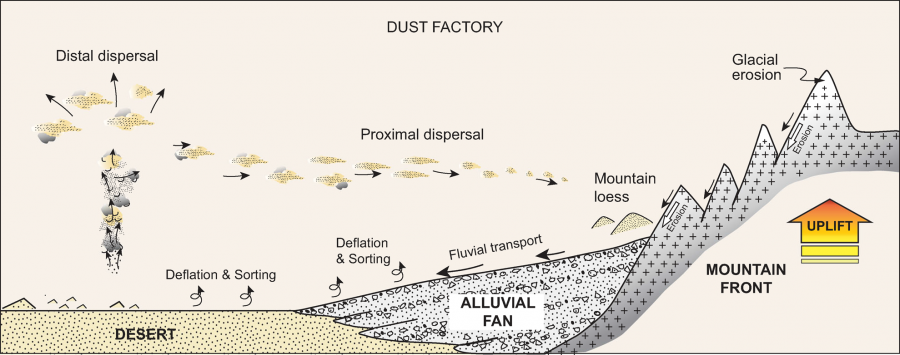 风尘工厂模型 |
 回复此楼
回复此楼