












| 查看: 4255 | 回复: 76 | ||
| 【奖励】 本帖被评价66次,作者chaos2012增加金币 52.6 个 | ||
| 当前只显示满足指定条件的回帖,点击这里查看本话题的所有回帖 | ||
[资源]
Chem. Rev. 最新综述: 低毒无镉量子点的制备及其生物医学的应用
|
||

|
该篇综述《New Generation Cadmium-Free Quantum Dots for Biophotonics and Nanomedicine》系统总结了近年来各种新型低毒无镉量子点的制备方法和生物光学及纳米医学的应用。介绍的量子点种类包括了最新的石墨烯量子点(Graphene quantum dots), 硅量子点 (Silicon QDs), InP/ZnS QDs, CuInS2 QDs, Ag2S/Ag2Se QDs, ZnS-AgInS2 (ZAIS) QDs, Doped ZnS/ZnSe QDs and Plasmonic QDs。 文章重点总结了这些无镉量子点在生物光子学 (Biophotonics) 和纳米医学 (Nanomedicine)上的发展。文中详细的介绍了各种Cd-free QDs的物理光学特性及其制备方法,综述的生物光子学应用包括 optical imaging, photoacoustic imaging, sensing, optical tracking, and photothermal therapy。 而在纳米医学方面,应用领域包括drug/gene delivery, protein/peptide delivery, image-guided surgery, diagnostics, and medical devices. 全文共94页,引文550篇。 Chem. Rev., Article ASAP DOI: 10.1021/acs.chemrev.6b00290 Publication Date (Web): September 22, 2016 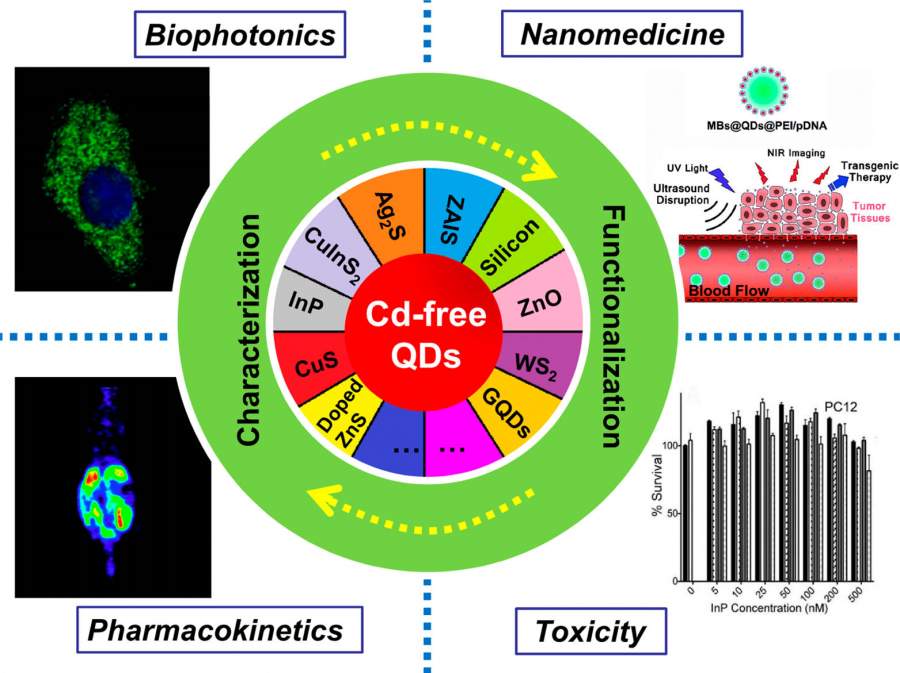 master.img-001.jpg 1. Introduction and Background 1.1 Introduction to Quantum Dots 1.2 Biophotonics Applications 1.3 Applications in Nanomedicine 1.4 Pharmacokinetics and Biodistribution 1.5 In vitro and in vivo Toxicity 1.6 Review Outline 2. Features of Cadmium-Free Quantum Dots 2.1 Quantum Confinement Effects 2.2 Core/Shell Architecture 2.3 Tunability in the Biological Transparency Window 2.4 Opportunity to Introduce Tunable Plasmonic Features 2.5 Doping to Achieve Enhanced Emission from Dopant States 2.6 Magnetic Doping to Introduce Magnetic Imaging Capability 2.7 Relationship of Quantum Dot Physics, Properties, and Applications 3. Selected Quantum Dot Systems 3.1 InP and InP/ZnS Quantum Dots 3.2 CuInS2 and CuInS2/ZnS Quantum Dots 3.3 Ag2S and Ag2Se Quantum Dots 3.4 ZnS-AgInS2 (ZAIS) Quantum Dots 3.5 Silicon Quantum Dots 3.6 Graphene Quantum Dots 3.7 Doped ZnS/ZnSe Quantum Dots 3.8 Plasmonic Copper Chalcogenide Quantum Dots 4. Preparation of Biocompatible Cadmium-Free Quantum Dots 4.1. InP and InP/ZnS Quantum Dots 4.2. CuInS2, CuInS2/ZnS and CuInZnS/ZnS Quantum Dots 4.3. Ag2S and Ag2Se Quantum Dots 4.4. ZnS-AgInS2 (ZAIS) Quantum Dots 4.5. ZnSe/InP/ZnS Quantum Dots 4.6. InAs/InP/ZnSe Quantum Dots 4.7. Silicon Quantum Dots 4.8. ZnO Quantum Dots 4.9. WS2 Quantum Dots 4.10. Graphene Quantum Dots 4.11. Doped ZnS/ZnSe Quantum Dots 4.12. Plasmonic Copper Chalcogenide Quantum Dots 5. Biophotonic Applications 5.1. Optical Imaging 5.2. Photoacoustic Imaging 5.3. Biosensing 5.4. Optical Tracking 5.5. Photothermal Therapy 5.6. Multimodal Imaging 6. Nanomedicine Applications 6.1. Drug Delivery 6.2. Gene Delivery 6.3. Protein and Peptide Delivery 6.4. Cancer Nanotechnology 6.5. Imaging Guided Surgery 6.6. In vitro Diagnostics 6.7. Infectious Diseases 7. Pharmacokinetics and Biodistribution of Cadmium-Free Quantum Dots 7.1 Biodistribution of Non-targeted Cadmium-Free Quantum Dots 7.2 Biodistribution of Targeted Cadmium-Free Quantum Dots 8. In vitro and in vivo Toxicity of Cadmium-Free Quantum Dots 8.1 In vitro Toxicity 8.2 In vivo Toxicity 8.3 Mechanism of Toxicity 9. Concluding Remarks and Perspectives Biography Paras N. Prasad is a SUNY Distinguished Professor of Chemistry, Physics, Electrical Engineering and Medicine; the Samuel P. Capen Chair of Chemistry; and the Executive Director of the Institute for Lasers, Photonics, and Biophotonics, University at Buffalo, State University of New York. He was named among the top 50 science and technology leaders in the world by Scientific American in 2005, and was recognized as a highly cited researcher in both chemistry and materials science fields by Thomas Reuters in 2014. He has published over 750 scientific and technical papers, four monographs (Introduction to Nanomedicine and Nanobioengineering, Nanophotonics, Introduction to Biophotonics, Introduction to Nonlinear Optical Effects in Molecules and Polymers), and eight edited books. He has received many scientific awards and honors (Morley Medal; Schoellkopf Medal; Guggenheim Fellowship; SPIE President’s Gold Medal; Honorary Doctorates from KTH, Sweden, and from the Aix Marseille Université, France; Fellow of the APS, OSA, and SPIE, etc.). His interests include biophotonics, nanophotonics, nanomedicine, metamaterials, and solar cells. Paras Nath Prasad是纽约州立大学布法罗分校杰出教授,湖南大学客座教授,现任美国物理学会 APS Fellow,美国光学学会 OSA Fellow,SPIE Fellow。他在集物理学、电子工程学、化学及医学等多学科领皆有深厚造诣,并在国际上享誉盛名,曾入选美国“Scientific American”杂志评选的“全球最杰出的50位科学家”,现已发表750篇高水平论文,并被引用多达49034次,出版专著8部。 [ Last edited by chaos2012 on 2016-10-27 at 15:59 ] |
 回复此楼
回复此楼» 本帖附件资源列表
-
欢迎监督和反馈:小木虫仅提供交流平台,不对该内容负责。
本内容由用户自主发布,如果其内容涉及到知识产权问题,其责任在于用户本人,如对版权有异议,请联系邮箱:xiaomuchong@tal.com - 附件 1 : acs%2Echemrev%2E6b00290.pdf
2016-09-23 20:54:51, 4.72 M
» 猜你喜欢
 无机化学论文润色/翻译怎么收费?
已经有126人回复
无机化学论文润色/翻译怎么收费?
已经有126人回复

» 本主题相关商家推荐: (我也要在这里推广)


38楼2016-09-29 09:15:26