









| 查看: 5383 | 回复: 26 | ||||
| 【奖励】 本帖被评价20次,作者springer_增加金币 14.8 个 | ||||
[资源]
Vibration Analysis and Structural Dynamics for Civil Engineers
|
||||

|
contents Part I Essentials 1 1 Introduction 3 1.1 Definitions, aims and general concepts 3 1.2 Basic features of a vibrating system, and further concepts 4 Tutorial questions 7 2 Single degree-of-freedom systems 9 2.1 Basic equation of motion 9 2.2 Free vibration response 9 2.3 Equivalent spring stiffnesses for various structural and mechanical systems 19 2.4 Response to harmonic excitation 24 Tutorial questions 30 3 Systems with more than one degree of freedom 33 3.1 Introductory remark 33 3.2 Equations of motion 33 3.3 Techniques for assembling the stiffness matrix 35 vi Contents 3.4 The flexibility formulation of the equations of motion and assembly of the flexibility matrix 40 3.5 Determination of natural frequencies and mode shapes 44 3.6 The flexibility formulation of the eigenvalue problem 46 3.7 Worked examples 47 3.8 The modal matrix 56 3.9 Orthogonality of eigenvectors 57 3.10 Generalized mass and stiffness matrices 59 3.11 Worked examples 61 3.12 Modal analysis 64 3.13 Worked example 69 Tutorial questions 73 4 Continuous systems 75 4.1 Introduction 75 4.2 Transverse vibration of strings 76 4.2.1 General formulation 76 4.2.2 Free vibration 77 4.3 Axial vibration of rods 81 4.4 Flexural vibration of beams 86 4.4.1 General formulation 86 4.4.2 Boundary conditions 88 4.4.3 Free vibration 88 4.5 Orthogonality of natural modes of vibration 92 4.6 Dynamic response by the method of modal analysis 97 5 Finite-element vibration analysis 103 5.1 The finite-element formulation 103 5.1.1 Introduction 103 5.1.2 Displacements 103 5.1.3 Strains 104 5.1.4 Stresses 105 5.1.5 Nodal actions and element stiffness matrix 106 5.1.6 Dynamic formulation and element mass matrix 107 5.2 Stiffness and consistent mass matrices for some common finite elements 109 5.2.1 Truss element 109 5.2.2 Beam element 111 5.2.3 Rectangular plane–stress element 116 Contents vii 5.3 Assembly of the system equations of motion 122 5.3.1 Procedure in brief 122 5.3.2 Illustration of assembly 122 5.3.3 Accounting for support conditions 124 5.3.4 Numerical example 125 References 127 Part II Group-theoretic formulations 129 6 Basic concepts of symmetry groups and representation theory 131 6.1 Symmetry groups 131 6.2 Group tables and classes 132 6.3 Representations of symmetry groups 135 6.4 Character tables 135 6.5 Group algebra 137 6.6 Idempotents 137 6.7 Applications 139 References 140 7 Rectilinear models 141 7.1 Introduction 141 7.2 A shaft–disc torsional system 141 7.2.1 Symmetry-adapted functions 142 7.2.2 Symmetry-adapted stiffness matrices 143 7.2.3 Eigenvalues 146 7.3 A spring–mass extensional system 147 7.3.1 Symmetry-adapted functions 148 7.3.2 Symmetry-adapted stiffness matrices 149 7.3.3 Eigenvalues 151 7.4 Conclusions 152 8 Plane structural grids 153 8.1 Introduction 153 8.2 Rectangular configurations 154 8.2.1 Symmetry-adapted functions 154 8.2.2 Symmetry-adapted flexibility coefficients 156 8.2.3 Eigenvalues 158 viii Contents 8.3 Square configurations 160 8.3.1 Symmetry-adapted functions 161 8.3.2 Symmetry-adapted flexibility coefficients 162 8.3.3 Eigenvalues 165 8.4 Conclusion 167 9 High-tension cable nets 169 9.1 Basic assumptions and geometric formulation 169 9.2 Outline of computational scheme 171 9.3 Illustrative examples 172 9.4 Symmetry-adapted functions 174 9.4.1 Rectangular 24-node configuration 174 9.4.2 Square 16-node configuration 177 9.5 Symmetry-adapted flexibility matrices 179 9.5.1 Basis-vector plots and subspace properties 179 9.5.2 Equilibrium considerations and symmetry-adapted flexibility coefficients 184 9.5.3 Derivation of the static equilibrium matrices 185 9.6 Subspace mass matrices 192 9.7 Eigenvalues, eigenvectors and mode shapes 193 9.8 Summary and concluding remarks 194 References 196 10 Finite-difference formulations for plates 197 10.1 General finite-difference formulation for plate vibration 197 10.2 Group-theoretic implementation 199 10.3 Application to rectangular and square plates 201 10.3.1 Basis vectors for the rectangular plate 203 10.3.2 Basis vectors for the square plate 205 10.3.3 Nodal sets 207 10.4 Finite-difference equations for generator nodes of the basis vectors 210 10.4.1 Generator nodes 210 10.4.2 Basis finite-difference equations for the rectangular plate 212 10.4.3 Basis finite-difference equations for the square plate 213 Contents ix 10.5 Symmetry-adapted finite-difference equations and system eigenvalues 214 10.5.1 Rectangular plate 214 10.5.2 Square plate 218 10.5.3 Remarks on the structure of symmetryadapted eigenvalue matrices 221 10.6 Concluding remarks 222 References 223 11 Finite-element formulations for symmetric elements 225 11.1 Group-theoretic formulation for finite elements 225 11.2 Coordinate system, node numbering and positive directions 226 11.3 Symmetry-adapted nodal freedoms 229 11.4 Displacement field decomposition 233 11.5 Subspace shape functions 237 11.6 Subspace element matrices 238 11.7 Final element matrices 241 11.8 Concluding remarks 246 References 247 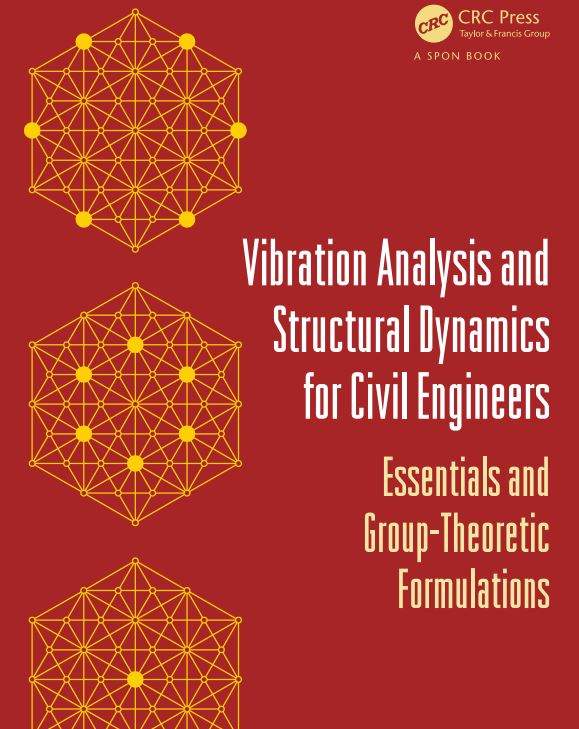 cover.JPG |
 回复此楼
回复此楼» 本帖附件资源列表
-
欢迎监督和反馈:小木虫仅提供交流平台,不对该内容负责。
本内容由用户自主发布,如果其内容涉及到知识产权问题,其责任在于用户本人,如对版权有异议,请联系邮箱:xiaomuchong@tal.com - 附件 1 : Vibration_Analysis_and_Structural.pdf
2016-03-23 12:51:00, 17.15 M
» 收录本帖的淘帖专辑推荐
 教学 教学 |
» 猜你喜欢
 40+中年人失业后,还能找到好工作吗?
已经有13人回复
40+中年人失业后,还能找到好工作吗?
已经有13人回复
-
用NBS溴化时溶剂除了CCl4外还有什么
已经有6人回复
-
申请科研项目纯靠实力能成功吗?
已经有11人回复
-
极限拉扯,如何抉择
已经有15人回复
-
二审4个多月了还是Awaiting Reviewer Scores
已经有4人回复
-
OpenAI又攻克数学难题了,离AI做有机合成还有多远?
已经有13人回复
-
课题组会帮你通过考核么?
已经有7人回复
-
售一区SCI文章T0P,我:8O.551.O54,科目全,可十急
已经有9人回复
-
售SCI一区T0P文章,我:8.O55.1.O.54,科目全,可十急
已经有8人回复
-
售SCI一区文章,我:8O5.5.1.O5.4,科目全,可伽急
已经有10人回复
» 本主题相关价值贴推荐,对您同样有帮助:
- 收集的汽车类的期刊目录
已经有18人回复
2楼2016-03-23 18:55:12
15楼2016-10-21 22:09:06
21楼2017-05-09 15:13:25
26楼2021-01-13 09:17:37
简单回复
年华混江水3楼
2016-03-24 15:08
回复
五星好评 顶一下,感谢分享!
清水无痕66184楼
2016-03-24 21:20
回复
civilp5楼
2016-03-25 00:19
回复
三星好评 顶一下,感谢分享!
civilp6楼
2016-03-25 00:29
回复
顶一下,感谢分享!
转动的风车7楼
2016-03-25 09:43
回复
三星好评 顶一下,感谢分享!
2016-03-29 13:04
回复
五星好评 顶一下,感谢分享!
hanl9楼
2016-05-05 14:55
回复
五星好评 顶一下,感谢分享!
tmgczb10楼
2016-07-07 14:30
回复
五星好评 顶一下,感谢分享!
lichuang557711楼
2016-07-28 15:54
回复
五星好评 顶一下,感谢分享!
civilp12楼
2016-08-02 17:14
回复
顶一下,感谢分享!
haoareyouFZX13楼
2016-10-18 19:15
回复
五星好评 顶一下,感谢分享!
zfyjs614楼
2016-10-18 23:19
回复
五星好评 顶一下,感谢分享!
sunpixel16楼
2016-10-23 08:43
回复
fjc131417楼
2017-01-13 19:04
回复
五星好评 顶一下,感谢分享!
jonewore18楼
2017-01-14 00:37
回复
谢谢分享。 发自小木虫Android客户端
qiaopeng19楼
2017-01-15 08:48
回复
一般 谢谢分享 发自小木虫Android客户端
slm20楼
2017-01-18 20:18
回复
五星好评 顶一下,感谢分享!
sltj22楼
2020-04-22 16:02
回复
五星好评 顶一下,感谢分享!
sltj23楼
2020-04-22 16:02
回复

cathy_uw24楼
2020-10-21 21:35
回复
五星好评 顶一下,感谢分享!
tsylgc25楼
2021-01-10 23:22
回复
五星好评 顶一下,感谢分享!
Acezhong27楼
2025-11-07 17:48
回复
五星好评 顶一下,感谢分享!


 200
200