|
|
★ ★ ★ ★ ★ ★ ★ ★ ★ ★ ★ 小木虫: 金币+0.5, 给个红包,谢谢回帖  送红花一朵 wonderfulong: 回帖置顶 2016-02-24 10:44:43wonderfulong: 金币+10, 侯老师辛苦! 2016-02-24 10:45:05
我们最近也做了一点!看看前言:
Iron (Fe) is one of the most abundant elements on earth and the sixth most abundant elements in the universe. It is of great importance to replace those noble metal based catalysts with artificial Fe-based materials for heterogeneous catalysis. Currently, Fe-based catalysts are widely used in ammonia synthesis [1], [2], [3] and [4], Fischer-Tropsch synthesis [5], and selective catalytic reduction of NOx with ammonia [6], and so on. Recently, it was reported that iron-based catalysts exhibited extraordinary performance for the direct coupling of methane to ethylene [7], for the oxygen-reduction reaction [8], and for selective hydrogenation of nitroarenes [9], where noble metals were required previously. And more recently, it was demonstrated that Fe-based nanohybrids were also capable to catalyze the graphitization of catkin [10], polymers [11], [12] and [13], and N-doped core–shell structured Fe/Fe3C in carbon nanotubes (CNTs) hybrids formed occasionally.
These findings are particularly interesting since the in-situ formed Fe/Fe3C particles ‘etch’ into solid material, leaving CNTs behind, and iron species encapsulated inside CNTs or graphene are extremely active for oxygen reduction reaction [10], [11], [12], [13], [14], [15], [16] and [17], and the selective hydrogenation [5] and [18]. These important achievements inspired us to explore a new strategy for the controlled synthesis and new application of Fe-based catalysts.
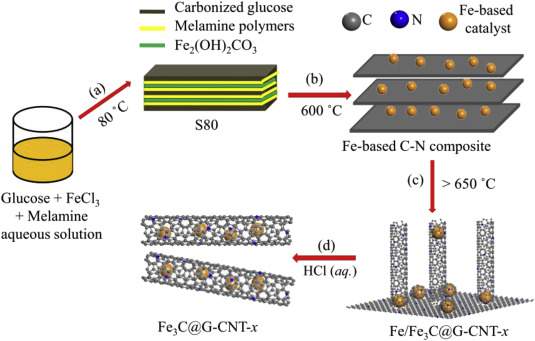
Herein, we demonstrated a new, one-step, facile strategy for the controlled synthesis of N-doped graphene layers (G) encapsulated Fe3C nanoparticles that embedded in N-doped carbon nanotubes (denoted as Fe3C@G-CNT) through direct pyrolysis a mixture of glucose (or xylitol, or sucrose), melamine and FeCl3 at varied temperature. The resulting Fe3C@G-CNT composites were applied for catalytic hydrogenation reactions. To our best knowledge, it is reported for the first time that the well-designed Fe3C-based CNTs composites have a great potential for highly catalytic activity and stability for hydrogenation reactions. The prominent catalytic performance and low production cost prove that Fe3C@G-CNT hybrid is a promising candidate to substitute noble metal catalysts in academic research. |
|












 回复此楼
回复此楼