









| 查看: 4711 | 回复: 135 | ||
| 当前只显示满足指定条件的回帖,点击这里查看本话题的所有回帖 | ||
[资源]
轻型汽车材料、设计和制造
|
||

|
Materials, design and manufacturing for lightweight vehicles Author(s): P K Mallick Series: Woodhead Publishing in material Language: English Pages: xii, 369 pages : illustrations This book updates our knowledge on the metal cutting processes in relation to theory and industrial practice. In particular, many topics reflect recent developments, e.g. modern tool materials, computational machining, computer simulation of various process phenomena, chip control, monitoring of the cutting state, progressive and hybrid machining operations, and generation and modelling of surface integrity. This book addresses the present state and future development of machining technologies. It provides a comprehensive description of metal cutting theory, experimental and modelling techniques along with basic machining processes and their effective use in a wide range of manufacturing applications. Topics covered include fundamental physical phenomena and methods for their evaluation, available technology of machining processes for specific classes of materials and surface integrity. The book also provides strategies for optimalization techniques and assessment of machinability. Moreover, it describes topics not currently covered in other sources, such as high performance and multitasking (complete) machining with a high potential for increasing productivity, and virtual and e-machining. The research covered here has contributed to a more generalized vision of machining technology, including not only traditional manufacturing tasks but also new potential (emerging) applications such as micro- and nanotechnology. - Many practical examples of modern machining technology- Applicable for various technical, engineering and scientific levels- Collects together 20 years of research in the field and related technical information Research into the manufacture of lightweight automobiles is driven by the need to reduce fuel consumption to preserve dwindling hydrocarbon resources without compromising other attributes such as safety, performance, recyclability and cost. Materials, design and manufacturing for lightweight vehicles will make it easier for engineers to not only learn about the materials being considered for lightweight automobiles, but also to compare their characteristics and properties. Part one discusses materials for lightweight automotive structures with chapters on advanced steels for lightweight automotive structures, aluminium alloys, magnesium alloys for lightweight powertrains and automotive structures, thermoplastics and thermoplastic matrix composites and thermoset matrix composites for lightweight automotive structures. Part two reviews manufacturing and design of lightweight automotive structures covering topics such as manufacturing processes for light alloys, joining for lightweight vehicles, recycling and lifecycle issues and crashworthiness design for lightweight vehicles. With its distinguished editor and renowned team of contributors, Materials, design and manufacturing for lightweight vehicles is a standard reference for practicing engineers involved in the design and material selection for motor vehicle bodies and components as well as material scientists, environmental scientists, policy makers, car companies and automotive component manufacturers. Table of contents : front-matter......Page 1 1......Page 13 2......Page 45 3......Page 89 4......Page 124 5......Page 184 6......Page 218 7......Page 242 8......Page 282 9......Page 316 10......Page 339 back-matter......Page 364 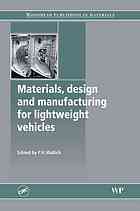 1.gif |
 回复此楼
回复此楼» 本帖附件资源列表
-
欢迎监督和反馈:小木虫仅提供交流平台,不对该内容负责。
本内容由用户自主发布,如果其内容涉及到知识产权问题,其责任在于用户本人,如对版权有异议,请联系邮箱:xiaomuchong@tal.com - 附件 1 : Materials,_Design_and_Manufacturing_for_Lightweight_Vehicles(1).pdf
2015-03-09 14:23:58, 14.73 M
» 本帖已获得的红花(最新10朵)
 1002070101
» 猜你喜欢
 40+中年人失业后,还能找到好工作吗?
已经有4人回复
40+中年人失业后,还能找到好工作吗?
已经有4人回复
-
极限拉扯,如何抉择
已经有15人回复
-
申请科研项目纯靠实力能成功吗?
已经有8人回复
-
中科院海洋所招收海洋材料相关领域博士研究生及研究助理
已经有4人回复
-
二审4个多月了还是Awaiting Reviewer Scores
已经有4人回复
-
OpenAI又攻克数学难题了,离AI做有机合成还有多远?
已经有13人回复
-
课题组会帮你通过考核么?
已经有7人回复
-
入职后第一次管课题组的专利缴费,对账才发现官费比别人多掏了一倍
已经有6人回复
-
售一区SCI文章T0P,我:8O.551.O54,科目全,可十急
已经有9人回复
-
售SCI一区文章,我:8O5.5.1.O5.4,科目全,可伽急
已经有10人回复
» 本主题相关商家推荐: (我也要在这里推广)


86楼2016-03-24 09:22:30
10楼2015-03-10 07:19:08
简单回复
wenhsien2楼
2015-03-09 14:43
回复
五星好评 顶一下,感谢分享!
2015-03-09 17:35
回复
五星好评 顶一下,感谢分享!
2015-03-09 17:45
回复
五星好评 顶一下,感谢分享!
zjys58875楼
2015-03-09 19:07
回复
五星好评 顶一下,感谢分享!
muxinjin6楼
2015-03-09 19:45
回复
五星好评 顶一下,感谢分享!
2015-03-09 21:16
回复
五星好评 顶一下,感谢分享!
2015-03-10 00:36
回复
五星好评 顶一下,感谢分享!
2015-03-10 02:33
回复
五星好评 顶一下,感谢分享!
luom11楼
2015-03-10 07:59
回复
五星好评 顶一下,感谢分享!
peterflyer12楼
2015-03-10 08:25
回复
五星好评 顶一下,感谢分享!
WANGLIN14513楼
2015-03-10 10:17
回复
五星好评 顶一下,感谢分享!
efoxxx14楼
2015-03-10 11:58
回复
五星好评 顶一下,感谢分享!


 10
10