









| 查看: 3551 | 回复: 3 | |||
| 当前只显示满足指定条件的回帖,点击这里查看本话题的所有回帖 | |||
lunalovehj木虫 (小有名气)
|
[求助]
生物统计学问题——试验结果不知道该选用什么检验方法来分析显著性差异??
|
||

|
楼主生物统计学知识没学好,只会一部分SPSS,现在要写文章了,不知道该怎么去分析数据的显著性,求虫友帮忙呀!!! 图中YY、XZ、WX分别代表不同的地方,H代表健康的三个生物学重复,I代表发病的三个生物学重复,现在算出来了U、D、H的指标来,这种结果应该用什么方法来表示显著性呀?已经试过two-way ANOVA和把地点分开来做的独立样本T检验,但是总觉得不能做出“平均值±标准差(显著性标注)”的形式,有没有什么可以把这两个因素都考虑进去的方法呀,求大师指点了!!! 或者说写文章的时候可以先分析two-way ANOVA,再分析独立样本T么?因为不止这三个指标哈,还有一些指标,在写成文章的时候到底该怎么去表示呢? 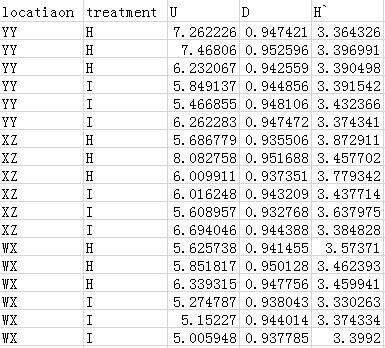 360截图20141113213805543.jpg |
 回复此楼
回复此楼» 猜你喜欢
 某top大学教授说“能够在市场中兑现的能力才是真能力”无比同意!
已经有13人回复
某top大学教授说“能够在市场中兑现的能力才是真能力”无比同意!
已经有13人回复
-
同一个分子,一条来自文献,一条来自AI——不告诉你答案,你会选哪条?
已经有7人回复
-
售SCI文章,我:8O.5.5.1O.54,科目全,可十急
已经有4人回复
-
售SCI一区T0P文章,我:8.O.55.1.O54,科目全,可伽急
已经有4人回复
-
售SCI一区文章,我:8.O.55.1.O.54,科目齐全,可伽急
已经有4人回复
-
售SCI一区T0P文章,我:8.O.55.1.O.54,科目齐全,可+急
已经有4人回复
-
售SCI-T0P文章,我:8O.5.5.1.O.54,科目齐全,可+急
已经有3人回复
-
售SCI文章,我:8O.5.5.1O.54,科目全,可十急
已经有3人回复
-
售一区SCI文章T0P,我:8O.551.O54,科目全,可十急
已经有3人回复
-
售SCI文章,我:8O5.5.1.O.54,科目齐全,可+急
已经有4人回复
» 本主题相关价值贴推荐,对您同样有帮助:
wizardfan
至尊木虫 (著名写手)

- BioEPI: 18
- 应助: 599 (博士)
- 贵宾: 1.818
- 金币: 24660.2
- 散金: 197
- 红花: 48
- 沙发: 2
- 帖子: 2254
- 在线: 400.7小时
- 虫号: 1879241
- 注册: 2012-07-05
- 性别: GG
- 专业: 生物信息学
【答案】应助回帖
★ ★ ★ ★ ★ ★ ★ ★ ★ ★ ★ ★ ★ ★ ★ ★ ★ ★ ★ ★ ★ ★ ★ ★ ★ ★ ★ ★ ★ ★ ★ ★ ★ ★ ★ ★ ★ ★ ★ ★ ★ ★ ★ ★ ★ ★ ★ ★ ★ ★
lunalovehj: 金币+50, ★★★很有帮助, 感谢,仔细阅读了! 2014-11-17 09:44:46
lunalovehj: 金币+50, ★★★很有帮助, 感谢,仔细阅读了! 2014-11-17 09:44:46
|
wiki page Analysis of variance (ANOVA) is a collection of statistical models used to analyze the differences between group means and their associated procedures (such as "variation" among and between groups), developed by R.A. Fisher. In the ANOVA setting, the observed variance in a particular variable is partitioned into components attributable to different sources of variation. In its simplest form, ANOVA provides a statistical test of whether or not the means of several groups are equal, and therefore generalizes the t-test to more than two groups. As doing multiple two-sample t-tests would result in an increased chance of committing a statistical type I error, ANOVAs are useful in comparing (testing) three or more means (groups or variables) for statistical significance. T-tests the most frequently used ways are: A one-sample location test of whether the mean of a population has a value specified in a null hypothesis. A two-sample location test of the null hypothesis that the means of two populations are equal. All such tests are usually called Student's t-tests, though strictly speaking that name should only be used if the variances of the two populations are also assumed to be equal; the form of the test used when this assumption is dropped is sometimes called Welch's t-test. These tests are often referred to as "unpaired" or "independent samples" t-tests, as they are typically applied when the statistical units underlying the two samples being compared are non-overlapping.[6] A test of the null hypothesis that the difference between two responses measured on the same statistical unit has a mean value of zero. For example, suppose we measure the size of a cancer patient's tumor before and after a treatment. If the treatment is effective, we expect the tumor size for many of the patients to be smaller following the treatment. This is often referred to as the "paired" or "repeated measures" t-test:[6][7] see paired difference test. A test of whether the slope of a regression line differs significantly from 0. So select the statistical method according to your situation see http://abacus.bates.edu/~ganders ... low_chart_v2014.pdf |

4楼2014-11-16 09:18:39
wizardfan
至尊木虫 (著名写手)
- BioEPI: 18
- 应助: 599 (博士)
- 贵宾: 1.818
- 金币: 24660.2
- 散金: 197
- 红花: 48
- 沙发: 2
- 帖子: 2254
- 在线: 400.7小时
- 虫号: 1879241
- 注册: 2012-07-05
- 性别: GG
- 专业: 生物信息学
2楼2014-11-15 07:11:43
lunalovehj
木虫 (小有名气)
- 应助: 1 (幼儿园)
- 金币: 2192.2
- 散金: 275
- 帖子: 118
- 在线: 25.3小时
- 虫号: 1837167
- 注册: 2012-05-28
- 专业: 土壤生态学
3楼2014-11-15 16:49:07
