









| 查看: 13672 | 回复: 408 | ||||
| 本帖产生 2 个 MN-EPI ,点击这里进行查看 | ||||
| 当前只显示满足指定条件的回帖,点击这里查看本话题的所有回帖 | ||||
nowitzki_ci专家顾问 (著名写手)
|
[资源]
Chem. Soc. Rev.热点综述:模板法制备纳米结构材料——殷亚东出品
|
|||


|
Templated synthesis of nanostructured materials 44页 引文431篇 In the past two decades, tremendous efforts have been made towards the development of synthetic strategies for nanostructured materials with well controlled size, shape, composition and spatial arrangement. Synthesis using a pre-existing nanostructured tem- plate is one of the most effective strategies towards achieving high degrees of synthetic control. As defined in the Merriam-Webster’s Dictionary, a template is a ‘‘gauge, pattern or mold used as a guide to the form of a piece being made,’’ which reveals the general advantages of templated synthesis. Typically, nanomaterials synthesized by templating strategies hold a well-defined size, shape and configuration, which usually benefits from the directing effect of the templates. The general route for templated synthesis of nanostructured materials includes the following steps: (1) template preparation, (2) directed synthesis of target materials using the template, and (3) template removal (if necessary). In nanoscale synthesis, theoretically, a template can be any substance with nanostructured features. Thus, there are abun- dant types of materials that can be taken into consideration. Some are naturally occurring (such as nanostructured minerals, biological molecular assemblies, and organs), while others are sourced from synthetic nanostructures which usually benefit from pre-existing synthesis methods (both direct synthesis and templated synthesis), including top-down and bottom-up approaches. Their physical properties can vary greatly, from soft materials such as molecular assemblies to hard materials such as colloidal particles, porous membranes and patterned solid surfaces. With regard to their chemical properties, they can either behave as a pure physical directing agent, which we refer to as a physical template, or as a physical director which is also involved in a chemical transformation during the synthesis, which we refer to as a chemical template. For the synthesis of target materials, synthetic strategies based on physical templates include a variety of methods such as surface coating and channel replication. In cases of chemical templated synthesis, chemical transformations during the synthesis may include isomerisation, addition, substitution and elimination of chemical species. As a result, nearly all types of materials can be utilized, from metals, semiconductors, and ceramics to soft polymers, to form zero-dimensional (0D) nano- particles, one-dimensional (1D) nanowires and two- and three- dimensional (2D and 3D) hierarchical nanostructures. In order to remove the template after synthesis, as long as the physical and chemical properties of the resultant materials can be preserved, both physical methods such as dissolution and chemical methods including calcination and etching can be applied according to the nature of the templates. In this review, we aim to review the development of template- based synthetic strategies for nanostructured materials. To fully examine the procedures of different templated synthesis methods while comprehensively covering all types of templates, the organization of a review on this topic should be based either on the types of templates or the classification of synthetic methods, as shown in Scheme 1. Herein, we choose the former in order to emphasize the importance of template preparation methods, while different synthetic methods are sorted to an extent as most synthetic strategies are only utilized in conjunc- tion with certain types of templates. Overall, the discussion of templates will be divided between colloidal and non-colloidal templates. Of the colloidal type templates, templated synthesis on hard colloids will be introduced in cases of both physical (Section 2) and chemical (Section 3) templating. Templated synthesis on soft materials will be introduced afterwards (Section 4). Finally, various types of templated syntheses on other non-colloidal templates will be discussed (Section 5). In each section, the discussion will focus on the preparation of templates and classical synthesis techniques based on these specific templates. In some cases, template removal strategies as well as comments on their advantages and disadvantages will also be included. After covering each class of templated synthesis, we will conclude with our opinions on the future direction of the field and important areas for further research. 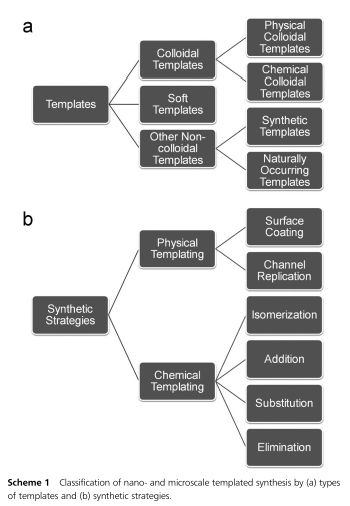 [ Last edited by nowitzki_ci on 2014-3-12 at 17:18 ] · 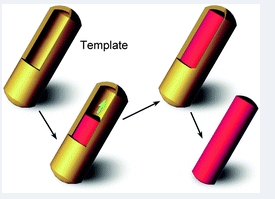 [ Last edited by nowitzki_ci on 2015-2-7 at 22:44 ] |
 回复此楼
回复此楼» 本帖附件资源列表
-
欢迎监督和反馈:小木虫仅提供交流平台,不对该内容负责。
本内容由用户自主发布,如果其内容涉及到知识产权问题,其责任在于用户本人,如对版权有异议,请联系邮箱:xiaomuchong@tal.com - 附件 1 : c2cs35369e.pdf
2014-03-12 17:17:03, 6.92 M
» 本帖已获得的红花(最新10朵)
 chzlf2797131
» 猜你喜欢
 修改论文,如何借助其他力量?
已经有4人回复
修改论文,如何借助其他力量?
已经有4人回复
-
中山大学潘越教授课题组2027级推免硕士研究生招生 新增一个专业医学技术名额
已经有21人回复
-
金属材料论文润色/翻译怎么收费?
已经有89人回复
-
哈尔滨工程大学国家级青年人才-27年申请考核制博士招生(材料、化学、生物医学专业)
已经有12人回复
-
HRTEM/原位TEM/HRSTEM检测|价格优·周期短·可加急
已经有0人回复
-
大家平时也可以交流下
已经有1人回复
» 本主题相关商家推荐: (我也要在这里推广)


343楼2014-12-18 08:53:19
简单回复
相识是缘2楼
2014-03-12 17:58
回复
五星好评 顶一下,感谢分享!
wkkkk3楼
2014-03-12 19:34
回复
五星好评 顶一下,感谢分享!
2014-03-12 19:41
回复
五星好评 顶一下,感谢分享!
2014-03-12 22:39
回复
五星好评 顶一下,感谢分享!
2014-03-13 08:31
回复
五星好评 顶一下,感谢分享!
2014-03-13 08:45
回复
五星好评 顶一下,感谢分享!
笃志笃行8楼
2014-03-13 11:19
回复
五星好评 顶一下,感谢分享!
2014-03-13 13:40
回复
五星好评 顶一下,感谢分享!
xuelai200910楼
2014-03-13 16:15
回复
五星好评 顶一下,感谢分享!
tandy_396411楼
2014-03-13 16:37
回复
五星好评 顶一下,感谢分享!
limh77052212楼
2014-03-13 18:13
回复
五星好评 顶一下,感谢分享!
guohuiqin13楼
2014-03-13 19:05
回复
五星好评 顶一下,感谢分享!
wangpinger14楼
2014-03-13 19:40
回复
五星好评 顶一下,感谢分享!


 200
200