









| 查看: 1928 | 回复: 3 | ||
Double_z金虫 (初入文坛)
|
[求助]
请问BWR中的压力控制池系统中的drywell和wet well的一般翻译是什么?
|

|
就是这个图里的drywell和wet well(Torus) 是不是wet well(Torus)就是翻译成压力控制池 那drywell翻译成什么?总不能是primary containment吧…… 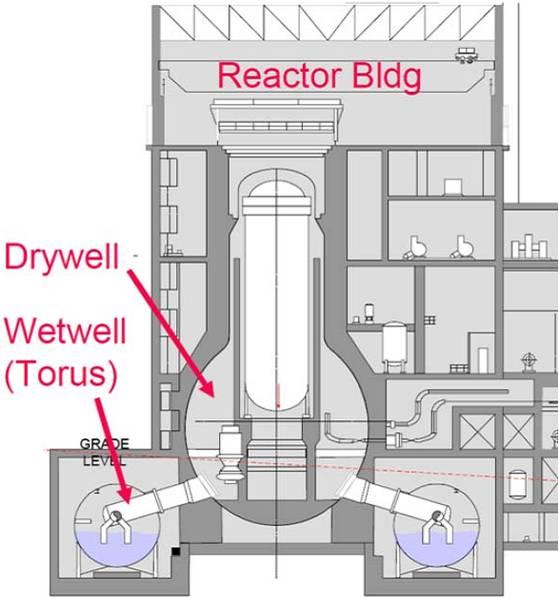 |
 回复此楼
回复此楼» 猜你喜欢
 申请科研项目纯靠实力能成功吗?
已经有11人回复
申请科研项目纯靠实力能成功吗?
已经有11人回复
-
40+中年人失业后,还能找到好工作吗?
已经有5人回复
-
极限拉扯,如何抉择
已经有15人回复
-
二审4个多月了还是Awaiting Reviewer Scores
已经有4人回复
-
OpenAI又攻克数学难题了,离AI做有机合成还有多远?
已经有13人回复
-
课题组会帮你通过考核么?
已经有7人回复
-
售一区SCI文章T0P,我:8O.551.O54,科目全,可十急
已经有9人回复
-
售SCI一区文章,我:8O5.5.1.O5.4,科目全,可伽急
已经有10人回复
-
售SCI一区T0P文章,我:8.O55.1.O.54,科目全,可十急
已经有8人回复
-
售SCI一区T0P文章,我:8.O55.1.O.54,科目全,可十急
已经有9人回复
googlefans
银虫 (小有名气)
- 应助: 6 (幼儿园)
- 金币: 314.3
- 散金: 300
- 帖子: 131
- 在线: 98.9小时
- 虫号: 1488251
- 注册: 2011-11-12
- 专业: 中国古代史
先复制下WIKI的解释等有空在和楼主探讨一下 In a BWR, the containment strategy is a bit different. A BWR's containment consists of a drywell where the reactor and associated cooling equipment is located and a wetwell. The drywell is much smaller than a PWR containment and plays a larger role. During the theoretical leakage design basis accident the reactor coolant flashes to steam in the drywell, pressurizing it rapidly. Vent pipes or tubes from the drywell direct the steam below the water level maintained in the wetwell (also known as a torus or suppression pool), condensing the steam, limiting the pressure ultimately reached. Both the drywell and the wetwell are enclosed by a secondary containment building, maintained at a slight sub-atmospheric or negative pressure during normal operation and refueling operations. The containment designs are referred to by the names Mark I, Mark II, and Mark III. The Mark I is the oldest, distinguished by a drywell containment which resembles an inverted lightbulb above the wetwell which is a steel torus containing water. The Mark II was used with late BWR-4 and BWR-5 reactors. It is called an "over-under" configuration with the drywell forming a truncated cone on a concrete slab. Below is a cylindrical suppression chamber made of concrete rather than just sheet metal. Both use a lighweight steel or concrete "secondary containment" over the top floor which is kept at a slight negative pressure so that air can be filtered. The top level is a large open space with an overhead crane suspended between the two long walls for moving heavy fuel caskets from the ground floor, and removing / replacing hardware from the reactor and reactor well. The reactor well can be flooded and is straddled by pools separated by gates on either side for storing reactor hardware normally placed above the fuel rods, and for fuel storage. A refueling platform has a specialized telescoping mast for lifting and lowering fuel rod assemblies with precision through the "cattle chute" to the reactor core area. |

2楼2013-04-02 11:01:00
Double_z
金虫 (初入文坛)
- 应助: 0 (幼儿园)
- 金币: 811
- 帖子: 41
- 在线: 23.6小时
- 虫号: 2047066
- 注册: 2012-10-07
- 性别: GG
- 专业: 工程热物理相关交叉领域
3楼2013-04-02 11:36:48
rhin000
新虫 (初入文坛)
- 应助: 0 (幼儿园)
- 金币: 24.4
- 散金: 156
- 帖子: 35
- 在线: 43.3小时
- 虫号: 1946136
- 注册: 2012-08-19
- 专业: 核技术及其应用
4楼2013-08-04 23:08:37

 200
200
