









| 查看: 923 | 回复: 4 | |||
| 本帖产生 1 个 翻译EPI ,点击这里进行查看 | |||
rockinuk铁杆木虫 (职业作家)
|
[求助]
求教化学方面的文章翻译~(简要的解说,非精翻译)--Part 1.
|
||

|
求教化学方面的文章翻译~(简要的解说,非精翻译) -- Part 1. 这篇内容是我向 RSC 索取的文件, 发表在 2002年 Chemistry in Britain 的一篇 title 为 Chemistry Encrypted 的论文~ (内容可能涉及生物化学还是分析化学方面~ 具体~我不清楚~) 因为想学这篇内容~ 但没有化学基础及知识背景~ 上来求教化学方面的专家~ 内容一个字一个字的输入进 word, 然后贴上来~ 所谓隔行如隔山~ 术业有专攻~ 这内容我不懂~ 特来请教这方面的专家~ ( 附件我放上 figure 1, figure 2. 及文字檔 chemistry encrypted9.doc) 我想知道~图一跟图二主要是在描述什么内容~ 我把文章依段落分成 5 段~ 放上来请专家帮忙解说~ 衷心感谢~ 谢谢~ Chemistry encrypted AFTER WITNESSING A COLLEAGUE’S transformation into a humanoid crustacean, with some feeling (and in bowdlerised form): You’ve got to be kidding’. Sometimes the audacity of a scientific idea can provoke a similar response. Columbia University chemistry professor Clark Still, while ruminating over a problem in combinatorial chemistry, had such an idea. When he explained it to his postdoctoral assistant, Micheal Ohlmeyer, it left the latter literally scratching his head. The problem that Still was thinking about was this. You have a large number millions of microscopic polystyrene beads. Each bead is coated with a different peptide. Some beads have stuck, via their peptides, to a clinically important target molecule. These sticky beads have identified themselves by going red in a diagnostic colour assay. Since the active peptides these beads display are potential drugs, it is essential to find out what their amino acid sequence are. How do you do it? Still imagined giving the amino acid sequence of the peptide on each bead a digital code. He limited himself to seven different amino acids, A-G, and numbered then in binary, A=001, B=010 and so on. The amino acid sequence could then be ‘digitised’ by placing the binary numbers of the amino acids in the order that they appeared in the peptide. So for a peptide with the amino acid sequence: D B A E F G C The digital code would be: 100 010 001 101 110 111 011 He then envisaged that the 1s and 0s at each of the 21 positions in this digital code would be represented by either the presence or absence of different tag molecules on the bead. These tags would be attached to the bead as the peptide was being assembled on it (Fig 1a). If the first amino acid was E(101), tag molecules 1 and 3 would cap a very small proportion of the reactive sites to which E is to be attached; E then couples to the remaining uncapped sites. The attachment of the second amino acid F(110) wound be accompanied by attachment of tag molecules 4 and 5. These new tags cap a small proportion of the first amino acid-sites where F would otherwise have attached. Further extension of the growing peptide chains is similarly by the addition of further tags. So if the third amino acid was G (111), this would be attached to the bead alongside tags 7, 8 and 9.Thus the encoding process is concurrent with peptide assembly. Once assembly is complete, each bead should have, in addition to many copies of a given peptide, its own digital code specifying the amino acid sequence of that peptide. The tags were to be attached to the reactive sites on the bead by a photocleavable link (Fig 1b), such that irradiating the bead with ultraviolet light would release them. They could then be subject to gas chromatography (GC), with the GC trace being the visible manifestation of the digital code. Therefore the tag molecules also needed to be easily detectable and resolvable by GC. Still chose a series of halogen-rich arenes for this purpose. The amino acid sequence of the gas chromatograph from left to right. Having an idea is one thing, realizing it quite another. To their considerable credit, Still and Ohlmeyer, along with six other co-workers did see it through. They built a library that theoretically contained 117649 different beads, each one digitally encoded for the peptide that it displayed. To see if their library was any good, they mixed it with an antibody they knew would bind to a particular peptide in the library. Amazingly, with this antibody they were able to pick out a bead that, when they read its digital code, had exactly this peptide. (They also picked out beads displaying peptides of related amino acid sequence.). Since this trail-blazing experiment - the first to make use of miniature barcode as far as I know - the bead encoding technology has been extended to include libraries of other small organic molecules besides peptides. Researchers have also refined the tagging step; the tag is now attached to the bead rather than to reactive sites used by the molecule being built. And the technology has spawned a drug discovery company – aptly named Pharmacopeia. figure 1.JPG 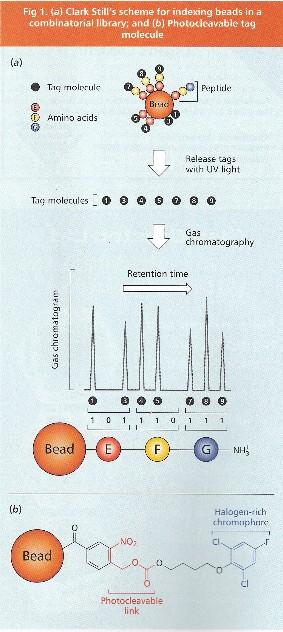 figure 2.JPG  |
 回复此楼
回复此楼» 本帖附件资源列表
-
欢迎监督和反馈:小木虫仅提供交流平台,不对该内容负责。
本内容由用户自主发布,如果其内容涉及到知识产权问题,其责任在于用户本人,如对版权有异议,请联系邮箱:xiaomuchong@tal.com - 附件 1 : chemistryencrypted9.doc
2013-01-24 10:32:58, 40 K
» 猜你喜欢
 郑州大学申博
已经有3人回复
郑州大学申博
已经有3人回复
-
40+中年人失业后,还能找到好工作吗?
已经有18人回复
-
人工智能虚构史料、伪造文献频现,多家期刊声明抵制
已经有5人回复
-
CsPbI2Br全无机钙钛矿SEM图像异常分析
已经有8人回复
-
申请科研项目纯靠实力能成功吗?
已经有12人回复

nwsuafliu
木虫 (著名写手)
- 翻译EPI: 144
- 应助: 42 (小学生)
- 金币: 2406.9
- 散金: 1449
- 红花: 18
- 帖子: 1437
- 在线: 315.6小时
- 虫号: 136928
- 注册: 2005-12-17
- 专业: 作物分子育种
【答案】应助回帖
|
在见证一个同事转变成一个人形甲壳类动物后,产生一丝感觉:你一定是在开玩笑吧。有时大胆的科学理念可以引起类似反应。哥伦比亚大学的化学教授Clark Still在反复思考组合化学中一个问题时,产生如此想法。他向他的的博士后助理Micheal Ohlmeyer解释这个时,后者挠头。。 Still教授在思考的问题是这样的。你有一个数以百万计的聚苯乙烯微珠。每个微珠上裹有不同的肽。有些微珠能通过它们的肽来结合某个临床上重要的靶分子。这些粘性微珠在诊断性颜色分析中变红,从而得到识别。由于这些微珠显示的活性肽是潜在的药物,有必要找出什么是其氨基酸序列。你怎么办呢? Still想象,给每个微珠上肽段的氨基酸序列一个数字码。他自己限定了7个不同的氨基酸A到G,进行二进制编号,A =001,B =010,如此以往。然后,按照这些氨基酸在肽中出现的顺序,排列氨基酸对应的二进制数字,实现氨基酸序列的“数字化”。因此,对于一个氨基酸序列为DBAEFGC的肽,其数字码是100 010 001 101 110 111 011 |

2楼2013-01-24 17:16:16
nwsuafliu
木虫 (著名写手)
- 翻译EPI: 144
- 应助: 42 (小学生)
- 金币: 2406.9
- 散金: 1449
- 红花: 18
- 帖子: 1437
- 在线: 315.6小时
- 虫号: 136928
- 注册: 2005-12-17
- 专业: 作物分子育种
【答案】应助回帖
|
然后,他设想在这组包含21个位置的数字码种,1和0分别代表珠子上不同标签分子的存在或不存在。当肽被组装在珠子上时,这些标签也附着在珠子上(图1a)。如果首个氨基酸是E(101),标签分子1和3将捕获结合E的活性位点的一小部分,而E和剩余的未捕获位点联结。第2个氨基酸F(110)和珠子的结合,则伴随标签分子4和5的结合。这些新标签捕获了首个氨基酸位点的一小部分,否则这些位点将被F占据。 进一步增加标签,就可以延伸肽链。因此如果第3个氨基酸是G(111),将沿着标签7、8和9附加在珠子上。因此编码过程和肽装配并行。一旦组装完成,每个珠子除了有某个肽的很多拷贝,也应该有代表该肽的氨基酸序列的珠子自身的数字代码。 |
3楼2013-01-24 17:33:28
nwsuafliu
木虫 (著名写手)
- 翻译EPI: 144
- 应助: 42 (小学生)
- 金币: 2406.9
- 散金: 1449
- 红花: 18
- 帖子: 1437
- 在线: 315.6小时
- 虫号: 136928
- 注册: 2005-12-17
- 专业: 作物分子育种
【答案】应助回帖
★ ★ ★ ★ ★ ★ ★ ★ ★ ★ ★ ★ ★ ★ ★ ★ ★ ★ ★ ★ ★ ★ ★ ★ ★ ★ ★ ★ ★ ★ ★ ★ ★ ★ ★ ★ ★ ★ ★ ★ ★ ★ ★ ★ ★ ★ ★ ★ ★ ★ ★ ★ ...
rockinuk: 金币+100, 翻译EPI+1, ★★★★★最佳答案, 一次全给~谢谢帮忙~^^ 2013-02-03 13:49:30
rockinuk: 金币+100, 翻译EPI+1, ★★★★★最佳答案, 一次全给~谢谢帮忙~^^ 2013-02-03 13:49:30
|
这些标签由可被光切割的链附着在珠子的活性位点,因此用紫外光照射,可以释放这些标签。这些标签然后用于气相色谱分析,气象色谱跟踪实现数字码的可视化。因此,标签分子也需要容易通过气象色谱检测和解析。Still教授选择了一系列富含卤素的芳烃用于此目的。气相色谱仪给出从左到右的氨基酸序列。 有想法是一回事,实现想法是另一回事。Still等8人建立了一个库,理论上包含117649种不同珠子,每一个珠子含有其显示的多肽的数字码。为了测试他们的库是否好用,他们混入一个已知的抗体,这个抗体会和库中的某个特定肽结合。奇妙的是,通过这个抗体,他们可以钓出一个珠子,当他们读取其数字代码时发现,正是带有这一特定肽的珠子。 (他们也钓到一些显示相关氨基酸序列的肽的珠子)。 由于这一开拓性的实验,据我所知属于首家使用微型条码, 珠子编码技术已经从肽扩展到包括其他有机小分子的库。研究人员还细化了标签步骤。现在,标签分子附着在珠子上,而不再是附着在标签分子所用的活性位点。而且该技术已经催生了一家药物研发公司,恰如其分地命名为药典(Pharmacopeia)。 |
4楼2013-01-24 17:51:00
nwsuafliu
木虫 (著名写手)
- 翻译EPI: 144
- 应助: 42 (小学生)
- 金币: 2406.9
- 散金: 1449
- 红花: 18
- 帖子: 1437
- 在线: 315.6小时
- 虫号: 136928
- 注册: 2005-12-17
- 专业: 作物分子育种
5楼2013-01-24 17:52:50