









| 查看: 3215 | 回复: 4 | ||
| 当前只显示满足指定条件的回帖,点击这里查看本话题的所有回帖 | ||
狗哥金虫 (小有名气)
|
[求助]
计时库仑法参数设置问题 已有1人参与
|
|

之前没有接触过计时库仑法,看到文献描述的chronocoulometry (CC): pulse period=500 ms, pulse width=500 mV. 不知道pulse period=500ms这个参数是怎么设定的哦? 知道的师兄师姐指点一下 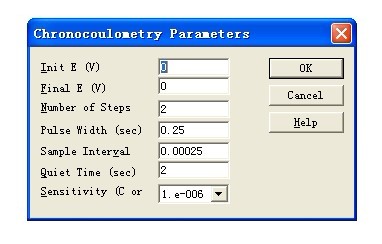 |
 回复此楼
回复此楼» 猜你喜欢
 27年化学方向博士自荐
已经有0人回复
27年化学方向博士自荐
已经有0人回复
-
印染废水脱色之争
已经有0人回复
-
物理化学论文润色/翻译怎么收费?
已经有269人回复
-
辰华电化学工作站型号及软件版本
已经有0人回复
-
石墨极板 改性增效 还是 概念包装?表面改性技术的实测检验
已经有0人回复
» 本主题相关价值贴推荐,对您同样有帮助:
- 用卡尔费休库仑法测定易结晶的化合物
已经有11人回复
- 分子动力学模拟长程库仑势的处理问题
已经有8人回复
- 求助关于控制电位电解库仑法的参数设置
已经有5人回复
- 【求助】50金币求助 设计实验:库仑滴定法测定水中微量铬
已经有9人回复
123just
金虫 (正式写手)
- 应助: 133 (高中生)
- 金币: 2908.7
- 散金: 20
- 红花: 26
- 帖子: 508
- 在线: 213.2小时
- 虫号: 1159825
- 注册: 2010-12-01
- 性别: GG
- 专业: 电化学


4楼2017-01-04 15:57:55
abc5710110
金虫 (著名写手)
- ECEPI: 3
- 应助: 33 (小学生)
- 金币: 93.4
- 散金: 1209
- 红花: 10
- 帖子: 2140
- 在线: 238.5小时
- 虫号: 1194602
- 注册: 2011-01-22
- 性别: GG
- 专业: 生化分析及生物传感
|
我们的工作站CHI660D的说明书介绍:希望能对你有帮助 Parameters for Chronocoulometry In Chronocoulometry (CC), potential is stepped from Init E toward Fianl E. The potential may step back. The following diagram shows the potential waveform applied as the function of time. The charge passing through the working electrode is recorded as the function of time. The following are the experimental parameters, their range and descriptions: Parameters Range Description Init E (V) -10 - +10 Initial potential Final E (V) -10 - +10 Final potential Number of Steps 1 - 320 Number of potential steps Pulse Width (sec) 1e-4 - 1000 Potential pulse width Sample Interval (s) 1e-6 - 10 Sampling Interval Quiet Time (sec) 0 - 100000 Quiescent time before potential step Sensitivity (C or A/V) 1e-12 - 0.1 or 1e-9C/V - 1e-6 C/V Sensitivity scale Notes: 1. Init E and Final E should be at least 0.01 V apart. 2. The maximum potential step range is 13.1 V. 3. A true integrator (charge-to-voltage converter) can be chosen. In this case, the sensitivity is 1e-9C/V to 1e-6C/V. If the charge exceeds the 8e-6 coulomb, the capacitor of the Potential(V) Init E Time (s) Final E Step 1 Step 2 Step 3 Init E Final E 0 Pulse Width Pulse WidthChapter 4. Setup Menu ________________________________________________________________________ 4-13 integrator will be discharged and the new charge will be added to the previous value. This allows higher charge to be measured with the integrator. There might be discontinuity in charge-time curve due to the capacitor discharge. The discontinuity should be negligible. However, if it is significant to the measurement, you may choose to use the current-to- voltage converter and integrate the current measured by software. 4. Current-to-voltage converter is not ideal for chronocoulometry, particularly if the early transient data is important, such as double layer capacitance, or surface reactions. Charge-to- voltage converter (true integrator) is a better choice. 5. If current-to-voltage converter is selected due to high total charge, shorter sample interval will increase data density, but will reduce the signal-to-noise ratio. If earlier transient data is important, shorter sample interval is recommended. If the later part of data is of interest, longer sample interval is recommended. However, minimum 1000 points per step are required, unless sampling rate does not allow it. 6. If the sample interval is less than 0.002s, the data will not be transferred on the real-time base. Instead the data will be transferred after the experiment is completed. Cell is turned off during the data transfer unless the Cell On between Run option is selected. From start of experiment and data transfer there is a delay. The total number of data points will be limited to 64K due to internal memory size limitation. Sample interval might be automatically altered to adjust the data points in the reasonable range. 7. If the sample interval is longer than 0.002s, data will be transferred during experiment. Maximum 64K total data points are allowed for each step. Sample interval might be automatically altered to adjust the data points in the reasonable range. 8. If the current-to-voltage converter is used, during the run, an “Overflow” warning might appear. This is due to the current transient immediately after the potential step. If the intercept (that gives information of double layer capacitance and adsorption) of Anson plot (Q-t 1/2 plot) is not your primary interest, you may not worry about it. However, if the data distortion can be seen visually, you have to lower the sensitivity scale. Sometimes, you may use i/E converter filter to slow the system down, but make sure that the time constant of the filter (1/cutoff freq) is much shorter than the pulse width. In order to reduce noise and enhance the accuracy of the measurement, it is recommended to use the highest sensitivity scale possible. 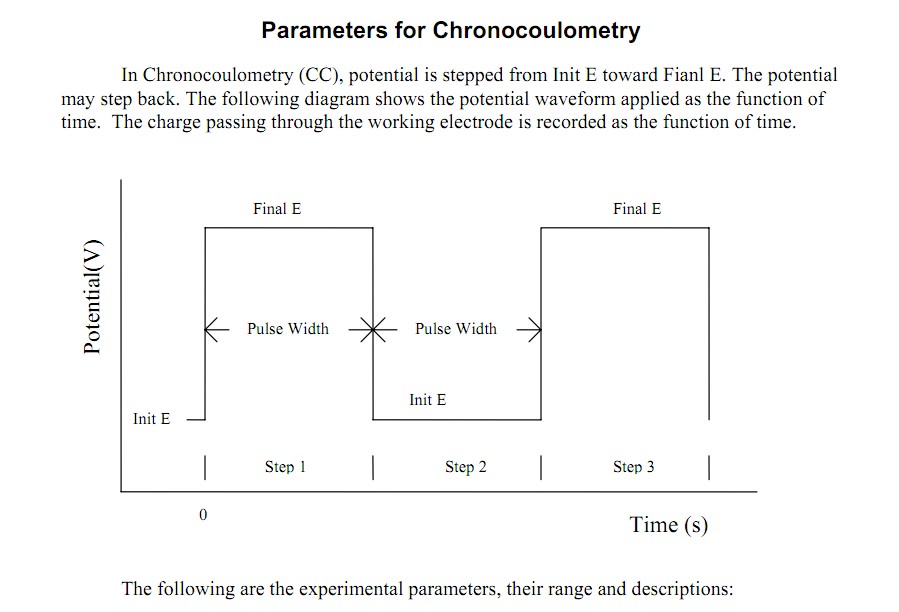 |
2楼2012-02-19 10:44:34
3楼2017-01-04 11:11:49
夏小七小能蛋
新虫 (初入文坛)
- 应助: 0 (幼儿园)
- 金币: 58.9
- 散金: 15
- 帖子: 17
- 在线: 4.7小时
- 虫号: 5227554
- 注册: 2016-11-12
- 性别: MM
- 专业: 电化学分析
5楼2017-07-25 15:38:36


 200
200