









| 查看: 1291 | 回复: 18 | ||||
| 【奖励】 本帖被评价16次,作者wenke1526增加金币 12.4 个 | ||||
[资源]
Theory of Phase Transitions in Polypeptides and Proteins (Springer Theses)2011
|
||||

|
There are nearly 100 000 different protein sequences encoded in the human genome, each with its own specific fold. Understanding how a newly formed polypeptide sequence finds its way to the correct fold is one of the greatest challenges in the modern structural biology. The aim of this thesis is to provide novel insights into protein folding by considering the problem from the point of view of statistical mechanics. The thesis starts by investigating the fundamental degrees of freedom in polypeptides that are responsible for the conformational transitions. This knowledge is then applied in the statistical mechanics description of helix?coil transitions in polypeptides. Finally, the theoretical formalism is generalized to the case of proteins in an aqueous environment. The major novelty of this work lies in comabining (a) a formalism based on fundamental physical properties of the system and (b) the resulting possibility of describing the folding?unfolding transitions quantitatively. The clear physical nature of the formalism opens the way to further applications in a large variety of systems and processes. Common terms and phrases: amino acids degrees of freedom dihedral angles heat capacity molecular dynamics partition function potential energy surface protein folding random coil Cover Springer Theses Theory of Phase Transitions in Polypeptides and Proteins ISBN 9783642227318 Supervisor’s Foreword Acknowledgments Contents 1 Introduction 1.1 Problems Addressed in the Thesis References 2 Theoretical Methods of Quantum Mechanics 2.1 Introduction 2.2 The Schrödinger Equation 2.3 The Born--Oppenheimer Approximation 2.4 Properties of the Wavefunction 2.5 Hartree--Fock Theory 2.6 Density Functional Theory 2.7 Molecular Mechanics Approach: a Way to Overcome the Complexity of Quantum Mechanics References 3 Degrees of Freedom in Polypeptides and Proteins 3.1 Introduction 3.2 Conformational Properties of Alanine and Glycine Chains 3.2.1 Determination of the Polypeptides Twisting Degrees of Freedom 3.2.2 Optimized Geometries of Alanine Polypeptides 3.2.3 Polypeptide Energy Dependance On the Dihedral Angle . 3.2.4 Potential Energy Surface for Alanine Tripeptide 3.2.5 Potential Energy Surface for Alanine Hexapeptide with the Sheet and the Helix Secondary Structure 3.2.6 Comparison of Calculation Results with Experimental Data 3.3 Conformational Changes in Glycine Tri- and Hexa-Peptide 3.3.1 Optimized Geometries of Glycine Polypeptides 3.3.2 Potential Energy Surface for Glycine Tripeptide 3.3.3 Potential Energy Surface for Glycine Hexapeptide with the Sheet and the Helix Secondary Structure 3.3.4 Comparison of Calculation Results with Experimental Data References 4 Partition Function of a Polypeptide 4.1 Introduction 4.2 Molecular Mechanics Potential 4.3 Hamiltonial of a Polypeptide Chain 4.4 Construction of the Partition Function 4.5 Thermodynamical Characteristics of a Polypeptide Chain References 5 Phase Transitions in Polypeptides 5.1 Introduction 5.2 Molecular Dynamics Simulations 5.3 a-HelixRandom Coil Phase Transition in Polyalanine 5.3.1 Accuracy of the Molecular Mechanics Potential 5.3.2 Potential Energy Surface of Alanine Polypeptide 5.3.3 Internal Energy of Alanine Polypeptide 5.3.4 Heat Capacity of Alanine Polypeptide 5.3.5 Calculation of the Zimm--Bragg Parameters 5.3.6 Helicity of Alanine Polypeptides 5.3.7 Correlation of Different Amino Acids in the Polypeptide 5.4 Phase Transitions in Polypeptides: Analysis of Energy Fluctuations 5.4.1 Fluctuations of Internal Energy and Heat Capacity 5.4.2 a-Helix Random Coil Transition in Alanine Polypeptide 5.4.3 p-Helix Random Coil Transition in Valine Polypeptide 5.4.4 p-Helix Random Coil Transition in Leucine Polypeptide 5.4.5 Appendix: Parameters of MD Simulation References 6 Folding of Proteins in Aqueous Environment 6.1 Introduction 6.2 Theoretical Methods 6.2.1 Partition Function of a Protein 6.2.2 Partition Function of a Protein in Water Environment 6.3 Results and Discussion 6.3.1 Heat Capacity of Staphylococcal Nuclease 6.3.2 Heat Capacity of Metmyoglobin References 7 Summary and Conclusions References u08eZUThffEC 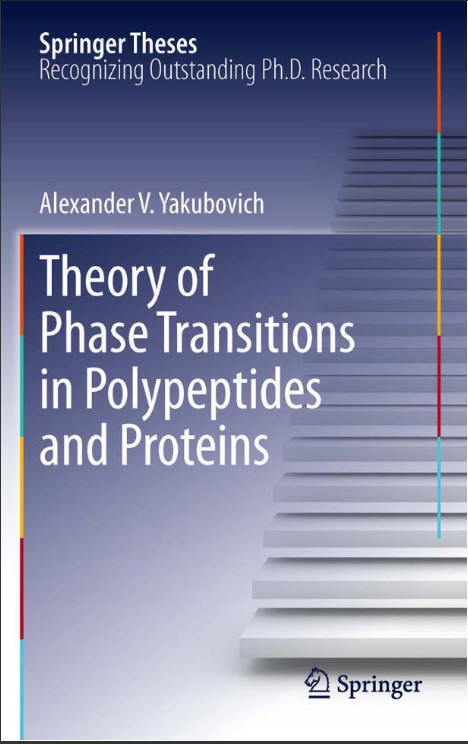 [ Last edited by wenke1526 on 2011-12-14 at 11:13 ] |
 回复此楼
回复此楼» 本帖附件资源列表
-
欢迎监督和反馈:小木虫仅提供交流平台,不对该内容负责。
本内容由用户自主发布,如果其内容涉及到知识产权问题,其责任在于用户本人,如对版权有异议,请联系邮箱:xiaomuchong@tal.com - 附件 1 : ebooksclub.org__Theory_of_Phase_Transitions_in_Polypeptides_and_Proteins__Springer_Theses_.pdf
2011-12-14 11:13:26, 2.8 M
» 收录本帖的淘帖专辑推荐
 锂电收藏 锂电收藏 | 国外专业电子书 |
» 猜你喜欢
 MDPI [Applied Sciences, Land, Remote Sensing, Sensors] 专题征稿
已经有1人回复
MDPI [Applied Sciences, Land, Remote Sensing, Sensors] 专题征稿
已经有1人回复
-
MDPI 多期刊联合专题征稿
已经有1人回复
-
冶金与矿业论文润色/翻译怎么收费?
已经有67人回复
-
MDPI 多期刊联合专题征稿—AI 材料
已经有0人回复
-
新加坡南洋理工大学NTU诚招电池相关方向博后
已经有28人回复
-
800摄氏度下薄膜电导率测量
已经有2人回复
-
九水硝酸铁作为碳前驱体石墨化催化剂的制备求助
已经有0人回复
-
碳材料在水中无法分散,如何在不改性的情况下使其在水中均匀分散
已经有2人回复
-
北京师范大学珠海校区|材料计算/第一性原理/极端条件材料|招收博士生1-2名
已经有0人回复
-
山东大学晶体材料全国重点实验室招收2027年锂金属电池负极材料博士一名
已经有105人回复
-
求XFD挂槽浮选机搅拌装置仿真模型
已经有0人回复
» 本主题相关价值贴推荐,对您同样有帮助:
- [2011-11-20][深圳]第九届全国物理有机化学学术会议
已经有60人回复
- 菜鸟急求Max phase 最基本知识 求各位前辈帮忙!
已经有5人回复
- 【求助】分析柱1.5min出峰,比例不管怎么调出峰时间变化不大?
已经有17人回复
- Journal of Colloid and Interface Science
已经有6人回复
- 【资源】Theory and Experiment in Electrocatalysis
已经有5人回复
- 【求助】Frontiers of Environmental Science and Engineering in China是SCI收录吗?
已经有6人回复
简单回复
2011-12-14 11:14
回复

vaughn3楼
2011-12-14 11:38
回复
三星好评 顶一下,感谢分享!
2011-12-14 11:50
回复
三星好评 顶一下,感谢分享!
zhke5235楼
2011-12-14 15:56
回复
五星好评 顶一下,感谢分享!
2011-12-14 16:28
回复
五星好评 顶一下,感谢分享!
dzb164097楼
2011-12-15 08:59
回复
五星好评 顶一下,感谢分享! 
lanxzh8楼
2012-05-12 06:24
回复
五星好评 顶一下,感谢分享!
杨寻9楼
2012-11-17 10:05
回复
五星好评 顶一下,感谢分享!
liusheng631110楼
2012-11-22 22:34
回复
五星好评 顶一下,感谢分享!
2012-12-29 16:43
回复
五星好评 顶一下,感谢分享!
2012-12-29 17:22
回复
顶一下,感谢分享!
xiefenxiefen13楼
2013-01-23 20:10
回复
五星好评 顶一下,感谢分享!
jhoo14楼
2013-08-30 16:02
回复
五星好评 顶一下,感谢分享!
一泓山人15楼
2013-09-07 17:01
回复
五星好评 顶一下,感谢分享!
geniuswq16楼
2013-09-24 18:11
回复
五星好评 顶一下,感谢分享!
迷失的羊羔17楼
2013-12-14 08:44
回复
五星好评 顶一下,感谢分享!
ypghnust6118楼
2013-12-20 14:41
回复
五星好评 顶一下,感谢分享!
lerel1234519楼
2019-02-20 17:29
回复
五星好评 顶一下,感谢分享!