









| 查看: 4165 | 回复: 12 | ||||||
ggrk至尊木虫 (职业作家)
理论与实践相结合
|
[交流]
Bioanalytical chemistry-John Wiley & Sons 已有10人参与
|

Bioanalytical chemistry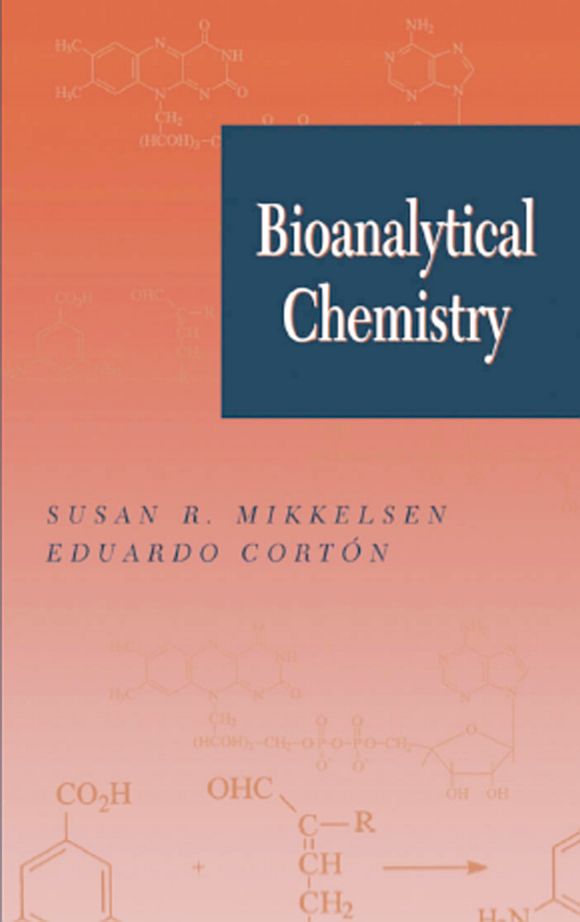 CONTENTS Preface xv Acknowledgments xvii 1. Spectroscopic Methods for Matrix Characterization 1 1.1 Introduction 1 1.2 Total Protein 2 1.2.1 Lowry Method 3 1.2.2 Smith (BCA) Method 3 1.2.3 Bradford Method 4 1.2.4 Ninhydrin-Based Assay 5 1.2.5 Other Protein Quantitation Methods 5 1.3 Total DNA 7 1.3.1 Diaminobenzoic Acid Method 7 1.3.2 Diphenylamine Method 9 1.3.3 Other Fluorometric Methods 9 1.4 Total RNA 10 1.5 Total Carbohydrate 11 1.5.1 Ferricyanide Method 11 1.5.2 Phenol–Sulfuric Acid Method 11 1.5.3 2-Aminothiophenol Method 12 1.5.4 Purpald Assay for Bacterial Polysaccharides 12 1.6 Free Fatty Acids 13 References 14 Problems 15 2. Enzymes 16 2.1 Introduction 16 2.2 Enzyme Nomenclature 17 2.3 Enzyme Commission Numbers 18 2.4 Enzymes in Bioanalytical Chemistry 19 2.5 Enzyme Kinetics 21 2.5.1 Simple One-Substrate Enzyme Kinetics 23 2.5.2 Experimental Determination of Michaelis–Menten Parameters 24 v 2.5.2.1 Eadie–Hofstee Method 25 2.5.2.2 Hanes Method 25 2.5.2.3 Lineweaver–Burk Method 26 2.5.2.4 Cornish–Bowden–Eisenthal Method 27 2.5.3 Comparison of Methods for the Determination of Km Values 28 2.5.4 One-Substrate, Two-Product Enzyme Kinetics 29 2.5.5 Two-Substrate Enzyme Kinetics 29 2.5.6 Examples of Enzyme-Catalyzed Reactions and Their Treatment 31 2.6 Enzyme Activators 32 2.7 Enzyme Inhibitors 33 2.7.1 Competitive Inhibition 34 2.7.2 Noncompetitive Inhibition 35 2.7.3 Uncompetitive Inhibition 35 2.8 Enzyme Units and Concentrations 36 Suggested References 38 References 38 Problems 38 3. Quantitation of Enzymes and Their Substrates 41 3.1 Introduction 41 3.2 Substrate Depletion or Product Accumulation 42 3.3 Direct and Coupled Measurements 43 3.4 Classification of Methods 45 3.5 Instrumental Methods 47 3.5.1 Optical Detection 47 3.5.1.1 Absorbance 47 3.5.1.2 Fluorescence 49 3.5.1.3 Luminescence 51 3.5.1.4 Nephelometry 53 3.5.2 Electrochemical Detection 53 3.5.2.1 Amperometry 53 3.5.2.2 Potentiometry 54 3.5.2.3 Conductimetry 54 3.5.3 Other Detection Methods 55 3.5.3.1 Radiochemical 55 3.5.3.2 Manometry 55 3.5.3.3 Calorimetry 56 3.6 Ultra-High-Throughput Assays (HTA) 56 3.7 Practical Considerations for Enzymatic Assays 57 Suggested References 57 vi CONTENTS References 57 Problems 58 4. Immobilized Enzymes 61 4.1 Introduction 61 4.2 Immobilization Methods 61 4.2.1 Nonpolymerizing Covalent Immobilization 62 4.2.1.1 Controlled-Pore Glass 63 4.2.1.2 Polysaccharides 64 4.2.1.3 Polyacrylamide 65 4.2.1.4 Acidic Supports 66 4.2.1.5 Anhydride Groups 67 4.2.1.6 Thiol Groups 67 4.2.2 Cross-Linking with Bifunctional Reagents 68 4.2.3 Adsorption 69 4.2.4 Entrapment 69 4.2.5 Microencapsulation 70 4.3 Properties of Immobilized Enzymes 71 4.4 Immobilized Enzyme Reactors 76 4.5 Theoretical Treatment of Packed-Bed Enzyme Reactors 79 Suggested References 82 References 82 Problems 83 5. Antibodies 86 5.1 Introduction 86 5.2 Structural and Functional Properties of Antibodies 87 5.3 Polyclonal and Monoclonal Antibodies 90 5.4 Antibody–Antigen Interactions 91 5.5 Analytical Applications of Secondary Antibody–Antigen Interactions 93 5.5.1 Agglutination Reactions 93 5.5.2 Precipitation Reactions 94 Suggested References 97 References 97 Problems 98 6. Quantitative Immunoassays with Labels 99 6.1 Introduction 99 6.2 Labeling Reactions 101 6.3 Heterogeneous Immunoassays 102 CONTENTS vii 6.3.1 Labeled-Antibody Methods 104 6.3.2 Labeled-Ligand Assays 104 6.3.3 Radioisotopes 106 6.3.4 Fluorophores 107 6.3.4.1 Indirect Fluorescence 108 6.3.4.2 Competitive Fluorescence 108 6.3.4.3 Sandwich Fluorescence 108 6.3.4.4 Fluorescence Excitation Transfer 108 6.3.4.5 Time-Resolved Fluorescence 109 6.3.5 Chemiluminescent Labels 110 6.3.6 Enzyme Labels 112 6.4 Homogeneous Immunoassays 116 6.4.1 Fluorescent Labels 116 6.4.1.1 Enhancement Fluorescence 116 6.4.1.2 Direct Quenching Fluorescence 116 6.4.1.3 Indirect Quenching Fluorescence 117 6.4.1.4 Fluorescence Polarization Immunoassay 117 6.4.1.5 Fluorescence Excitation Transfer 118 6.4.2 Enzyme Labels 118 6.4.2.1 Enzyme-Multiplied Immunoassay Technique 118 6.4.2.2 Substrate-Labeled Fluorescein Immunoassay 119 6.4.2.3 Apoenzyme Reactivation Immunoassay (ARIS) 119 6.4.2.4 Cloned Enzyme Donor Immunoassay 120 6.4.2.5 Enzyme Inhibitory Homogeneous Immunoassay 120 6.5 Evaluation of New Immunoassay Methods 121 Suggested References 126 References 126 Problems 127 7. Biosensors 131 7.1 Introduction 131 7.2 Response of Enzyme-Based Biosensors 132 7.3 Examples of Biosensor Configurations 135 7.3.1 Ferrocene-Mediated Amperometric Glucose Sensor 135 7.3.2 Potentiometric Biosensor for Phenyl Acetate 137 7.3.3 Potentiometric Immunosensor for Digoxin 138 7.3.4 Evanescent-Wave Fluorescence Biosensor for Bungarotoxin 139 7.3.5 Optical Biosensor for Glucose Based on Fluorescence Energy Transfer 141 7.3.6 Piezoelectric Sensor for Nucleic Acid Detection 142 7.3.7 Enzyme Thermistors 144 viii CONTENTS 7.4 Evaluation of Biosensor Performance 145 Suggested References 147 References 147 Problems 148 8. Directed Evolution for the Design of Macromolecular Bioassay Reagents 150 8.1 Introduction 150 8.2 Rational Design and Directed Evolution 152 8.3 Generation of Genetic Diversity 154 8.3.1 Polymerase Chain Reaction and Error-Prone PCR 155 8.3.2 DNA Shuffling 157 8.4 Linking Genotype and Phenotype 158 8.4.1 Cell Expression and Cell Surface Display (in vivo) 158 8.4.2 Phage Display (in vivo) 159 8.4.3 Ribosome Display (in vitro) 160 8.4.4 mRNA-Peptide Fusion (in vitro) 160 8.4.5 Microcompartmentalization (in vitro) 160 8.5 Identification and Selection of Successful Variants 161 8.5.1 Identification of Successful Variants Based on Binding Properties 162 8.5.2 Identification of Successful Variants Based on Catalytic Activity 163 8.6 Directed Evolution of Galactose Oxidase 164 Suggested References 165 References 165 Problems 166 9. Principles of Electrophoresis 167 9.1 Introduction 167 9.2 Electrophoretic Support Media 171 9.2.1 Paper 171 9.2.2 Starch Gels 172 9.2.3 Polyacrylamide Gels 173 9.2.4 Agarose Gels 177 9.2.5 Polyacrylamide–Agarose Gels 177 9.3 Effect of Experimental Conditions on Electrophoretic Separations 177 9.4 Electric Field Strength Gradients 178 9.5 Detection of Proteins and Nucleic Acids After Electrophoretic Separation 180 9.5.1 Stains and Dyes 181 CONTENTS ix 9.5.2 Detection of Enzymes by Substrate Staining 183 9.5.3 The Southern Blot 184 9.5.4 The Northern Blot 184 9.5.5 The Western Blot 185 9.5.6 Detection of DNA Fragments on Membranes with DNA Probes 185 Suggested References 188 References 188 Problems 189 10. Applications of Zone Electrophoresis 191 10.1 Introduction 191 10.2 Determination of Protein Net Charge and Molecular Weight Using PAGE 191 10.3 Determination of Protein Subunit Composition and Subunit Molecular Weights 193 10.4 Molecular Weight of DNA by Agarose Gel Electrophoresis 195 10.5 Identification of Isoenzymes 196 10.6 Diagnosis of Genetic (Inherited) Disease 197 10.7 DNA Fingerprinting and Restriction Fragment Length Polymorphism 199 10.8 DNA Sequencing with the Maxam–Gilbert Method 202 10.9 Immunoelectrophoresis 206 Suggested References 210 References 211 Problems 211 11. Isoelectric Focusing 213 11.1 Introduction 213 11.2 Carrier Ampholytes 214 11.3 Modern IEF with Carrier Ampholytes 216 11.4 Immobilized pH Gradients (IPGs) 219 11.5 Two-Dimensional Electrophoresis 222 Suggested References 224 References 225 Problems 225 12. Capillary Electrophoresis 227 12.1 Introduction 227 12.2 Electroosmosis 229 12.3 Elution of Sample Components 229 12.4 Sample Introduction 230 x CONTENTS 12.5 Detectors for Capillary Electrophoresis 231 12.5.1 Laser-Induced Fluorescence Detection 232 12.5.2 Mass Spectrometric Detection 235 12.5.3 Amperometric Detection 236 12.5.4 Radiochemical Detection 239 12.6 Capillary Polyacrylamide Gel Electrophoresis (C-PAGE) 240 12.7 Capillary Isoelectric Focusing (CIEF) 242 Suggested References 244 References 244 Problems 244 13. Centrifugation Methods 247 13.1 Introduction 247 13.2 Sedimentation and Relative Centrifugal g Force 247 13.3 Centrifugal Forces in Different Rotor Types 249 13.3.1 Swinging-Bucket Rotors 249 13.3.2 Fixed-Angle Rotors 250 13.3.3 Vertical Rotors 250 13.4 Clearing Factor (k) 251 13.5 Density Gradients 252 13.5.1 Materials Used to Generate a Gradient 252 13.5.2 Constructing Pre-Formed and Self-Generated Gradients 253 13.5.3 Redistribution of the Gradient in Fixed-Angle and Vertical Rotors 254 13.6 Types of Centrifugation Techniques 255 13.6.1 Differential Centrifugation 255 13.6.2 Rate-Zonal Centrifugation 256 13.6.3 Isopycnic Centrifugation 257 13.7 Harvesting Samples 257 13.8 Analytical Ultracentrifugation 257 13.8.1 Instrumentation 258 13.8.2 Sedimentation Velocity Analysis 259 13.8.3 Sedimentation Equilibrium Analysis 262 13.9 Selected Examples 263 13.9.1 Analytical Ultracentrifugation for Quaternary Structure Elucidation 263 13.9.2 Isolation of Retroviruses by Self-Generated Gradients 264 13.9.3 Isolation of Lipoproteins from Human Plasma 264 Suggested References 265 References 265 Problems 266 CONTENTS xi 14. Chromatography of Biomolecules 268 14.1 Introduction 268 14.2 Units and Definitions 268 14.3 Plate Theory of Chromatography 269 14.4 Rate Theory of Chromatography 270 14.5 Size Exclusion (Gel Filtration) Chromatography 272 14.6 Gel Matrices for Size Exclusion Chromatography 277 14.7 Affinity Chromatography 278 14.7.1 Immobilization of Affinity Ligands 280 14.7.2 Elution Methods 281 14.7.3 Determination of Association Constants by High-Performance Affinity Chromatography 283 14.8 Ion-Exchange Chromatography 286 14.8.1 Retention Model for Ion-Exchange Chromatography of Polyelectrolytes 288 Suggested References 292 References 293 Problems 293 15. Mass Spectrometry of Biomolecules 295 15.1 Introduction 295 15.2 Basic Description of the Instrumentation 297 15.2.1 Soft Ionization Sources 297 15.2.1.1 Fast Atom–Ion Bombardment 297 15.2.1.2 Electrospray Ionization 299 15.2.1.3 Matrix-Assisted Laser Desorption/Ionization 299 15.2.2 Mass Analyzers 300 15.2.3 Detectors 303 15.3 Interpretation of Mass Spectra 304 15.4 Biomolecule Molecular Weight Determination 308 15.5 Protein Identification 310 15.6 Protein–Peptide Sequencing 312 15.7 Nucleic Acid Applications 315 15.8 Bacterial Mass Spectrometry 318 Suggested References 318 References 319 Problems 320 16. Validation of New Bioanalytical Methods 322 16.1 Introduction 322 16.2 Precision and Accuracy 323 xii CONTENTS 16.3 Mean and Variance 324 16.4 Relative Standard Deviation and Other Precision Estimators 325 16.4.1 Distribution of Errors and Confidence Limits 325 16.4.2 Linear Regression and Calibration 326 16.4.3 Precision Profiles 328 16.4.4 Limit of Quantitiation and Detection 329 16.4.5 Linearizing Sigmoidal Curves (Four-Parameter Log-Logit Model) 329 16.4.6 Effective Dose Method 331 16.5 Estimation of Accuracy 332 16.5.1 Standardization 333 16.5.2 Matrix Effects 333 16.5.2.1 Recovery 333 16.5.2.2 Parallelism 333 16.5.3 Interferences 334 16.6 Qualitative (Screening) Assays 335 16.6.1 Figures of Merit for Qualitative (Screening) Assays 335 16.7 Examples of Validation Procedures 336 16.7.1 Validation of a Qualitative Antibiotic Susceptibility Test 336 16.7.2 Measurement of Plasma Homocysteine by Fluorescence Polarization Immunoassay (FPIA) Methodology 337 16.7.3 Determination of Enzymatic Activity of b-Galactosidase 340 16.7.4 Establishment of a Cutoff Value for Semi-Quantitative Assays for Cannabinoids 342 Suggested References 344 References 345 Answers to Problems 346 Index 357 虫友们给个评价哈~ |
 回复此楼
回复此楼» 本帖附件资源列表
-
欢迎监督和反馈:小木虫仅提供交流平台,不对该内容负责。
本内容由用户自主发布,如果其内容涉及到知识产权问题,其责任在于用户本人,如对版权有异议,请联系邮箱:xiaomuchong@tal.com - 附件 1 : 生物分析化(Bioanalytical Chemistry)-John Wiley.pdf
2011-11-29 20:20:11, 3.85 M
» 收录本帖的淘帖专辑推荐
 酶工程 酶工程 | Raman-RRS-SERS-TERS-other related applications & fields | my file |
» 本帖已获得的红花(最新10朵)
 axiu3961
» 猜你喜欢

» 本主题相关价值贴推荐,对您同样有帮助:
0.8
| 顶一下,感谢分享! |
2楼2011-11-29 22:35:12
0.4
| 顶一下,感谢分享! |
3楼2011-11-29 22:52:49
| 感谢分享。 |
4楼2011-11-30 08:24:57
 |
5楼2011-11-30 09:27:33
 |
6楼2011-11-30 16:46:06
|
|
7楼2012-06-20 08:56:36
8楼2013-01-18 10:47:53
| 谢谢分享!!! |
9楼2013-01-18 14:10:06


10楼2013-03-02 19:45:16