









| 查看: 2967 | 回复: 8 | |||
| 当前只显示满足指定条件的回帖,点击这里查看本话题的所有回帖 | |||
[交流]
【求助】电子态1Δg,1∑+g,2p等怎么定义的,
|
|||

|
我最近看文献,一直看到这个。实在有点不明白这些电子态是什么意思。只知道它是电子态。望大侠们给我解析一下,必有重金酬谢 其他电子态的说明也可以在下面留言,与前几个电子态一视同仁,金币不是问题 求讲解 越详细越好 |
 回复此楼
回复此楼» 猜你喜欢
 申请2027年材料/化学类博士
已经有7人回复
申请2027年材料/化学类博士
已经有7人回复
-
求相关合成条件
已经有14人回复
-
物理化学论文润色/翻译怎么收费?
已经有53人回复
-
2027春季申博自荐
已经有6人回复
-
青基的材料青椒们,可以把硕士联培生送我这里,要研二男生
已经有69人回复
-
申博
已经有2人回复
-
【接测试】TPD-TPR、TPO、脉冲吸附、原位红外,电化学原位红外,站内联系
已经有1人回复
-
核磁分析求助
已经有4人回复
-
有偿核磁分析求助
已经有1人回复
-
2027申博自荐-木质衍生电磁波吸收材料方向
已经有6人回复
» 本主题相关价值贴推荐,对您同样有帮助:
- 百鲜美食谱精典【转载】
已经有26人回复
- 罪与罚【陀思妥耶夫斯基】【已搜索无重复】
已经有37人回复
- 中外名人格言钢笔字帖(赵忱)【转载】
已经有61人回复
- 怎么根据态密度图积分算区间的电子数
已经有8人回复
- 金与什么有机物可以配合,且配合物整体呈正价态?
已经有4人回复
- 请教vulcanized rubber的定义
已经有6人回复
- flory分子量分布函数中定义t时基团反应概率为反应程度P,此处不懂,求助
已经有7人回复
- 脉冲筛板萃取柱中30块塔板可用周期边界条件简化定义边界么
已经有5人回复
- fluent中怎样定义边界层厚度和动量层厚度
已经有5人回复
- 晶界的表示:“Σ3”怎么定义的
已经有19人回复
- 等效位置的态密度分析
已经有9人回复
- ansys 13.0 网格划分和边界定义怎么设置,拜求高手
已经有13人回复
- 机械振动中的模态是怎么定义的
已经有7人回复
- 【求助】分子中是怎么定义成键态和反键态的
已经有18人回复
» 抢金币啦!回帖就可以得到:
-
电子科技大学电子科学与工程学院向全军教授2027年博士研究生招生
 +2/468
-
诚征女友
+1/463
-
云南大学丁军桥团队2027年博士招生
+1/99
-
高原交汇区水资源安全与水环境保护教育部重点实验室海内外高层次人才招聘公告
+1/91
-
昆明 征女友
+1/84
-
2027年上海大学王亮课题组招收电催化研究背景的博士生
+2/58
-
香港城市大学(东莞)雷进程课题组博士研究生、研究助理招聘
+1/45
-
华南师范大学(211)- 光电科学与工程学院招收物理学(一流学科)2027级博士
+1/42
-
关于食品方向的刊物,发表难度低点的
+1/39
-
【招生】国家级人才王新才教授课题组招收2027级“申请-考核”制博士研究生
+1/36
-
中山大学柔性电子方向,博士招生/博士后招聘(材料、材料加工、化学、化工等背景)
+1/25
-
香港科技大学(广州)段圭粤课题组招收风能与流体力学方向博士生、研究助理、博士后
+1/19
-
gpt官方代充
+1/6
-
【2027级博士申请】双非硕・一作 SCI 3 篇(2篇CEJ 一区 Top)储能方向
+1/5
-
华南理工大学无线柔性电子课题组2027级博士生招生:无线传输与低功耗电路方向(1名)
+1/5
-
某知名美资公司招应用工程师(AS, 北京)
+1/5
-
博士名额申请
+1/5
-
AI3T 2026 第一届人工智能基础设施与互联技术国际会议
+1/2
-
东北大学招收2027级硕士、博士研究生(推免、报考)凝聚态物理/微电子/电子等相关方向
+1/2
-
癌症九大特征:肿瘤生物学研究的核心理论框架与蛋白检测策略
+1/1
★ ★ ★ ★ ★
zhang302(金币+10): 2011-04-01 09:10:58
小红豆(金币+5): 谢谢分享你的看法 2011-04-16 14:07:04
zhang302(金币+10): 2011-04-01 09:10:58
小红豆(金币+5): 谢谢分享你的看法 2011-04-16 14:07:04
|
In molecular physics, the molecular term symbol is a shorthand expression of the group representation and angular momenta that characterize the state of a molecule, i.e. its electronic quantum state which is an eigenstate of the electronic molecular Hamiltonian. It is the equivalent of the term symbol for the atomic case. However, the following presentation is restricted to the case of homonuclear diatomic molecules, or symmetric molecules with an inversion centre. For heteronuclear diatomic molecules, the u/g symbol does not correspond to any exact symmetry of the electronic molecular Hamiltonian. In the case of less symmetric molecules the molecular term symbol contains the symbol of the group representation to which the molecular electronic state belongs. It has the general form: 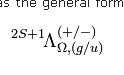 where * S is the total spin quantum number * Λ is the orbital angular momentum along the internuclear axis * Ω is the total angular momentum along the internuclear axis * u/g is the parity * +/− is the reflection symmetry along an arbitrary plane containing the internuclear axis For atoms, we use S, L, J and MJ to characterize a given state. In linear molecules, however, the lack of spherical symmetry destroys the relationship [\hat\mathbf L^2, \hat H]=0, so L ceases to be a good quantum number. A new set of operators have to be used instead: \{\hat \mathbf S^2, \hat\mathbf{S}_z, \hat\mathbf{L}_z, \hat\mathbf{J}_z=\hat\mathbf{S}_z + \hat\mathbf{L}_z\}, where the z-axis is defined along the internuclear axis of the molecule. Since these operators commute with each other and with the Hamiltonian on the limit of negligible spin-orbit coupling, their eigenvalues may be used to describe a molecule state through the quantum numbers S, MS, ML and MJ. The cylindrical symmetry of a linear molecule ensures that positive and negative values of a given ml for an electron in a molecular orbital will be degenerate in the absence of spin-orbit coupling. Different molecular orbitals are classified with a new quantum number, λ, defined as λ = |ml| Following the spectroscopic notation pattern, molecular orbitals are designated by a smallcase Greek letter: for λ = 0, 1, 2, 3,… orbitals are called σ, π, δ, φ… respectively. Now, the total z-projection of L can be defined as M_L=\sum_i {m_l}_i. As states with positive and negative values of ML are degenerate, we define Λ = |ML|, and a capital Greek letter is used to refer to each value: Λ = 0, 1, 2, 3… are coded as Σ, Π, Δ, Φ… respectively. The molecular term symbol is then defined as 2S+1Λ and the number of electron degenerate states (under the absence of spin-orbit coupling) corresponding to this term symbol is given by: * (2S+1)×2 if Λ is not 0 * (2S+1) if Λ is 0. Ω and spin-orbit coupling Spin-orbit coupling lifts the degeneracy of the electronic states. This is because the z-component of spin interacts with the z-component of the orbital angular momentum, generating a total electronic angular momentum along the molecule axis Jz. This is characterized by the MJ quantum number, where MJ = MS + ML. Again, positive and negative values of MJ are degenerate, so the pairs (ML, MS) and (−ML, −MS) are degenerate: {(1, 1/2), (−1, −1/2)}, and {(1, −1/2), (−1, 1/2)} represent two different degenerate states. These pairs are grouped together with the quantum number Ω, which is defined as the sum of the pair of values (ML, MS) for which ML is positive. Sometimes the equation Ω = Λ + MS is used (often Σ is used instead of MS). Note that although this gives correct values for Ω it could be misleading, as obtained values do not correspond to states indicated by a given pair of values (ML,MS). For example, a state with (−1, −1/2) would give an Ω value of Ω = |−1| + (−1/2) = −1/2, which is wrong. Choosing the pair of values with ML positive will give a Ω = 3/2 for that state. With this, a level is given by 2S + 1ΛΩ Note that Ω can have negative values and subscripts r and i represent regular (normal) and inverted multiplets, respectively.[1] For a 4Π term there are four degenerate (ML, MS) pairs: {(1, 3/2), (−1, −3/2)}, {(1, 1/2), (−1, −1/2)}, {(1, −1/2), (−1, 1/2)}, {(1, −3/2), (−1, 3/2)}. These correspond to Ω values of 5/2, 3/2, 1/2 and −1/2, respectively. Approximating the spin-orbit Hamiltonian to first order perturbation theory, the energy level is given by E = A ML MS where A is the spin-orbit constant. For 4Π the Ω values 5/2, 3/2, 1/2 and −1/2 correspond to energies of 3A/2, A/2, −A/2 and −3A/2. Despite of having the same magnitude, levels of Ω = ±1/2 have different energies associated, so they are not degenerate. With that convention, states with different energies are given different Ω values. For states with positive values of A (which are said to be regular), increasing values of Ω correspond to increasing values of energies; on the other hand, with A negative (said to be inverted) the energy order is reversed. Including higher order effects can lead to a spin-orbital levels or energy that do not even follow the increasing value of Ω. When Λ = 0 there is no spin-orbit splitting to first order in perturbation theory, as the associated energy is zero. So for a given S, all of its MS values are degenerate. This degeneracy is lifted when spin-orbit interaction is treated to higher order in perturbation theory, but still states with same |MS| are degenerate in a non-rotating molecule. We can speak of a 5Σ2 substate, a 5Σ1 substate or a 5Σ0 substate. Except for the case Ω = 0, these substates have a degeneracy of 2. Reflection through a plane containing the internuclear axis There are an infinite number of planes containing the internuclear axis and hence there are an infinite number of possible reflexions. For any of these planes, molecular terms with Λ > 0 always have a state which is symmetric with respect to this reflection and one state that is antisymmetric. Rather than labelling those situations as, e.g., 2Π±, the ± is omitted. For the Σ states, however, this two-fold degeneracy disappears, and all Σ states are either symmetric under any plane containing the internuclear axis, or antisymmetric. These two situations are labeled as Σ+ or Σ−. Reflection through an inversion center: u and g symmetry Taking the molecule center of mass as origin of coordinates, consider the change of all electrons’ position from (xi, yi, zi) to (−xi, −yi, −zi). If the resulting wave function is unchanged, it is said to be gerade (German for even); if the wave function changes sign then it is said to be ungerade (odd). For a molecule with a center of inversion, all orbitals will be symmetric or antisymmetric. The resulting wavefunction for the whole multielectron system will be gerade if an even number of electrons is in [[ungerade orbitals]], and ungerade if there is an odd number of electrons in ungerade orbitals, independently of the number of electrons in gerade orbitals. [ Last edited by jmlong on 2011-4-1 at 06:09 ] |

5楼2011-04-01 06:01:35
2楼2011-03-31 11:39:19
3楼2011-03-31 15:37:45
★ ★
zhang302(金币+10): 很感谢呀,我是不太会用度娘 2011-04-01 09:11:58
小红豆(金币+2): 谢谢分享你的看法 2011-04-16 14:06:39
zhang302(金币+10): 很感谢呀,我是不太会用度娘 2011-04-01 09:11:58
小红豆(金币+2): 谢谢分享你的看法 2011-04-16 14:06:39
|
其实度娘真的很有用,动动手啥都有了 http://good.gd/1081561.htm |
4楼2011-03-31 19:51:38